
Business
Wind wisdom
Supernova Technologies is constantly innovating products that can generate eco-friendly energy as an alternative to electricity
Sunrise or windfall — both are equally welcome at Supernova Technologies Private Limited for they are in the business of harnessing solar and wind energy as an alternative source of power which is cheap, inexhaustible and clean. "There is a growing demand for environmental friendly products and with power being such a big problem,” in 2001 they started exploring the possibility of generating "non conventional sources of energy,” remarks Harsh Amersey, a director of the company. In the last five years since they have commenced manufacture of their wind generators as also the hybrid varieties which are a combination of wind and solar generators, they have sold over 100 pieces. In the small wind generator segment "that makes us the highest selling company in India without subsidy from the government,” states Amersey.
"Awareness in the general public is coming slowly,” observes his mother Meher, also a director of the company, though not involved in the day-to-day operations. "Although the company is growing slowly, there is tremendous potential,” she adds giving credit to her husband Purshottam for pursuing this line of business once his elder son Arvind started shouldering the reins of their 54-year-old family owned company, Milton Private Limited, that manufactures and exports ladies clothes, primarily to the European market. The Amersey family also runs a machinery business under the banner of AEPL.
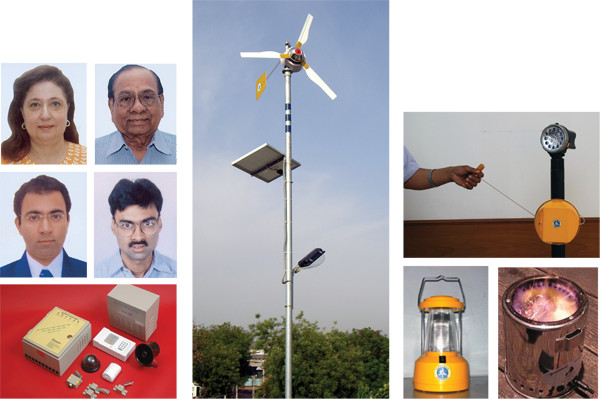
(From left): Meher and Purshottam (top row), Harsh and Arvind Amersey (second row); security alarm systems (bottom); hybrid wind and solar generator (center); manually operated Swa Nirbhar Urja powers lantern and wood-gas stove (below)
The Bombay office of all these three companies is located at their premises on Reay Road. On the terrace of the building are prominently positioned two hybrid generators. While the arms of one windmill were rotating vigorously, the other was showing lackadaisical movement. This was mainly due to one battery requiring charging and the other being full. The smaller solar panels beside it were also harnessing the heat and light of the sultry, summer afternoon. The conjoined power the wind generators and the solar panels create can be used directly or by storing it in the battery bank and consuming it indirectly by an inverter.
Temple lighting for shrines, office lighting for companies, apartment lighting for residential complexes, campus lighting for educational institutions… Many are the locales where Supernova has offered its expertise to provide custom based solutions, undertaking to integrate their wind power systems into existing solar PV (photovoltaic), diesel geneset or grid based systems, as notes their brochure. Their company, enlisted by the Ministry of Non-conventional Energy Sources (MoNES) at New Delhi, is sanguine that their systems would work in remote locations, mines, hilly and desert areas and in regions where temperature falls below 0° centigrade. The Supernova system installed on the offshore platforms at Bombay High have facilitated the working of certain equipment mid-sea.
"It takes about one month to complete manufacturing 20 wind systems,” explains Shreelal Jha, their honorary scientific advisor who is deputed by the Sardar Patel University of Gujarat to oversee the research work at Supernova, "and about three-four days to install the system.” Unlike their competitors — U. D. Systems or Unitron — which mainly import or assemble their products "we have indigenous technology to design systems as per weather conditions and customer needs,” notes Jha explaining how their wind systems can function even where the wind speed is as low as 2.2 m as versus the Indian mean wind speed of 5.5 m. Further their wind systems can be installed on terraces by restricting the blade rotations per minute to 300 so that minimal vibrations and noise do not disturb the residential sectors.
Whilst Supernova offers six models of the hybrid variety, the ones most in demand are SNT10 (with a storage capacity of 7.2 kwh at a wind speed of six meters per second, generating an output of 1,400 w, ideal for use in residential bungalows) and SNT 50 (with a storage capacity of 28.8 kwh at a wind speed of six meters per second, generating an output of 5 k/w, recommended for use in schools and colleges). The cost ranges from four to 15 lakh rupees, depending on the configuration. "These generators are really meant to benefit those not living in urban areas where there is no electricity or inconsistent power supply,” says Meher referring to the project undertaken by the Time and Talents Club to provide street lighting in one village.
The other plus points of the wind energy system are recalled: designed to last for over 20 years with no scheduled maintenance required, no recurring fuel cost since it is dependent on the most eco-friendly source of energy, very economical compared to solar PV cell, fuel and electricity, benefit in taxation for commercial establishments.
Parsi residential colonies could easily install these systems to provide common lighting in the stairways and compounds. At Doongerwadi too, the installation of such systems could generate lighting within the estate, mentions Jha. Few Parsis have opted for this alternate energy concept mainly because the community is concentrated in Bombay where electricity is fairly regular, believes Meher. Enquiries in recent times have been coming in from those who have weekend homes in Alibaug and Lonavla, states Harsh. Just as the Amerseys have installed a generator at their home in Matheran and their P. N. Amersey School in Gandhidham, Gujarat, they feel others too could introduce such environmentally friendly systems (more details available on tel: 23757090-94, e-mail: milton1@vsnl.net).
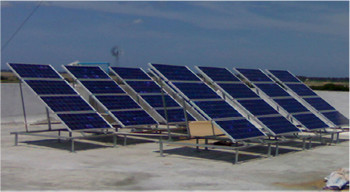
Solar panel generates energy
Additionally, the financial gains could be substantial, states Jha, referring to an individual who installed a wind mill in Siyalbet, an island off the coast of Gujarat with a population of around 10,000, for whom it has now become lucrative business to permit charging of mobiles for Rs 10 per hour, TV viewing for five rupees per hour… The power generated is used for street lighting as well. In Poona’s Orange County complex where the Supernova system has been accommodated, as per the housing society rules, usage of 500 units per flat is permitted under the ecofriendly system, beyond that, it is charged to the grid. "So you have to plan your power consumption optimally,” notes Jha. In New Bombay, there is a discount in property tax if a building has installed a non-conventional system of energy.
The end users of alternate systems of energy can avail of incentives offered by the government like 50 percent subsidy to NGOs (nongovernmental organizations) purchasing the equipment, or 90 percent subsidy if installed in the Andaman and Nicobar islands. "Since the government is not able to increase the conventional sources of power, we would like them to finance (non-conventional energy) projects in areas where no grids are available,” states Harsh.
The annual turnover of Supernova is in the region of four crore rupees, reveals Harsh. This year they hope the figures will double with the launch of a stand-alone power generator kit which is marketed at Rs 5,500. Their product named Swa Nirbhar Urja (SNU) would be ideal for use in forests, valleys, fishing boats, mountaineering camps, remote government check posts where there is irregular or no electricity, no regular wind, no good solar radiation or no water streams. This SNU generator, as demonstrated to us, is charged by repeatedly pulling a manually operated string to keep the generator rotating, and in turn produce electric currents which through a battery can power a lantern or wood-gas stove, or other devices like radio, laptop charger and mobile charger through an adaptor. One-and-a-half hour’s efforts on the hand operated generator assures four hours of power to run two lanterns and three hours of power for a stove. The first consignment of SNU generators was scheduled to leave for Kenya on June 17, 2009. Personnel from Supernova are also in talks with the Carter Foundation which has shown an interest in distributing these kits, mentions Harsh.
Supernova has a workforce of 43 employees, 10 of whom are at the Bombay office, 30 in Anand (including workers, administrative, sales and accounts staff), and three in research. Besides security alarm systems and automatic sprayers manufactured by Supernova, through ongoing research they have also introduced in the market special products for the physically challenged. Alongside their Training Education Enhancement System they have the Braille Language Lab that facilitates one visually impaired teacher to simultaneously tutor 10-20 students with the help of the main master panel which has the talking control. Alternately a person not knowing braille can teach through a computer interface keyboard which has a talking software. Similarly there is a Language Lab for the hearing impaired, we learn as Jha introduces us to a couple who had come for more details on this invention.
Yet another kit propels a battery operated tricycle for the handicapped with the simple pressing of a button. This battery is recharged at the normal 5 amp plug point in four-six hours and can run up to 20 km at a maximum speed of 18 km without pedaling on level land, notes their website.
Recently a mobile company evinced interest in their satellite dish being powered by alternate sources of energy instead of regular electricity. With conventional sources of energy drying up and electricity bills mounting, Supernova is confident that the winds of change will lead to a new horizon.
◆ ◆ ◆
From the archive