
“Where do we begin?”
Environmental engineer Sorab Arceivala cautions India that we may become the world’s number one polluter
The US emits 20 tons of carbon dioxide (CO²) per person per year; Europe (including Russia) emits 10 tons of CO², China four tons and India now emits almost 1.3 tons, similar to Africa. CO² is one of the main reasons for global warming. The gas acts as a thermal blanket, trapping heat radiating from earth towards space. He cautioned that if the Indian economy grows at eight to nine percent, we may become the highest emitters. We are currently number four. "We must develop a system and plan… So what should we do?
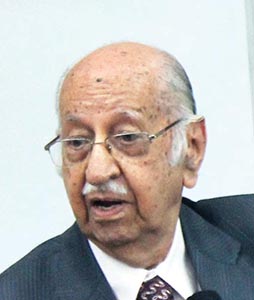 "Where do we begin?” he posed rhetorically and answered: "Everywhere… cities need more management, villages need more development. We can ill afford to make the same mistakes.” Forty percent of the country is without electricity and 80% without sanitation, he noted. "…We are making a mess,” he put it succinctly.
First on his wish list is waste management: Effluence or toxic waste discharged into the atmosphere is termed greenhouse emissions (GHE). As the world revolves, "my emission becomes Pakistan’s problem, which in turn becomes Dubai’s problem and so on… This can’t be dealt with by state pollution boards (as is done in India). It is a political problem with the universal response ‘if-he-does-not-do-it-why-should-I?’ So now the world competes not to do any more than the other – and each country wants to do the least, at the least cost.”
His second suggestion was to use more renewable systems such as solar, wind, wave, biomass and hydro energies. He recommends using less fossil fuel (FF) such as coal, oil and petrol. And his last suggestion was to grow more trees and make this endeavor profitable.
The United Nations has a slogan "Raise your voice and not the sea level.” Statistics say the sea level has risen 20 cms in 20 years. Citing the example of the sinking Maldives islands, he informed the audience that the authorities there are in talks with India to accept their inhabitants when the islands eventually get submerged into the sea. Similarly, Lakshadweep and Bangladesh may also be submerged with the rising sea, he averred. All nations are looking decades ahead.
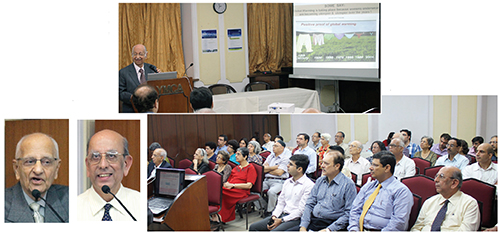
The more electricity we use, the more CO² is released. If you put on a switch in your house, CO² is produced at the power station. Because one does not see this, one is unaware of it. We produce half a kilo of CO² for every kilowatt of electricity. In the commercial city of Bombay, there are about 3,000 billboards on the streets. These consume 15,000 units of electricity a day, generating 7,500 kg of CO². He recommends we all switch to CFL/LED (Compact Fluorescent Light bulbs and Light Emitting Diode) lights. Most people seem to shy away from the CFL/LED route because of the initial expense (Rs 125 to Rs 200 per bulb) but Arceivala declares it uses five times less power, drastically bringing down electricity bills and lasts for a longer time. In Punjab it is an offence to advertise without using CFL/LED lighting. The same should hold true of Bombay, the professor expressed.
"There are some excellent examples,” Arceivala said. Tamil Nadu and Kutch in Gujarat harness wind and solar energies respectively. The Narmada river canal in Gujarat has floating solar power panels to generate electricity. Going the green way, more unutilized land is now being bought by the Gujarat Government to sell harnessed solar energy to other states in the future. The Tatas continue use of hydro power at Khopoli, Maharashtra and float panels on the lake in Lonavla to harness solar energy. Similarly, he recommends setting up solar panels on stadium roofs, railway stations and large factories. He also recommends setting up wind farms in shallow coastal waters to avoid land use. His consistent message seems to be to have dual use of renewable energy for maximizing both land and water-body usage.
Plans for redevelopment at Bhendi Bazar as an energy-saving non-polluting area are already afoot. The Indian Environment Association — of which Arceivala was the first president — is involved with this project and oversees its progress. Dharavi intends to follow on similar lines but plans are yet to be formulated, he says.
As per a study by KPMG — one of the largest professional services companies in the world — solar energy will have price parity by 2017 with hydro power. There will then be no subsidy offered, as is currently done by the Indian government. In fact, renewable energy sources will boom as prices come down.
Waste not, want not
Arceivala’s mantra — ‘do not waste’ — led him to set up the postgraduate course on Environmental Engineering at VJTI (Victoria Jubilee Technical Institute), Bombay in 1959. He set up a consultancy company specializing in water and environmental engineering as early as 1961 and was director of the National Environmental Engineering Research Institute, Nagpur. These pioneering efforts were responsible for the United Nations inviting him to be regional advisor for pollution control in the European region and then chief of environmental health, South East Asia. Author of three books on environmental issues, he has co-authored one more.
Solar power, he claimed can only be used from 9 a.m to 4 p.m, so storage facility is needed. Generally this is done in a battery, a method that is an environmental disaster, he cautioned. It is better to feed this harnessed energy into the grid itself which may then be used at night. Gujarat is already leading by example, he noted. The professor professed that 70% of our electricity produced from wind turbines is during the four months of the monsoon.
He narrated how in Gorai the Municipal Corporation of Greater Mumbai ploughed in Rs 50 crores to set up a biogas plant, recycling waste produced by breaking down organic matter. It earned Rs 72 crores from this project. Setting the tone, six more applications are currently pending with the government.
Specific municipalities such as Mahableshwar, Matheran could put up wind farms leading to energy self-sufficiency instead of using diesel gensets which consume even more oil in transportation. Thermax Limited in Poona which harnesses steam power and offers water and waste solutions, uses geo thermal energy. All this will lead to a reduction in energy imports.
He predicted that in India 100 new, smart, environment-friendly cities will be built. The first example of a green city is Dholera near Ahmedabad on the Delhi-Mumbai Industrial Corridor.
Paris, with its limited sunlight, uses solar power whilst we do not take advantage of our climatic conditions, he lamented. In fact Tatas are the only electricity suppliers who have gone beyond the Indian Government’s mandate of power suppliers to provide at least five percent of their electricity from renewable sources to save the import of FF, he asserts.
Minoo Shroff, global president of WZCC, who introduced Arceivala noted green energy is financially viable. Adi Siganporia, current chairman of WZCC, Mumbai Chapter tellingly expressed "Pollution of the human mind creates all other pollution.”