
Health
“I have MS, MS doesn’t have me”
On the occasion of the first World Multiple Sclerosis Day, awareness was created for the disabling disease that attacks many Zoroastrians
"Many who have Multiple Sclerosis (MS) don’t know they have it and those who do know don’t want to disclose it,” conveyed Firdose Vandrevala, honorary president of the Multiple Sclerosis Society of India (MSSI) at a press meet convened at the Kilachand Conference Room of the Indian Merchants’ Chamber on May 22, 2009. To create awareness of this "disease that cannot be cured but can be contained,” to improve the quality of life of MS patients as also to remove the social stigma associated with this infliction, the World MS Day will be observed on the last Wednesday of May each year, he added.
The first World MS Day was celebrated in Bombay on May 27, 2009, with the building of a human chain at the Masina Hospital after which the Father of Neurology in India, Dr Noshir Wadia was felicitated with Vandrevala presenting him a specially compiled book of memoirs incorporating letters of gratitude and appreciation from the medical fraternity, patients, caregivers, family and friends. Dr Sarosh Katrak’s audiovisual presentation on Wadia provided interesting insights into the neuro-logist’s life. A message of hope for MS patients was offered by Dr Bhim Sen Singhal, honorary chairman and chief of MSSI, All India Medical Panel. The 45 patients that evening were sporting badges reading, "I have MS, MS doesn’t have me!” The participants in the human chain, including well-wishers like Bombay Parsi Punchayet chairman Dinshaw Mehta and trustee Armaity Tirandaz, had cards strung round their necks reading: "Always there, ready to care. Let’s fight it together!” The function culminated with the singing of Hum hogé kaamyaab (We shall succeed) with beams from several small torches directed at the ceiling symbolizing the joint commitment to this cause.
Both Wadia and Singhal were also present at the Press meet to explain how the protective myelin sheath on the axon (nerve fibres) gets damaged at multiple intervals (the reasons for which are not known but possibly a combination of environmental and genetic factors) because of which the central nervous system gets affected whereby the simplest everyday tasks can no longer be taken for granted. The symptoms include blurring of vision, weak limbs, tingling sensations, tremors, spasms, unsteadiness, fatigue, difficulty in passing urine. For some patients MS is characterized by periods of relapse and remission while for others it has a progressive pattern. Therefore steroids like cortisone have to be administered to abort an aggressive attack or on a regular basis prophylactics have to be injected to prevent successive attacks. The breakthrough in treatment occurred nearly 15 years ago with the introduction of Disease Modifying Agents like Interferrons.
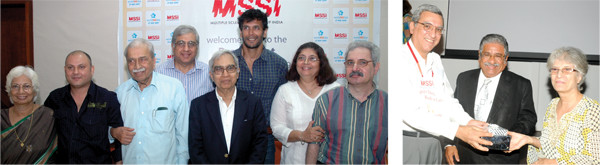
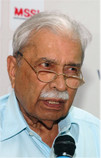
Dr Noshir Wadia (top); at the MSSI press meet (above from left): Sheela Chitnis, Nadeem Naqvi, Wadia, Firdose Vandrevala, Dr Bhim Sen Singhal, Milind Soman, Anita Vesuvala and Cawsi Randeria; on World MS Day Dr Sarosh Katrak being honored by Dinshaw Mehta and Armaity Tirandaz
The term multiple sclerosis which means "many scars” is "a handicapping disease which affects most in the 20-50 age group and sometimes even children. It is more common among those who are fair, blond haired, light eyed,” mentioned Wadia, adding that in the 20-30 group, females are more vulnerable. Therefore in countries like Ireland/Scotland the prevalence is 150 per 100,000. In contrast, in India it is five per 100,000. Among Zoroastrians though the average rises to 25 per 100,000 (see "Patiently borne”). "Because it is a rare disease with a relatively small number of patients I discouraged the starting of the Society (MSSI) in the 1970s,” confessed Wadia who though played a pivotal role in the formation of the Society in July 1985 for "each disease requires a support group...
"Roughly 1.5 million in the world must be suffering from MS,” noted Wadia. "We estimate there are over 40,000 patients in India but less than 10 percent are registered with us,” revealed Vandrevala. "We believe MSSI can make a difference,” stressed the president, referring to the medical, physical and psychological treatment these patients require. MSSI is affiliated to the Multiple Sclerosis International Federation along with 42 MS societies worldwide.
Bringing to light the travails of MS patients, the CEO and national honorary secretary of MSSI Sheela Chitnis (whose husband Mukund along with Cawsi Randeria and Rusi Patel were the first MS patients when the Society was founded with the commitment of volunteers like A. H. Tobacowala and Rehmut Fazelbhoy) pointed out, "We get no help from the government. The concessions granted remain only on government paper. Drugs are so expensive that they are out of reach of many patients. The government should abolish duties so that the pharmaceutical companies can sell them at affordable prices…Here no one thinks of the difficulties of the handicapped people because of which they become homebound. There are no disabled friendly toilets. In the initial stages a person does not look sick. When not permitted rest during working hours their fatigue builds up and they ultimately have to quit.” MS is not hereditary or contagious. However there is still a stigma — there is fear of the patients remaining unmarried. "We need to create constant awareness. We need volunteers for our cause and more funds to improve facilities for MS patients,” stressed Chitnis happy that their brand ambassador, supermodel and actor Milind Soman has been supporting them over the last 10 years.
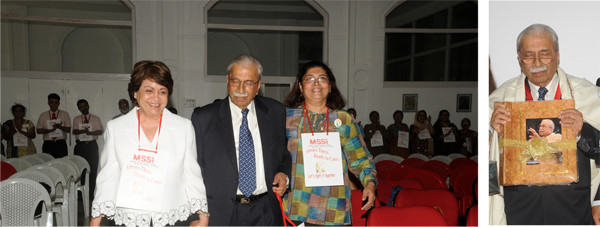
On World MS Day, Dr Noshir Wadia with book of memoirs and (far left) with Dr Piroja Wadia and Anita Vesuvala. Behind them human chain formation
Seeing the MSSI volunteers "tirelessly work for others,” Soman remarked, "These are the people who inspire me to be a better person every day of my life.” He commended the "supreme compassion” of the MSSI members and admired the "guts and courage with which the patients face their handicap…Ten years ago I knew nothing of MS. I didn’t know how to spell it, how to pronounce it. If a famous face is able to impact even one person positively then it’s worth the effort.” There is much that can be learnt of this crippling though not killer disease from their website: www. mssocietyindia.org, 259, Seeta Sadan, Ground floor, Flat No 2, Sion (W), Bombay 400022, Tel: 24037390/7399, e-mail mssimumbai@gmail.com
"All of a sudden my life came to a full stop,” MS patient Nadeem Naqvi recalled the frustration and "suicidal tendencies” he experienced when MS struck him "flat on the bed for six months” after just two years of marriage. Having led a very active life hitherto — he was the best gymnast of his school, had earned a diploma in automobile engineering and had assisted in the making of films like Ishq and Raja — the changed circumstances required him to reorient his life. "My wife is the light of my life. She makes me work out at the gym every day. The MSSI is my extended family. We can fall back on it even if we need help at 2 a.m.,” he acknowledged, alluding to its different activities like free medical tests, MRIs done at low cost, regular interactive sessions, providing aids and appliances, home physiotherapy, nursing, diet workshops, social awareness and recreational programs…
"There is hope for patients with MS,” summed up Singhal. Described as an auto-immune disease or a self-propagating disease where "many do get disabled and almost all are distressed or worried,” Singhal referred to the availability of drugs to reduce the number of attacks and defer the next onslaught so that the patients can lead a fairly productive life. "The drugs are available at huge costs and cause many side effects,” he described the properties of different medicines whilst mentioning that "60-70 percent respond to treatment…” There is optimism that stem cell research will provide a breakthrough in treatment but presently to offer a prognosis is hypothetical, believed the doctor.
Thanking their gold sponsor — Punj Lloyd Group, as also the silver sponsors — Godrej, Hirco, HDFC and Thermax, Anita Vesuvala, honorary secretary of MSSI’s Mumbai chapter, urged the Press corps to create an awareness and understanding of the different projects undertaken by the Society through its nine chapters so that better care can be offered to MS patients for whom she has an empathy, her husband being one of them, and she being a cancer survivor.
Presently chairman and managing director of Hirco Developments Private Limited, Vandrevala who has served the Tatas in different capacities — chairman of Tata Teleservices, managing director of Tata Power, deputy managing director of Tata Steel, as also Motorola as chairman and corporate vice president, reinforced, "MSSI has taught me that the joy of giving is more than that of taking.”
◆ ◆ ◆
From the archive