
Books
Cruel canvas of conquest
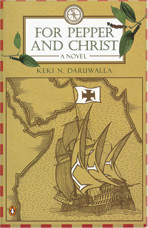
For Pepper and Christ by Keki N. Daruwalla. Published in 2009 by Penguin Books India Private Limited, 11 Community Centre, Panchsheel Park, New Delhi, 110017. Pp: 354. Price: 399.
After establishing himself as one of India’s best known poets, Keki Daruwalla has turned his skills to writing For Pepper and Christ, a novel set in the times of Vasco da Gama. We are so inured to Parsi novelists describing the Parsi milieu replete with Parsi characters with the usual stock eccentricities that it is a refreshing change to see Daruwalla breaking the age old tradition and writing a novel totally devoid of any trace of Parsiness.

Keki Daruwalla: multiple narratives and voices
The novel encompasses one of the most stimulating and adventurous periods in history, a time of great excitement, of venturing forth into the relatively unknown, an age of discovery, one which certainly "catches human imagination by the forelock.” Daruwalla has been researching this subject for a long time and has been historically truthful and accurate in his portrayal of the background of the age with the two journeys of Vasco da Gama in 1497 and 1502, and the one undertaken by Cabral forming the main events against which the destinies of the various characters are played out.
The first voyage of Vasco da Gama from Lisbon in July 1497 consisted of four ships and a crew of over 150 men. We are propelled directly into the voyage in which da Gama captained the Sao Gabriel, his elder brother, Paulo, commanded the Sao Raphael, Nicholau Coelho, the Berrio and Goncalo Nunes, a smaller sea storage ship. To this historically factual account, Daruwalla introduces the character of Brother Figuero and we witness a lively debate which sets the mood and the background for the novel. At this stage, it is the idea of trade and the search for Prester John which motivates the Portuguese though the final result of these expeditions is much more malevolent. Brother Figuero has Christianity on his mind and plans to use the apparent pretext of trade and discovery to strike at the root of infidelity for "the greater glory of Christendom.”
Daruwalla creates a very convincing, exciting, cruel and a bloody canvas of conquest, discovery and proselytism. There is a lot of factual historical data, obviously the result of careful and dedicated research, which one may find a trifle long and dense and requiring a second reading. One is often faced with detailed and occasionally unpalatable chunks of history but the poetic quality of Daruwalla’s language, his keenly perceptive and sensitive eye and the sense of adventure so convincingly portrayed carries the reader along. The novel moves from one continent to the other, from Cairo to Mozambique, to Calicut and Cochin.
In Cairo, we are introduced to a host of splendidly etched characters — Ehtesham, Taufiq, Muhtasib and Ibn Majid, to name a few — who remain with us for a long time after we have closed the book. Even before we meet with Ehtesham we are aware that he is not fanatic about his religion; he has just woken from his sleep and has not heard the call for prayer. In his subsequent interview with the Muhtasib, officially the Inspector for Weights and Measures but unofficially "the upholder of virtue and the scourge of vice” Daruwalla portrays Ehtesham as a charming character who is quiet and respectful; at the same time, he behaves with a lot of self respect and not in an obsequious manner. He is endearing in his courtship of Zainab and gentle in his treatment of her uncle. One can’t help admiring his commitment to art and the risks he runs by displeasing the powerful Muhtasib and painting scenes from the life of Christ in a Church fully aware of the disastrous consequences which could befall him. Interesting characters are met in India as well and an outstanding example is Chirukandan, a senior minister of the Zamorin in Calicut, who has abandoned his wife, Lakshmi, for a liaison with his mistress Kanni, ensnared by the headman’s daughter with "brown irises the size of a small copper coin, a damdi and ringlets in her hair,” and who finally meets his just desserts at the hands of Rayiru, one eyed and wild.
However, it is Taufiq who steals the show. He is the son of a seaman and what runs through his veins is not blood but sea water and the eternal quest for voyage. Ahmed bin Majid, cartographer, navigator and the author of several volumes of prose and poetry, who is historically responsible for assisting da Gama to find his way to India, lends Taufiq’s services to the Portuguese. Things come to head when Cabral invades Calicut and Daruwalla describes the ensuing scenes of warfare and intense cruelty at considerable length. Taufiq does not know where he belongs and where his loyalties lie and resents it when Shakoor, whose daughter he courts, brackets him with the Portuguese. At one point of the battle at Calicut when Shakoor tries his best to get Taufiq to escape, all he can think of is "But how could one get out of that mess.” The comment is double-edged as escape for him is not merely a physical fact but a psychological one as well as he feels he has to atone for the disastrous effect his assistance to the Portuguese has resulted in.
Daruwalla uses multiple narratives and voices to portray the complexity and the broad canvas he has undertaken to paint. The two most interesting voices are those of Brother Figuero, the fervent Christian missionary and his alter ego Taufiq, the sailor. Through the use of alternate chapters Daruwalla presents not only a holistic view of the situation but also the same events as seen from two very divergent points of view. This technique is very effective especially in the scene when a ship with more than 700 men, women and children returning from a pilgrimage is attacked and eventually set on fire. Brother Figuero calls the ship the Mirim and even shudders to use the word "pilgrimage” for a venture which is undertaken by the infidel. If the children are spared it is not out of any mercy for young, innocent creatures; it is merely that they can be baptized and brought up as good Christians. However, it is through Taufiq’s eyes that the reader faces the full horror of the events on what he calls the Miri as it eventually dawns on him that he is equally responsible for the scenes of carnage and violence as "all this would not have happened if I had not guided them across the ocean!...It is a heavy burden on the soul, to have spawned history, and such a terrible one at that.” Taufiq pays for his sins as the novel proceeds to its climax in a spine chilling and thought provoking finale.
Though the novel is based on history, it certainly does not read like a dull and boring history book. In Daruwalla’s poetic hands it becomes an exciting adventure full of engaging and well drawn characters and a very fulfilling and satisfying read.
◆ ◆ ◆
From the archive