
Zoroastrians Abroad
Toronto symposium
"Zoroastrian Literature as a Part of the Cultural Heritage of Modern Zoroastrians,” was the theme of the third Khorshed Jungalwala Lecture, presented this year in Toronto by Prof Oktor Skjaervo of Harvard University. The annual lecture sponsored by the Federation of Zoroastrian Associations of North America (FEZANA) and chaired by Ervad (Dr) Jehan Bagli, former president of the North American Mobed Council, "is fast becoming one of the most prestigious lectures to deliver for scholars of Zoroastrian studies,” notes a report filed by Daraius Bharucha of Toronto. The Canadian city was the venue of a symposium titled "Cultural and Historical Perspectives of the Zoroastrian Faith” on March 29, 2009, jointly sponsored by FEZANA, the World Zoroastrian Organisation (WZO) and the Zoroastrian Society of Ontario (ZSO) and attended by nearly 200 people from the US and Canada.
A feature of the meet was the musical and dance events with a Zoroastrian background which interspersed the four lectures of the day. Starting with Skjaervo, the other speakers were Prof Jenny Rose of Stanford and Claremont Graduate University, Prof Maria Subtelny of the University of Toronto and Prof Jamsheed Choksy of Indiana University. "An open forum question and answer session with all the speakers followed the final presentation. This session was moderated by Bagli, where the audience participated with numerous questions and sometimes passionate declarations about the various topics,” notes Bharucha.
Skjaervo "provided some fascinating insights on Zoroastrian literature; the Avesta, the Pahlavi texts as well as the rock inscriptions of the ancient Persian emperors. He made some interesting assertions with regard to the historicity and antecedents of some of the texts which both intrigued and challenged the audience into looking at things in new ways,” writes Bharucha.
The lecture was followed by an interlude during which the Iranian Zoroastrian Choir, ably led by Shahram Bastani, provided a rendition in song of parts of the Yasna to the applause and appreciation of the audience.
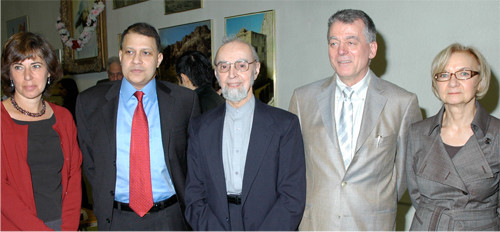
L to R: Jenny Rose, Jamsheed Choksy, Jehan Bagli, Oktor Skjaervo and Maria Subtelny
Rose’s topic "Keepers of the Flame: The Early Zoroastrians of Central Asia” provided some "unique insights into the early history of Zoroastrianism and focused on the spread of the Zoroastrian religion and its influence on the Iranian people of Sogdiana, Margiana and Bactriana. Through a variety of illustrations that she presented Rose showed the audience how Zoroastrianism had exerted considerable influence on both the culture and ideology of the people who lived and traded along the Silk Road extending from Iran all the way into China,” states Bharucha who chaired the session.
"The Water of Omniscience and the Milk of Knowledge: Zoroastrian Elements in the Apocalypse of Muhammad” was the theme of Subtelny’s talk. She shared with the audience her study and understanding of several Zoroastrian elements that were incorporated into the early versions of Prophet Muhammad’s ascension to heaven, says Bharucha. She focused on the symbolism and significance of special drinks that were consumed as well as the motif of the cosmic rooster and its links to the Yazata Srosh. This first post lunch session was chaired by Freddy Mirza.
The second cultural interlude was a popular Iranian dance performed by Mahsa Khodadadi, Shahrzad Rahna-moun, Asha Farhadi, Mahshad Khosra-viani and Anahita Dehmoubed. Kaipa Bharucha followed with a solo flute performance of two items of classical music rendered with flair, showcasing her skill at the instrument.
Choksy, who grew up in Sri Lanka, spoke about "How a Minority Adapts: Zoroastrians in Ceylon/Sri Lanka from Antiquity to the Present.” His talk provided some "intriguing and fascinating evidence” of the presence of Zoroastrians in Sri Lanka from the sixth century BCE to the present time. In particular he focused on the pivotal role and influence of a Zoroastrian Magus (Magi/Priest) on the fortunes and affairs of a central Sri Lankan kingdom, Bharucha informs us.
Bagli and his team of ZSO volunteers including Mithra Jam, Sam Vesuna, Kevin Mancherjee, Kerman Katrak, Mirza and Bharucha had organized the symposium. Mancherjee, Keki Bhote and Firdosh Mehta who represented ZSO, WZO and FEZANA respectively, had welcomed the speakers and guests to what turned out to be a very satisfactory event inclusive of a sumptuous lunch ticketed at $ 8, thanks to the joint sponsorship by the three organizations.
◆ ◆ ◆
From the archive