
Professions
“We believe in relationships”
Zubin Songadwala and Kersy Anklesaria speak fondly about their years with the ITC Welcomgroup Hotels
"When this hotel was first conceived and thought of, we all wondered, why is ITC (Indian Tobacco Company) investing in a hotel in a place like Parel? Nobody ever thought that this locality would have the potential for a clientele of a five star hotel,” candidly declares Zubin Songadwala, general manager, ITC Grand Central, Bombay. But this four-year-old impressive hotel from the ITC Welcomgroup chain has "redefined the laws of geographical importance in terms of location. When we started there was nothing around. But projects actually started taking off here and the USP (unique selling proposition) was that there is a five star hotel in the vicinity,” he adds.
By virtue of its location the ITC Grand Central experiences an equal mix of domestic and international travelers. The hotel does not have any airline crew residing there during layovers but secures business from the various corporate houses and offices that are located in its vicinity. From Bandra Kurla Complex, located in north Bombay to various companies in the southern areas of Nariman Point and Fort, the Grand Central is often a favorite venue for corporate gatherings and meetings.
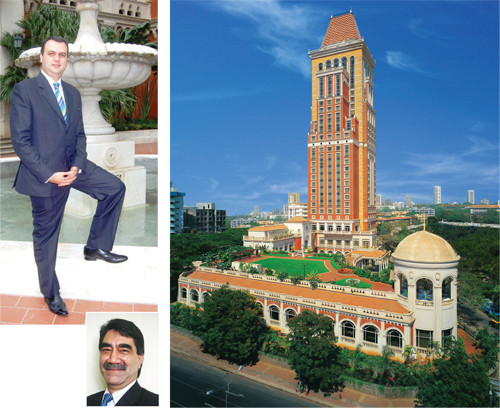
Above: Zubin Songadwala Alongside: Kersy Anklesaria Right: ITC Grand Central
The hotel mainly witnesses business travelers with a few other patrons who come on vacations. "Bombay is not a holiday destination, but more of a business destination. While in a city like Delhi one can combine business and leisure, check out monuments, etc, Bombay is more or less a one-day stay sort of a place. For leisure people go to places like Jaipur, Jodhpur, Agra, Goa, or they go to South India. There is nothing really to see in Bombay. In Bombay you don’t want to travel, you might as well stay where your work is,” supplements Kersy Anklesaria, Head of the Department, Sales and Marketing.
An important segment of tourists that the hotel caters to are the NRIs (non-resident Indians) who usually come down in the months of December and January. Instead of inconveniencing relatives by staying at their homes where the accommodation may be limited, NRIs prefer putting up at the Grand Central, points out Songadwala.
But business is not all that draws visitors to the ITC Grand Central. The hotel has a state-of-the-art spa called Kaya Kalp where tourists can relax and rejuvenate themselves with the slew of ayurvedic, dermatological treatments and massages offered there. Furthermore, the hotel also has a well-laid out and hygienic swimming pool, gym, sauna and steam facilities. So no matter how stressed out or jet lagged a guest may be, with its various facilities the Grand Central makes patrons look forward to their next day of work. Also, the hotel has a couple of fetching lounges, including a bar called Dublin.
Women can avail of the services of the exclusive Eva floor, which is solely dedicated to lady business travelers! Available at the Grand Central and other ITC hotels, these floors are equipped with standardized facilities for women travelers. Interestingly, without the room key card, one cannot even stop at the Eva floor. The card needs to be swiped in the elevator to direct it to the Eva floor, allowing limited entry and the best possible security.
With several Parsi baugs and colonies in the vicinity, the Grand Central has become one of the favorite venues for Parsi functions. States Anklesaria, "The hotel has somehow got associated with Parsis.” For a five star experience their only other option is either to go to North Bombay or to "aapru (our) Taj” in south Bombay.
Previously the favorite destination for navjotes and weddings in this part of town was Heritage Hotel in Byculla but it was not equivalent to a five star experience, mentions Songadwala. "We have a great buffet. We are absolutely sold out on Pateti, Navroze… It’s literally like a gahanbar. On New Year’s too you will invariably find two or three tables only of Parsis,” he notes. ITC Grand Central will soon introduce authentic Irani food items during lunch and tea time.
And it’s not just the clientele but also the work strength that is constituted of several Parsis. While the ITC Welcomgroup as a whole has around six Zoroastrians in senior management, the enticing food at various chains is prepared under the expertise of Zoroastrians chefs like Geve Desai, area chef, Bombay and Hormuzdyr Gabba, sous chef at Grand Central. The ITC Grand Central also has a concentration of Zoroastrian employees working in various departments including finance, front office and so on.
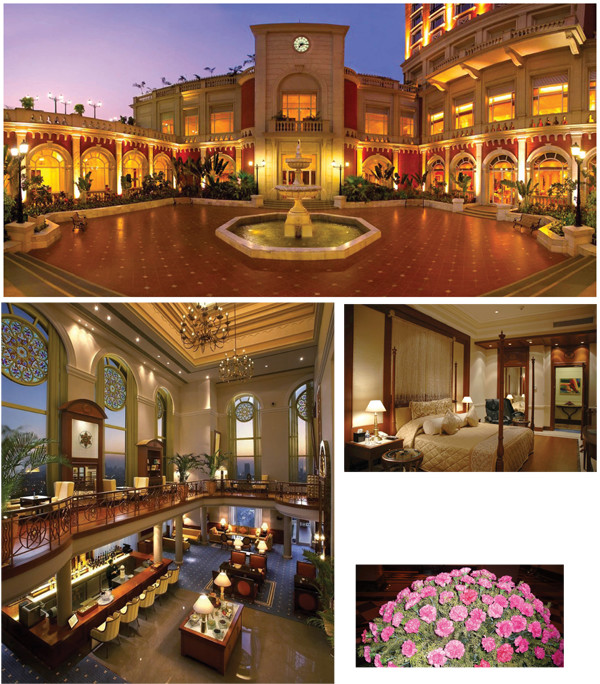
(Top) Courtyard at dusk. (Above) Premium lounge — Point of View (left) and Presidential suite at ITC Grand Central
While the astute and dynamic Songadwala has had a tenure of around 20 years with the company, the jovial and effervescent Anklesaria has been with the group for 29 long years, making them both more or less veterans at the ITC Welcomgroup. "I have been with the hotel industry as long as I can remember and basically with ITC itself,” reports Songadwala. "My background is essentially in food and beverages. I passed out from Dadar Catering College (Institute of Hotel Management, Catering Technology and Applied Nutrition, Bombay) in 1989 and joined the prestigious Welcomgroup Management Institute as a management trainee right away. I had opportunities at the Oberoi as well as ITC, both as management trainee. And given the circumstances then, I chose ITC over the Oberoi. Taj wasn’t even in the reckoning. And it worked well for me throughout. After having a short stint with Sea Rock hotel in Bandra, I moved to Bangalore. I worked as a restaurant manager for six years at the ITC Windsor in Bangalore, following which I was at Agra for three years and have basically held management positions at ITC Welcomgroup hotels in Agra and Bombay. When I returned to Bombay in mid-2000, we were on our way to open the Grand Maratha in Andheri. I spent seven years at the Maratha — started off as food and beverage manager, moved on to become the resident manager of the hotel, and finally went off to Delhi for a year. I returned to Bombay last year.” He has been the general manager at ITC Grand Central since May 2008.
Associated with the Grand Maratha since its inception, Songadwala confesses, "I hold the Maratha closest to my heart as that was the hotel I could say I gave birth to... From setting up the hotel, brick and mortar, giving it life, giving each of the restaurants the character that they today have and what they stand for…The Maratha opened around the same time as my daughter was born. It’s got that much more significance.”
Speaking about his tenure at the ITC Welcomgroup, Anklesaria stated, "I joined Sea Rock in 1980 and subsequently came to ITC in 1991. After working in the Gulf for a few years, I moved on to joining the pre-opening team of the ITC Maratha in August 2000. I had been heading the sales team at the Maratha for the past eight years, and have now been entrusted with the responsibility of heading the sales team of young and energetic people at the ITC Grand Central.”
Neither Songadwala nor Anklesaria have ever regretted their decision of being with the ITC Welcomgroup for so long a duration. As explained Songadwala, "The fact is that I have held different responsibilities in different locations in different hotels. So you work with different sets of people, interact with different people. You don’t have scope to get bored! You are evolving...”
"Grow together”
A career in hotel management not only involves hard effort and grit, but also means working on Sundays, bank holidays and so on. Equating the staff’s role to that of a "mummy” Anklesaria explains that just as mothers derive satisfaction when their children enjoy, the staff feel rewarded when guests have a good time. Highly passionate about their work these two pillars of the ITC Welcomgroup believe, "You don’t have to work a single day, when you love the job you are doing.”
However, Songadwala does observe a sharp decline in the number of youth entering the hotel industry due to various reasons, the most important one being unclear expectations and subsequent disillusionment. While most people associate the industry with style, glamor and fancy, the reality is different. He noted, "Every year thousands of people graduate out of catering colleges but only 40-50 percent get into the hotel industry right after they graduate. The dropout rate is also very high.”
Gone are the days when the Parsi youth primarily sought professions in the hotel and aviation industry. While the legacy of certain names such as the Tatas and Pesi Shaw of Fariyas lives on till date, the present day businessmen opt for IT (information technology) work related to the hotel industry, it is noticed.
In spite of having a scrumptious line-up of various exotic cuisines day in and day out, Anklesaria’s loyalties lie with the typical Parsi dar (lentils), chawal (rice) and fried fish meal. Biased towards the Grand Central, Songadwala confesses that every time he dines at any hotel other than the ones belonging to the ITC group, he invariably gets highly analytical about the food and the service. He refers to the delicious Indian dishes offered at Kebabs & Kurries which bagged the prestigious Times Mumbai Food Guide Award in the Best Indian Food 2008-2009 category. A favorite hangout of Anklesaria and Songadwala is the humble chaiwala and vada pavwala available in the area.
"The economic recession has taken a toll on everybody. It’s not boom time but we are getting out of it,” states Anklesaria. "Basically clients and we need to grow together. They are in business, and so are we. We stand shoulder to shoulder with most of our clients, in good times and also in bad. When they have a problem, want to reduce the costs, we try and accommodate them. We try making things fair at both ends.”
"It’s a fine balance that we have to maintain,” Songadwala notes. "Organizations today are very conscious about costs. We believe in relationships more than business contracts or business deals. There were times when a particular organization could afford to pay us the rates that they could... Today organizations ask us to rationalize things. So that’s when we work together. A give-and-take kind of an understanding where the clients assure us a certain volume of business, and we accordingly realign our rates and realign deals with them. In fact Kersi has been working very closely with many such organizations that have been our supporters over the last four years. In spite of this economic recession, business in India is still going to grow. The economy is set to grow by 60-70 percent, which is very encouraging. And we will also grow with that, I can assure you.” He added, "The trick is to actually price yourself in the right price band, to make yourself affordable in a market like this and attract the maximum business that you can.”
While the Grand Central has followed the Six Sigma management philosophy of "Lean” to reduce unnecessary expenditure, the hotel strongly believes in not compromising in providing the perfect experience to its clients.
Business, after the 26/11 terrorist attacks in Bombay, has experienced a slight drop whereas expenditure, particularly in the area of security, has risen drastically. Beginning 2009, demand has started picking up and the hotel has managed to show better returns.
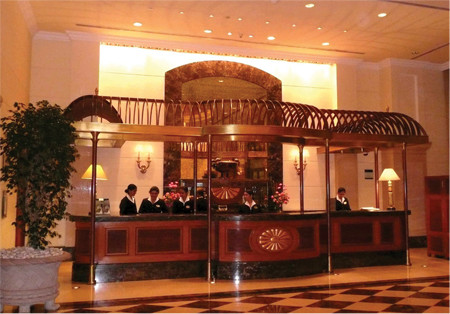
Front reception desk: "You don’t have to work a single day, when you love the job you are doing.”
Photo: Benaifer J. Mirza
Apart from rendering maximum customer satisfaction, the ITC Group is highly conscious of its corporate social responsibilities. Elaborating on this Songadwala mentions, "ITC follows a philosophy of the Triple Bottom-line.” In addition to monetary profits, they believe contribution to society and developing the society at large is a corporate social responsibility of the organization. Duty towards the environment is the third responsibility. "Today ITC, as far as the Grand Central hotel is concerned and the organization as a whole that operates large factories across the country, generates zero solid waste, which means that there is no waste that goes and gets dumped in a landfill on the periphery or the outskirts of Bombay,” announces Songadwala. "Everything is recycled. The biodegradable food waste and plant waste is recycled (into manure) in an organic waste converter that we have within the hotel premises. Paper gets recycled, the glass gets recycled. Whatever you see is absolutely recycled.
"ITC as a company believes it should give back to the environment more than what it consumes. So today it is a carbon positive company with the kinds of initiatives that we have made to generate more oxygen, be it through a tree plantation drive, or through drives to ensure that pollution is controlled. We are a water positive company, which means that the water that we generate and use is 100 percent utilized and recycled as potable water again and it is not wasted. All the water that goes down the taps or the drains is also treated and is recycled.”
In addition, the ITC Welcomgroup believes in offering equal employment opportunities to differently-abled people for which it has been conferred the NCPEDP-Shell Helen Keller award thrice. Songadwala notes, "The ITC hotels are an organization that actually promotes and encourages those who are less fortunate, in terms of physical disabilities, in all parts of the hotel not out of sympathy but because they are competent,” notes Songadwala. Currently, over 207 people with disability are already employed by the ITC group in its hotels.
Walking around the imposing edifice of the Grand Central one cannot but admire the pains taken in designing the place, from the selection of colors to the tasteful choice of furniture. And looking at the vista of the city from the "Point of View” on the 30th floor one feels an instant connection — to Bombay and its restless millions.
◆ ◆ ◆
From the archive