
Business
Creative Curiosity
Working with unusual materials like semi-precious stones in addition to wood and glass Roomi Maneckshaw and Rakesh Jeswani design unique furniture for a select clientele
Life is a mosaic, he knew. That mosaic, wood and glass would form such an integral part of his life Roomi Maneckshaw had no idea until a few years ago he joined hands with his friend Rakesh Jeswani to make a success of their furniture enterprise, Curiosity. They make a well-balanced team with Maneckshaw’s expertise in various practical aspects of cost cutting, manufacturing and business-efficiency complementing Jeswani’s gift of creative designing and artistry.
"A lot of people think that stone and mosaic work is our style, but that’s not really true. We use all types of materials,” mentions Maneckshaw. In stone itself their range varies from totally precious to semi-precious to marble to Indian Jaisalmer stones, etc. Then there are mirrors, glass in all its forms... Having used various materials such as tiger eye, red onyx, amethyst, tiger onyx, Maneckshaw notes that at Curiosity the style is more or less contemporary. The mosaics designed are themed as well as abstract.
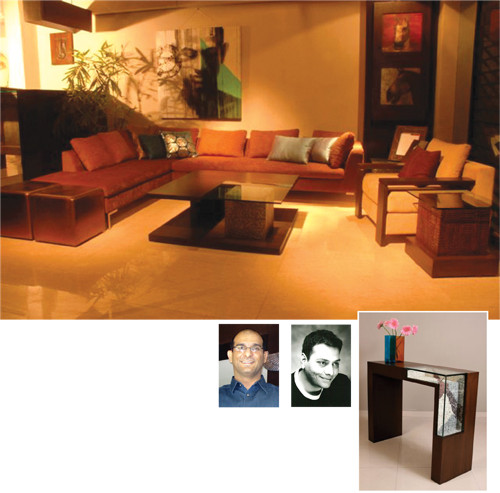
Interesting array of Curiosity furniture; (bottom) Roomi Maneckshaw Photo: Benaifer J. Mirza and Rakesh Jeswani
"We named the company Curiosity because we wanted to do furniture and artifacts that were different and unusual,” reveals Jeswani. Elaborating on Curiosity’s distinctive trend he adds, "Our basic design philosophy is that we like to keep the lines simple and add a little bit of embellishment to jazz up the pieces. But basically, we like simple and clean lines. We also stress a lot on the quality. We don’t compromise on the quality for the look or the visual appeal. For us, quality comes first. The quality of the materials is very important to us because we want our furniture to last for an extremely long time. We want people who buy it to enjoy it for a very long time.”
Though initially Maneckshaw and Jeswani used to meet their clients only by appointments, their shop which opened at Versova in August 2008 offers a rather broader platform for the display of their truly unique pieces of furniture.
Curiosity has more or less become a common household name amongst the who’s-who of India, five star hotels and large industries. Says Maneckshaw, "Our business is very small-sized, but very niche. We have got top notch clients, most of them on first name basis.” Impressed with the Curiosity range, Sunu Aibara, of Neterwala and Aibara, one of India’s leading firms of interior architects states: "They are extremely innovative. There’s the winning combination of creativity with good quality. I have been buying furniture from Curiosity from the time they’ve started (in 2001). There really are no complaints or problems.” Bollywood actor Bikram Saluja and his wife Schauna Chauhan, chief executive officer of Parle AGRO have been purchasing items from Curiosity for the last five years ever since they bought a house, convinced that "their furniture is very well-finished, meticulous and elegant.”
"I have been buying furniture from there (for) the last nine-10 years, when it was at Bandra. I find the pieces really interesting and unique, not the typical factory-made tables, chairs, etc. I still go there to pick up my coffee table and other things because I feel everything has its own individual touch and feel,” acknowledges well-known dance and film director Farah Khan giving credit to Jeswani for designing most of her former house. "Besides being creative and artistic, the quality and the finish are very good. I bought my sofa in 2001 and it’s still going strong. A single stitching hasn’t come out, the legs are holding well and it still looks new…I think being half-Parsi has helped him.”
Considerably influenced by his Parsi mother and Sindhi father Jeswani has been an interior designer most of his life. After a brief apprenticeship at Phirosa Neterwala Associates, Jeswani worked with her as a full-fledged interior designer for almost seven years. He notes that his background in interiors was a big plus point in designing furniture since he understood well what kind of furniture needs to be designed to fit into good interiors. Besides it was a field in which not many people showed interest or specialized.
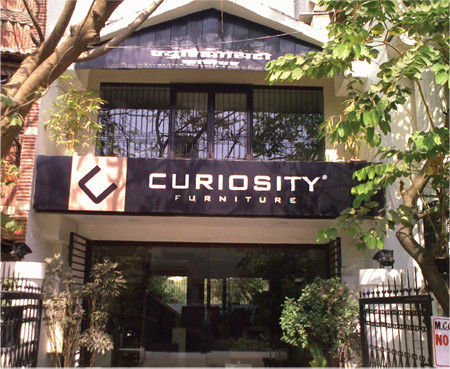
Newly opened shop at Versova
Maneckshaw came on the scene when "Rakesh gave me an offer to run his workshop. It was a loss making company but within a year things were set right and I became a partner in the company…without having to pay any capital.” After graduating in history Maneckshaw had earlier hoped to make a career in the Indian Administrative Service (but he could not clear his exams) and later as a fitness trainer (but he broke his leg).
"I really never imagined myself making furniture or doing anything with the arts,” says Maneckshaw. While his grandmother had an excellent hand at charcoal art, the 34-year-old admits that he had close to zero interest in any sort of art or designing, showing a greater inclination towards hardware and the likes. He recalls his initial days in the business when he used to wear a vest and sit in the workshop the entire day and also go to other people’s workshops to increase his knowledge on the subject of furniture. Today there is close to nothing that can leave Maneckshaw bewildered on the topic of furniture. Though he does at times feel he should have joined a proper course, on hindsight he realizes that the knowledge gained from his partner’s proficiency and practical experience at a workshop are way beyond any college course. Having mastered the art he knows exactly which piece of furniture will last for how long.
"We are quite straightforward and upfront. Whatever I lack, Rakesh makes up for 10 times over. We don’t bother aai paisa kaunna chhè, péla paisa kaunna chhè (whose money is this and whose money is that)? I listen to him and he listens to me. It’s brilliant the way it goes, designing, manufacturing, whether we should take a certain order or not, try to do something or not. From decisions of whether we should buy a laptop or not, we take it all together. It’s brilliant, touchwood! He doesn’t have any ego problems. Hopefully I too have no problem!”
There is one principle on which both the partners are resolute: "To stand strong and not give in to clients’ demands, and at the same time make them happy.” One of their terms and conditions stipulates that the partners may modify the design during its execution. Thus if a client’s initial choice of color or dimension does not suit a particular design, with the customer’s approval they rework it.
Moreover, though it is mentioned in the bill that the delivery of the goods has to be taken within two weeks, failing which there would be an extra charge incurred, at Curiosity they are willing to make a few adjustments to suit the client’s convenience. They are also willing to fix or mend pieces, absolutely free of cost, years after they have been purchased.
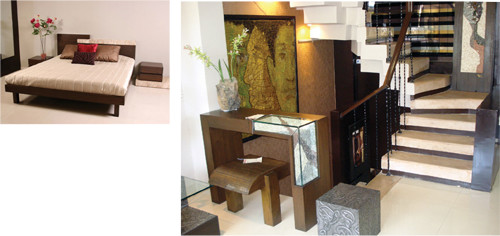
Simple and clean lines of a bed (above) with unusual artefacts (right) Photo: Benaifer J. Mirza
With prices ranging from around Rs 12,000 for dining table chairs, to anything between Rs 20,000 and above for a coffee table, to a bed worth around a lakh of rupees, Curiosity is firm on its bargaining policy. "What people add up is the cost of the wood, the Fevicol, glue and the other things, but they refuse to think that if it wasn’t for the brains, the chair wouldn’t exist. Our biggest challenge is the client’s budget. Even the richest people in the country come here and bargain for Rs 5,000 and 10,000,” Maneckshaw has observed.
Thanks to their previous experiences, both the partners are now extremely stringent about the payment policies. On the price tag itself, the prices mentioned are inclusive of VAT (value added tax). So irrespective of whether an individual is making the payment in cash or cheque, the duo insist on VAT. There are around 50 odd highly skilled kaarigars (craftsmen) working in their workshop at Kandivali in whom they have implicit trust.
"There is a degree of customization in most of the furniture pieces and mosaics created at Curiosity. There is a premium to be paid for not repeating the design.” For the partners every delivery is a learning experience, notes Maneckshaw referring to one assignment where the raw cost of the glass itself (19 mm + 19 mm fused together) was worth around 1.5 lakhs and on which they made a substantial loss because the finishing was proving difficult and it needed to be sent back and forth. "But thanks to that we started sticking glass in our own workshops and not relying on the kaanchwaalas (glass vendors),” appreciates Maneckshaw.
"We get inspiration from everywhere! Absolutely everywhere! I don’t think we have any favorite style,” says Maneckshaw. An extremely interesting and noteworthy style of furniture is the carving of certain religious mantras into the wood, which continues in the mosaic and then comes back through the carving into the wood again.
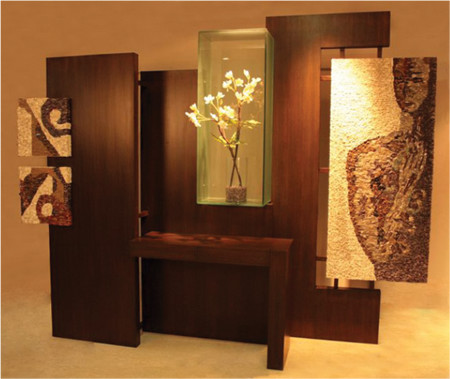
A merger of mosaic, wood and glass
Curiosity’s Zoroastrian lineage is reflected in the wooden Farohar that adorns the wall next to the entrance. In fact they have gifted a four-and-a-half-foot Farohar to Udvada too. Maneckshaw is a member of the World Zarathushti Chamber of Commerce and is really keen on attending the World Zoroastrian Congress in Dubai in end 2009. He may also consider contesting the Bombay Parsi Punchayet (BPP) trusteeship elections in the near future. However, he prefers remaining miles away from the "bickering and tickering” that is a part and parcel of it all. The 2008 BPP elections made him feel proud especially when he saw so many Zoroastrians at one time, all assembled for a common cause and mission. He jokingly notes, "I must add that the quality of finger ink used was far better than the government ink. It lasted for ages.”
The ebullient man tied the knot with Bakhtavar in 2007. Though she does not have a keen inclination towards designing and furniture, she keeps herself busy with her work at the renowned travel portal WCities.
"The community needs to wake up,” believes Maneckshaw, adding, "I don’t want non-Parsi marriages to take place as such, but I don’t think we can avoid them either. So I think we need to join the system rather than move away. Maybe we should do things in a way that Parsis marry Parsis. I could easily have married a non-Parsi, but of course my views would have changed. And even if I had married a non-Parsi I would have definitely missed my russ chawal and dhansak.” If not busy at Curiosity, Maneckshaw is chilling at his Malcolm Baug garden area.
He opines, "The first thing that needs to be done is create business, jobs and education — hardcore education.” He conveys with pride that Rachna Sansad, the renowned school of interior designing, has invited Rakesh to be a visiting faculty at their institute.
Keen to see their business expand to several other parts of the country and across the world, Maneckshaw would like "at least one international shop five years down the line...” Curiosity furniture that presently stands on its own legs will then start moving!
◆ ◆ ◆
From the archive