
Observation
Sights and insights
While savoring the wonders of Turkey and Egypt, a journey into the lives of one’s fellow travelers can be equally interesting
The Bosphorus Strait, the Ottoman Empire, the Sphinx and the Great Pyramids of Giza — names remembered from school day studies, stepped out from the mists of memory when in the October of 2008, my husband Edul and I joined a tour to Turkey and Egypt. It was an education in cultures and cuisines, history and archeology.
Our first surprise and moment of pride was to see a pearl grey Tata Indica parked just ahead of our tourist bus as we emerged from Ataturk Airport in Istanbul. In the course of our nine-day stay in Turkey we saw many more Tata Indicas and Tata pick-up trucks, Tata service stations and showrooms. The same scenario was repeated in Egypt. Our Indian group, more specifically the Parsis, felt a great sense of pride from this and lost no opportunity to tell the locals that these cars were made in our country by aapro (our) Ratan. Tatas was the only Indian brand and presence we saw in our three-week tour of Turkey and Egypt, apart from busloads of other Indian tourists. We also discovered that the most widely known and idolized Indian in both these countries was Amitabh Bachchan. From the boatmen on the Nile to guides at the Topkapi palace, Amitabh was India.
The Spenta Travel and Tours group of 24 people was a microcosm of the Zoroastrian community, all from Bombay save Edul and I from Nagpur and a sprinkling from other communities. Though the age of the tourists ranged from 18 to 80 years, the older folk could match the others in both step and spirit. Some of the younger men and women were still working, but many had recently retired or taken voluntary retirement from banks and insurance companies. There were women in their sixties along with their husbands. There were women who had come without their husbands, letting their hair down. There were widows and single women. The men were few and far between. The latter argued, joked and discussed the merits of the beautiful Turkish women!
One gets amazing insights into the lives of people while talking with them during long rides in the coach or while wandering around the ruins of the ancient temples of Isis, Osiris or Horus, the hawk-headed God. After you have seen the first three, the temples all begin to look alike with a replay of the same characters. But the joys and sorrows of the individuals in our group made a fascinating tapestry of weaves and colors.
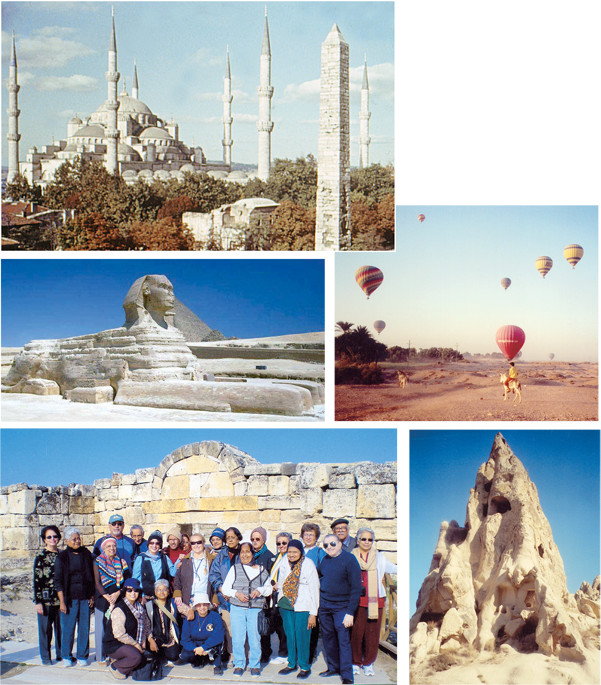
Clockwise from top left: The Sultan Ahmet Camii (Blue Mosque) adjoining the Bosphorus Strait, Istanbul, Turkey; hot air balloning over the valley of the Kings in Egypt; natural formation in Cappadocia, Turkey; tour group with guide; the Sphinx outside Cairo
Of the six dignified and cultured non-Parsi women in our group three were in the academic field. One was a remarkable businesswoman who has successfully faced the odds that life has dealt her. This spirited woman with a beautiful face but a wasted body was confined to a wheelchair, but the strength she lacked in her limbs was more than made up for by enthusiasm, will power and zest for everything around her. She came (almost) everywhere in her wheelchair, assisted by a friend.
The oldest member of our group, an amazing lady of over 80 years of age, was a widow who had seen better days. With the modest amount of money at her disposal, she joined tours and traveled around the world. She did not miss out on a single museum, monument, temple or tomb, even when warned that the walk would be arduous or the incline steep. She never asked for help but accepted it graciously when it was extended. Never badgering the guide with questions, she listened with rapt attention to all that was said. She ate and drank with a robust appetite. She told us she had recently sold her flat and would need to look for a place in which to stay. Her zest for living and her nonchalance in the face of an uncertain roof over her head needs to be saluted.
Another member of the group was a prototype of the independent, intelligent, dependable career woman of integrity. As head of operational risk in a global banking firm, she was widely traveled and had a mature head on strong shoulders. But the oft seen syndrome of being too good in her work and too independent in outlook to get married underlined the loss to the Parsi community.
Among us was an elderly priest who led the coach in two Yathas and one Ashem Vohu at the start of each day’s excursion. His life seemed to have given him little by way of a happy family life either in childhood or in adulthood. Praying for other people’s tandarosti (well-being) enabled him to put together the money to travel, allowing him to occasionally shed the drab coat of a daily routine.
Another, a firebrand photographer, entered everything with passion whether it was photography, finance or philosophy (of religion). He invariably got left behind at a palace or pyramid because his eye was glued to the camera lens and never on the time! It was only because of his watchful and devoted wife that the coach did not leave him behind in a catacomb or in Cappadocia!
A lady who epitomized the spirit of industry in Parsi women spent the lazy days on the Nile cruise stitching sudrehs, while talking with friends and watching the swaying palms, sand dunes and villages along the banks. A worthy example to the rest of us!
A nattily dressed gentleman with a neatly combed head of grey hair, looking like he had stepped out of a Hollywood movie of the 1940s, devotedly looked after his ailing wife and sprightly grandson in Bombay. But when the magic time for the tour came around, he left his inhibitions behind along with his wife in the mundane metropolis as he took a break in new environs. He loved to dance whether alone, with a partner or in a group. He delighted in joining every discussion, holding center stage (the aisle of the coach) with his rhetoric, reminiscent of a Clark Gable! He exhibited good-natured panache, knowing he provided fun and entertainment to the rest on the coach.
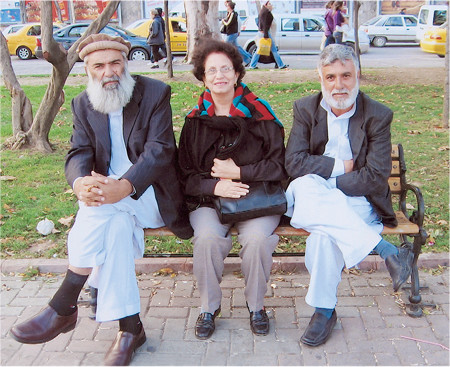
The author with Turks: Though 97 percent of Turkey is in Asia it is more European than Asian
Turkey, on the cusp of two continents, is definitely more European than Asian, though in fact 97 percent of its land mass lies in Asia (Anatolia) and only three percent in Europe (Thrace). Our guide in Turkey was an extremely intelligent and interesting woman. She was a devout Moslem, but one would not have guessed that from her dress, appearance or outlook. When we expressed pleasant surprise at her attitude on various issues, she told us, "We in Turkey are Moslem by religion but modern in our outlook. There are some fundamentalists who are trying to impose rules and restraints that go against what Ataturk fought for when he overcame the Ottoman Empire and established the Turkish Republic.” This enlightened woman explained: "Islam is in the heart and the mind. It does not come from covering your head or the way you dress or the rituals you follow.”
The 80 percent Parsi component of our group covered the full range of religious sentiment, from orthodox to liberal. Naturally the upcoming Bombay Parsi Punchayet (BPP) trusteeship elections were hotly discussed and debated. However, the sparring was always lighthearted and lacked acrimony. But when the results of the BPP elections started trickling in by way of SMSs and mobile phone calls, the bus was split down the middle. Tempers and voices rose. "Aapro (our) Mistree means what?” thundered an indignant lady (referring to newly elected trustee Khojeste Mistree). "Tamaro Mistree hosé (Must be your Mistree).” "Vulture to gayu (the vulture has gone),” lamented another, "now culture bhi gayu (has also gone).” "Dadar Ahura Mazda no shukar karo, aapro dharam bachi gayo (Thank Dadar Ahura Mazda that our religion is saved)!” shouted others. Our ever affable and able tour organizer, also a good singer and actor, defused the situation by grabbing the mike and giving a mock acceptance speech (for supposedly winning the election) which had everyone rolling with laughter. He promised the community roti, kapda aur makaan (food, clothes and shelter), with chhaato paani (drinks) thrown in for good measure! The only extra demand made by the men was "Four wives to every Parsi male, in the interests of increasing our dwindling numbers!” The airconditioned coach settled back to its former bonhomie with most members of the group making a conscious effort to keep off the inflammatory topic of BPP elections.
Monuments, mosques and mausoleums, the incredible landscape in Cappadocia (Turkey) shaped by thousands of years of volcanic activity, the Great Pyramids and the temples on the banks of the mighty Nile, are just a few of the fantastic things we saw. Other memorable experiences included a Turkish Hamam (bath) which starts with being steamed like paatra ni machhi, followed by a strong massage, a soapsuds and loofah scrub and ends with a cold shower. You emerge pink, cleansed, relaxed and rejuvenated in body and mind. Other highlights of the tour included a ride in a hot air balloon over the Valley of the Kings in Egypt, the dance of the whirling Dervishes, a glide in a glass-bottomed boat in the incredibly blue Mediterranean to see coral, sea plants, shoals of fish and a sunken ship.
An emotional experience for the Zoroastrians in the group was visiting the tomb of the Shah of Iran, Mohammad Reza Shah Pahlavi at the Al Rifai mosque in Cairo. The serene sepulcher is made of onyx and surrounded by exquisite Persian carpets. The Shah’s first wife Fawzia was the sister of King Farouk of Egypt. The Shah ruled in Iran, was exiled first in the USA, then in Egypt. He died of cancer in 1980, while in exile.
The Khan Khaleli Market in Cairo, spread over a large area of narrow lanes with shops on either side selling everything from spices to souvenirs, was where we spent the last night of our tour. It is fronted by coffee shops and eating places crammed so close together you don’t know where one restaurant ends and the other begins! Vibrant, colorful and loud with the sounds of bargaining, the marketplace captures the essence of Cairo. We spent the last of our Egyptian money buying replicas of the bust of Tutankhamen and wallplates with the head of Nefertiti, sipping mint tea in crowded roadside cafes as we watched the Egyptian world go by. We exchanged addresses with each other and reminisced about the days spent together.
Twelve hours later everyone was enveloped in the swelter of Bombay and the demands of everyday life. But memories, like pearls in a strand, connect people and places long after one moves on.
◆ ◆ ◆
From the archive