
Books
Mehta, the maestro
The Score of My Life by Zubin Mehta. Published in 2008 by Roli Books Private Limited, M-75, Greater Kailash II Market, New Delhi 110048. Pp: 201. Price: Rs 395.
The Score of My Life, Zubin Mehta’s autobiography, is an engaging and engrossing account of a very grand life. It is the story of the musical journey of an extraordinary man who despite his phenomenal international success has never severed his links with the country of his birth — he retains his Indian passport — and remains proud of his Parsi heritage. A citizen of the world, the jet-setting conductor is the perfect advertisement for cultural synthesis and has been an unofficial ambassador of the country for the past 50 years.
The Score of My Life (as told to Renate Matuschka) was first published in German to coincide with Mehta’s 70th birthday in 2006. At the launch of the English translation (by Anu Pande) at the Taj Mahal Palace and Tower hotel in Bombay in October 2008 Mehta told the audience about the book’s genesis. A German publisher wanted him to write about his experiences in Munich as the music director of the Bavarian State Opera. That was when he thought that it would be a good idea to tell the story of his life rather than just his German experience. When the publisher Roli Books evinced interest in it, he updated the his his life rather than just his German experience. When the publisher Roli Books evinced interest in it, he updated the draft and made a few changes for an Indian audience.
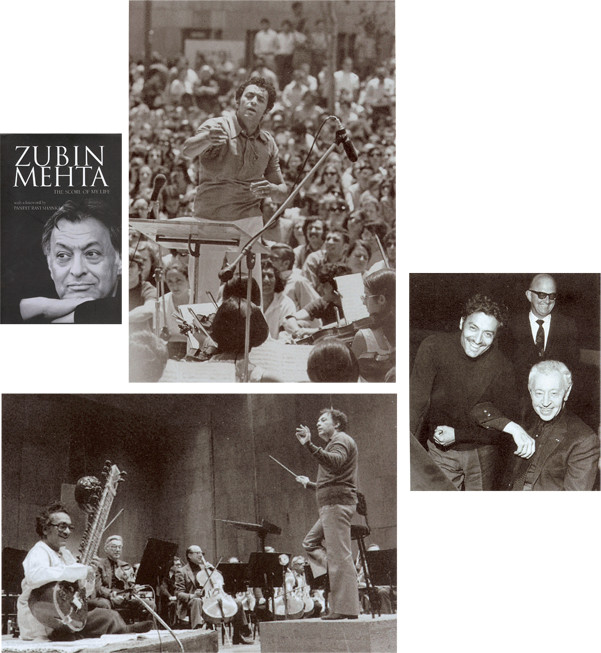
Clockwise from right: Zubin Mehta at a protest concert against Vietnam war on the UCLA campus; with Arthur Rubinstein (r) and Pierre Beique (in the background); with Ravi Shankar
Most of us have long been acquainted with Zubin Mehta’s prodigies: at 26 he was the music director of both the Montreal Symphony Orchestra and the Los Angeles Philharmonic. Not only was he the youngest conductor of a leading American orchestra, but he was also the only man ever to direct two major orchestras in North America at once. Mehta was also one of the youngest men ever to conduct both the Berlin and Vienna Philharmonic orchestras. He is also the first, and thus far, only music director of the Israel Philharmonic.
Without doubt the biggest romance of Mehta’s musical life has been with the Israel Philharmonic Orchestra of which he is the music director for life. Mehta first conducted the Orchestra when he filled in for Eugene Ormandy in 1961. When the Six-Day War broke out in 1967 Mehta dropped all his international commitments and flew to Israel to conduct the Orchestra that had been left stranded by the sudden cancellation of Erich Leinsdorf whom Mehta diplomatically refrains from naming. He flew to Tel Aviv in an aircraft which was carrying ammunition, with the governor of the bank of Israel and a Newsweek correspondent for company. When the Yom Kippur war broke out in 1973 Mehta was already in Israel. In 1991 when the Gulf War started Mehta cancelled his appointments with the New York Philharmonic and rushed to Israel to demonstrate his solidarity. The maestro has always identified with the Israeli nation and its people during their crises.
In 1981 he insisted on performing Wagner in Israel despite the unofficial ban on Wagner in that country and completed the Tristan Prelude in spite of the hooliganism with which it was greeted. This greatly upset an Israeli politician who said that Israel had had enough of Mehta and that he should go home. The Orchestra’s response: they offered him the music directorship for life, an indication of the deep mutual affection conductor and players have for each other. It is not a written contract. Mehta says that every few years he asks them if they want him to continue.
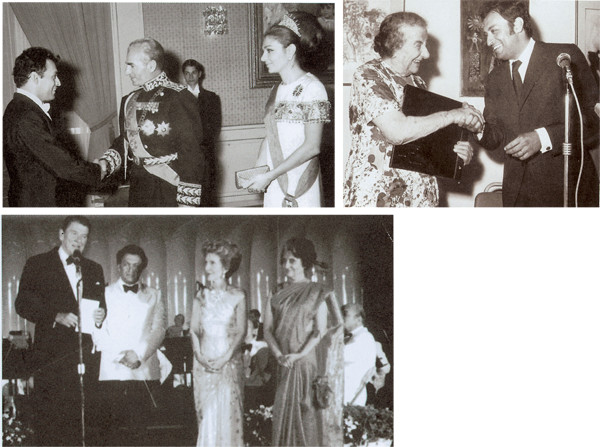
Clockwise from left: Mehta with US President Ronald Reagan, his wife Nancy and Prime Minister Indira Gandhi; with the Shah of Iran and the Shahbanoo; with Israeli Prime Minister Golda Meir
Surprisingly, one finds no mention of the American Friends of the Israel Philharmonic Orchestra (AFIPO) in the book. It was sometime in 1980 that Fredric Mann and Mehta got the idea of setting up an endowment for the Israel Philharmonic, something which was necessitated by the lack of substantial Israeli government subsidy. Mann and Mehta created an Endowment Fund in the United States to ensure the future of the Orchestra they both loved so much. Since 1981 contributions from thousands in the United States and Canada have generated millions of dollars, helping to secure the Orchestra’s financial future while providing general operating support. Numerous events, concerts and fund raisers have contributed to the resources of the Fund.
A watershed in Mehta’s career was his ascendancy to the music directorship of the Los Angeles Philharmonic. This was unfortunately embroiled in avoidable controversy. Dorothy Chandler the grande dame of Los Angeles culture had appointed Mehta as an associate conductor without consulting Georg Solti, the music director. Solti, who felt that his directorial prerogatives had been compromised, resigned, paving the way for Mehta. Mehta feels that the unseemly controversy could have been avoided if there had been frank communication between all the parties concerned. He regrets that this incident soured his relations with Solti for many years.
In Los Angeles, Mehta was often criticized for his flamboyance and ‘Hollywood attitude.’ His magnetic personality, charisma, and drop-dead good looks made him a huge hit with women. Over time the playboy image grew fuelled by the Press who started treating him like a celebrity. A classical musician, he received the adulation of a rock star. While Mehta may not have been the relentless discharger of libido he was projected as, girls were very high on his agenda during this period. This is something which irked him because ‘Zubi Baby’ (his nickname in Los Angeles) thought that this came in the way of his being considered a serious musician, which he undoubtedly was. [Mehta maintains (not in the book) that nobody ever called him ‘Zubi Baby’ in Los Angeles, and that the reporter who made up the name admitted as much to him.]
Mehta spent 16 long years with the Los Angeles Philharmonic and nobody would deny his stellar role in its all-round improvement. Mehta has also never shied away from experimentation, be it his infamous concert with Frank Zappa, the NBC crossover concert on TV, or conducting the three tenors for the World Cup Finals in Rome. In the early ’80s Mehta and Ravi Shankar (who has written the foreword to this book), took part in a fusion experiment (Ravi Shankar’s Concerto for Sitar and Raga Mala) which while it was successful abroad, was greeted less enthusiastically in India. It has long been understood that Indian and western classical music have little in common from a musical standpoint since there is little opportunity for genuine interaction between an oral tradition where improvisation is central, and a notated one.
Later Mehta gave another example of his sitzfleisch (staying power). His 13-year tenure (1978-91) as the music director of the New York Philharmonic represents the longest incumbency of any chief conductor in the orchestra’s history. Before he took over there was the famous contretemps with the orchestra’s musicians when his now infamous remarks about the orchestra soured his relationship with the New York musicians. In December 1967 Mehta had rather tactlessly said, "A lot of us think, why not send our worst enemy to the New York Philharmonic and finish him off once and for all.” Though it was a remark made in private a Newsweek reporter overheard it and it became Mehta’s most celebrated verbal gaffe, the skeleton that rattled in Mehta’s cupboard every time the New York Philharmonic was mentioned.
Mehta apologized but it took years for the wound to heal. Later as music director too, he hardly received a uniformly favorable Press. Mehta refers to the poor Press especially in his last few years in New York in his book but apart from naming Harold Schonberg who he says took a balanced view, refrains from naming Donal Henahan his nemesis at the New York Times. (Similarly his adversarial relationship with Martin Bernheimer in Los Angeles doesn’t seem to merit a mention.) But most conductors seem to have been given a hard time by the Press in New York. Leonard Bernstein was the favorite whipping boy of the New York critics; and before him both John Barbirolli and Dimitri Mitropoulos were given the treatment. Also, many agree that Mehta’s place-to-bury-one’s-worst-enemy remark was only a reflection of the standard opinion of the New York Philharmonic as a band of hard-boiled musicians who, if so inclined, could walk all over any conductor.
While the Mehta appeal is linked with two of the world’s oldest orchestras, the Vienna and the New York Philharmonic, his musical legacy remains deeply rooted in the Central European tradition. For Mehta, who commands a clean precise beat, the ‘true sound’ has always meant the Viennese sound. Musically, Mehta is equally adept with Mozart, Mahler and Schoenberg, and capable of recreating that unique Viennese sound with orchestras as far apart as the Israel Philharmonic and the Maggio Musicale Fiorentino. He has also protested against Vietnam and Bosnia with his music. Mehta has been actively involved with the Maggio Musicale in Florence for long and was the music director of the Bavarian State Opera from 1998 to 2006.
Mehta, now almost 73, offers a fascinating account of his musical career and his interactions with the great names of the 20th century music world. The journey from Cuffe Parade to Vienna Woods and his meteoric rise to international stardom from the ranks of a lowly apprentice in almost the blink of an eye, make fascinating reading. Or as Mehta himself would have liked to put it: his progress was as continuous and soaring as a Richard Strauss melody, given that he responds with special keenness to Strauss’ music.
Mehta was born on April 29, 1936, the day Arturo Toscanini conducted his last concert with the New York Philharmonic orchestra, and coincidentally also the first anniversary of the founding of the Bombay Symphony Orchestra. Mehta’s extraordinary journey from Bombay to the most prestigious podiums of the music world is a saga of genius, dedication and luck. (Mehta confesses that he made his career by jumping in at the last minute when he substituted for the big names. But as he says one has to be ready when one gets the chance and make the most of the opportunity.) Classical western music as a career was not an option in the upper middle class, close-knit Parsi family in which Mehta grew up in the 1940s and ’50s. In fact, Mehta started out as a medical student, while his father Mehli Mehta had initially taken up accountancy though his real love was music. Mehli, a gifted musician in his own right, was a self-taught violinist (later studying under Ivan Galamian in the United States) who founded the Bombay Symphony Orchestra in 1935 and played in the Bombay String Quartet. Mehli nurtured his son’s talent and eventually permitted him to go to Vienna to study music. In Vienna under the tutelage of the redoubtable Hans Swarowsky, young Zubin discovered the joys of listening to a real orchestra in the great concert halls and not secondhand from his father’s vast collection of records which were anything but high fidelity. Mehta tells us his feelings when he first heard the 4th Symphony of Tchaikovsky being played by the great Herbert von Karajan. "And again, I was familiar with the piece from one of my father’s records of the Boston Symphony Orchestra under Serge Koussevitzky. However, what I heard through the doors sounded completely different.”
Mehta is especially close to the pianist and conductor Daniel Barenboim, a friendship which began when Mehta met Barenboim, only 13 at the time, and a prodigy to boot, at the Accademia Musicale Chigiana, Siena. Mehta also befriended Claudio Abbado at this time. Barenboim’s first wife, the late Jacqueline du Pre was a good friend of Mehta. Mehta supported the attempt by Barenboim and the late intellectual Edward Said to bring together young Israeli and Palestinian musicians in the West-Eastern Divan project. Mehta counts among his many friends Yitzhak Perlman, Pinchas Zukerman and Placido Domingo to name only a few. He has been on the scene for the past 50 years and there is no one in the world of western classical music he does not know or did not know. Mehta is after all the thin upper crust of what is a very small loaf. Past associations ranged from the great Karajan to Karl Bohm who gifted him the Nikisch ring in his final testament. Others include Arthur Rubinstein, Jascha Heifetz, Yehudi Menuhin, Isaac Stern, Nathan Milstein, Mstislav Rostropovich, Hans Hotter, Jessye Norman and Leontyne Price in what is a potentially endless list.
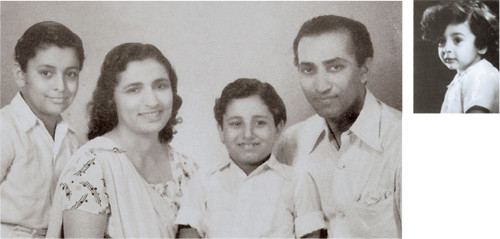
(L to R): Zubin, mother Tehmina, brother Zarin and father Mehli; (Far right): Zubin in early childhood
Mehta counted among his friends the late actors Danny Kaye, Yves Montand and Gregory Peck. (He shared his chilies which he grows in his garden in Los Angeles with the last named.) He is also well acquainted with Sophia Loren whose son Carlo Ponti Jr, a conductor of much promise, took lessons from both Mehli and Zubin. Back home, Dr Yusuf Hamied of Cipla was a neighbor and they played together as kids. He is also close to Nusli Wadia and his wife Maureen. Ratan Tata and Mehta studied in St Mary’s together. Mehta also acknowledges his debt to Mehroo Jeejeebhoy, the moving spirit and indefatigable worker behind the Mehli Mehta Music Foundation in Bombay.
In the book there are many profound, but unelaborated, pearls of wisdom which afford the reader fleeting glimpses of the formidable reserves of musical experience and knowledge Mehta embodies. There are also some priceless anecdotes in the book. An amusing one involves Enrico Mainardi who was playing Schumann’s Cello Concerto in September 1961 when Mehta was conducting the Berlin Philharmonic. Mainardi tried to tell Mehta something during the performance but he did not catch on. At the end of the Concerto when Mehta saw that his fly was open he realized what Mainardi’s whispered ‘Pantaloni son aperti…’ had meant.
Mehta’s meeting with Alma Mahler-Werfel (Gustav Mahler’s widow) in New York — her home crammed with memorabilia of her various husbands and lovers — is another gem. She was 80 at the time Mehta met her and held his hand throughout the visit. She cast her spell so completely that Mehta missed his flight to Paris. "I remarked quite in passing that I found her granddaughter in Los Angeles very beautiful,” Mehta recalls, "I received the succinct but slightly jealous answer that she thought the young lady had too large a bottom.”
Two anecdotes which do not find a mention in this book come to mind. There is the story about how while on tour Mehta got up early in the morning and changed all the breakfast orders of the orchestra’s musicians and watched the fun as the mix-up unfolded.
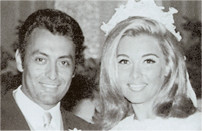
Zubin and Nancy on their wedding day
Or there is the story of a young Mehta’s tour to Vienna with the Israel Philharmonic Orchestra in 1968, where his orchestra was to play under both his baton and that of the legendary Josef Krips. The night after Mehta’s concert — a triumph — he took his musicians out to Grinzing on the outskirts of Vienna, famous for its sparkling wine. It was three o’clock in the morning when the very happy, if not completely inebriated musicians, reached their hotel. Only half turned up at next morning’s rehearsal with Krips and when they finally all assembled, they played terribly. A visibly upset Krips wanted to know what was happening. When he was told about the previous night’s outing, he fumed with a heavy German accent, "Das ist sabotage.” In the end the orchestra overcame its collective hangover and performed well enough to keep its and Mehta’s reputation intact.
This book, as the life it encapsulates, is about music. It is Zubin Mehta’s life in music and readers looking for details found in a conventional autobiography are likely to be disappointed. Personal insights come incidentally, they are not central to the autobiography. There are a few of those but in most cases details are either missing or remain unelaborated. His first marriage to Canadian Carmen Lasky, who later married his brother Zarin, is dismissed in just two lines. He has two children from his first marriage — Zarina and Mervon. He is more forthcoming about his 40-year-long marriage to former actor Nancy Kovak but apart from confessing in a most dignified manner his two children out of wedlock — Alexandra, who was conceived between his two marriages, and his Israeli son Ori, 18, the outcome of an affair that he acknowledges must have caused his wife great hurt — he remains reticent about his private life.
As he admits in the preface, he hesitated for long before agreeing to an autobiography because the task "requires intensive retrospection and it is certainly not one of my favorite occupations.” Granted that this autobiography is not the result of his innate longing for confidential expansion, one would still have liked to know details of his family — his wives, children and brother (now the president of the New York Philharmonic and considered by many to be one of the finest music administrators in the world). And the two people to whom he owes everything: his parents. Or for that matter, more details about himself: his love for spicy food (he is famous for drenching his food in Tabasco sauce because "in America one has to cook on the table”); his travels; his love for cricket; and his reading habits. Mehta is also known to have a great sense of humor and there are numerous anecdotes about his pranks. It is possible that Mehta thought that inclusion of these would indicate a lack of gravitas. One can argue to the contrary: it would have shown the many facets of his personality. And then there is the small matter of the awards and honors bestowed on him. Modesty prevents him from listing his numerous awards (apart from the Israel Prize of which he is the most proud), denying his readers the chance to enjoy vicariously his many accomplishments.
If there was a Mount Rushmore for conductors Mehta’s visage would certainly be there. His fame and musical ability warrant it. And there is no denying that his unyielding features are ideally suited for a rendition in granite. Mehta projects that imperious air for which he is so famous — conductor as Lion King. One can’t help thinking that this book is merely an appetizer; a definitive and full-length biography of this extraordinary life remains to be written. In his autobiography Mehta has shown us the maestro; we would like to see the man as well.
◆ ◆ ◆
From the archive