
Cover Story
Slain sentinels
Among the 188 killed in the terrorist attacks on Bombay were three Zoroastrians, each one of whom had made a mark in his career
Sentinels of Zoroastrian philanthropy… foresight… entrepreneurship — The Taj Mahal Palace and Tower, Cama and Albless Hospital, Leopold Café — were helpless bystanders as mindless terrorists wreaked wanton destruction within the portals of the grand edifices. Having weathered the ravages of time they were able to withstand the onslaught of the fiends who caught south Bombay unawares on the night of November 26, 2008. But many were the innocent lives that were snuffed out, including those of three known Zoroastrians, in the nearly 60-hour carnage before the terrorists met their ignoble end.
The youngest among the community members who lost their lives was 28-year-old Kaizad Kamdin considered "one of the best young chefs in the country,” according to the Hindustan Times of November 29. He reportedly helped everyone out from the Taj kitchen but lost his life in the bargain. His father Noshir, a Poona resident, recalls the phone call that came at 9.40 p.m. on November 26: "Daddy there is a mad man pointing and firing guns. Don’t worry,” the son assured his father. When the next call came two hours later Noshir urged his son to leave the Taj but Kaizad replied that he had an assignment to take care of people. The last call came at 3.45 a.m. "I spoke to him and he said, ‘I can go. The police have come. I am putting the phone down.’ After that there was no word from him,” said the father. At 7.30 a.m. Kaizad’s body was found outside the main kitchen with three bullet wounds, on the face, below the abdomen and in the leg.
Well known karateka and fitness trainer Farokh Dinshaw and advertising ace Rohinton Maloo fell to bullets at the Trident where they had gone to dine. Maloo was at the Kandahar restaurant at the Trident with a friend when the terrorists struck. The diners were taken to the 19th floor and shot. Fifty-two-year-old Dinshaw was at the Trident for a meal at the Tiffin with a colleague Dev Bulchandani. When the terrorists entered the lobby and fired randomly, one of the bullets hit Dinshaw who was rushed to the Bombay Hospital. The doctors operated on him but he ultimately succumbed to his injuries.
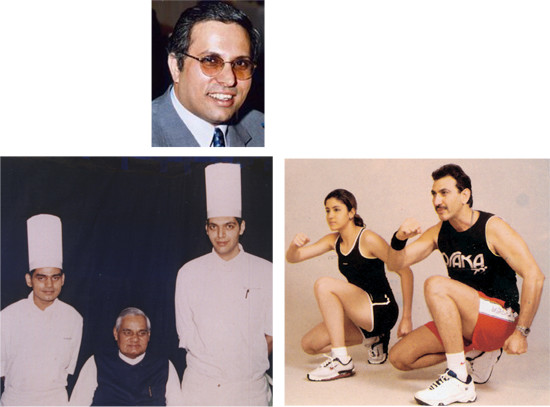
(Above): Former Prime Minister Atal Behari Vajpayee with Kaizad Kamdin (right); Farokh Dinshaw along with athlete Ayesha Billimoria; (top): Rohinton Maloo
According to the Afternoon Despatch and Courier of December 3, Noshir Sanjana, a security officer with the Taj, walked into the Hotel at 1 a.m. when everyone else was desperate to flee. Seeing the TV coverage in his off-duty hours he felt obliged to return to work. He managed to help a few guests to safety before he was shot in the knee. He lay there all night and managed to crawl out of the place in the morning.
Café Leopold, jointly owned by the Jehanis and Dehmiris, was able to resume operations after a three-day break. As reported in The Indian Express of November 30, "Leo, as the café is fondly called, is now squeaky clean. But the scars caused by the terrorist attacks on the city… are all over the place. The bullet marks are on its walls and counter; the mirrors are broken, doors now have holes and the grenade has formed a mini crater on its marbled floor.” Despite nearly 10 people being killed in the café and several others injured during the shooting, partner Farhang Jehani was emphatic, "We want the terrorists to know that they have not won, we have,” he was quoted in The Times of India of December 1. Although Leopold was the city’s first target for the gun-wielding terrorists on November 26, Jehani believes the intention of the terrorists was to divert attention while they gained an easy entry into the Taj. Farhang is confident that Bombay "believes in looking ahead, nothing can dent its spirit,” as his wife Shenaz and brother Farzad keep busy sorting out the belongings (handbags, knapsacks, wallets, mobile phones, books) left behind in the commotion by customers who they hope will soon come and claim them.
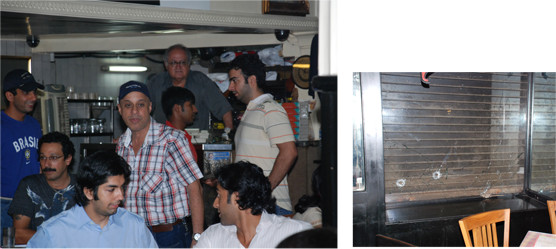
Right : Bullet holes in Café Leopold window. Alongside from left: Meherzad Dehmiri, Farzad and Farhang (standing) Jehani and behind cashier Cyrus Udwadia
The café, named after an Austrian King Leopold, was an oil store when it first opened in 1871. The joint took its present form nearly two decades ago. In 1991 it introduced its pub, then the biggest and the city’s second. However its novelty — nearly three-foot beer towers, imported from Canada, came on the scene much later.
Tata Group chairman Ratan Tata was concerned that the city "still does not have a crisis infrastructure in place” despite repeated attacks. "Innocent people have been killed…It is very easy to say everyone is doing their best but it is not coming together fast,” he lamented before urging, "We must show that we cannot be disabled or destroyed but that such heinous acts will only make us stronger. It is important that we do not allow divisive forces to weaken us. We need to overcome these forces as one strong unified nation.”
Distraught at the destruction of the landmark hotel former Bombay Parsi Punchayet chairman Minoo Shroff mentioned, "Taj is the symbol of all that is truly representative of Bombay’s cosmopolitan culture and its vibrancy. I personally have great nostalgia of the Taj, having stayed in its vicinity for over 30 years. Besides my great grandfather Sorabji Contractor was personally involved in the construction of this, undoubtedly our most majestic hotel.
"It was one of the jewels in the crown of the visionary Jamsetji Tata, who spent his personal resources to create this landmark to demonstrate the pride of Indians, originally debarred from entry into English run hotels and clubs. Though the ownership was later transferred to Indian Hotels Company Limted, the community always took immense pride that this great edifice was built by an outstanding Parsi industrialist and patriot. The entire community, wherever located, fervently yearns that Taj should be restored to its pristine glory at the earliest.” While the financial loss to the 105-year-old Taj had yet to be calculated, it is expected that it would take almost a year to repair the devastation.
As commented BPP trustee Noshir Dadrawala, "It was heart-wrenching watching the Taj hotel billowing thick black smoke and the leaping flames menacing around the grand dome. Even more heart-wrenching was the sight of blood and destruction at Café Leopold …(which) I have always described as a happy and happening place… Material destruction can be compensated for and even rebuilt. But what about the loss of innocent lives? And where were the defenders of the ‘sons of the soil’ when Bombay’s sacred soil was splattered with the blood of its innocent sons and daughters?”
Describing the tragedy as "heart-wrenching…it shouldn’t happen to anybody,” BPP chairman Dinshaw Mehta added, "It is most unfortunate.” He felt obliged to attend the funerals of all three slain members at Doongerwadi and referred to the "tears that came to my eyes.” The perpetrators of the heinous crimes "should be wiped out from the face of this earth,” he spoke forcefully. In a subsequent press release the Punchayet offered "to do whatever it can to provide succor to the innocent victims of this unprovoked attack.”
Media found a match in Maloo
With over 25 years of varied experience in media and technology marketing, 48-year-old Rohinton Maloo was the managing director of Cutting Edge Media. As recalls his childhood friend and business colleague Marzban Patel, founder of media sales agency, Mediascope: "Success came to Rohinton easily; he was very bright, likeable and full of ideas. Always a step ahead of the market he could see a trend many years ahead. Given his early passion for technology and computer literacy (he introduced me to my first computer) he could have easily built a major software enterprise. But he stuck to what he loved — media and advertising.
"Rohinton was a dear, dear friend. All the things that boys do post their teens, we did together — in our teens! We grew up and went our separate ways.” After completing his schooling from St Mary’s High School, graduation from H. R. College and postgraduation from Xavier Institute of Communications, Maloo started his career in 1981 in brand planning at Trikaya Grey (now Grey Worldwide) where he worked on the launch of Thums Up in India. Three years later he launched Adverts Advertising and Marketing, followed by Sheri Louise Slimming Centers and Professional Slimming Centers and Adar Nutrimetics, makers of pickles, jams, salt. In 1987, Maloo co-founded the computer training institute Computerland which was subsequently renamed Aptech. Among his other launches are Slim Fast Food, Medical Hair Centres.
Adds Patel: "Fate made sure we bumped into each other again and we decided to start up a business — just to stay in closer touch! We tried our hand at many opportunities none of which saw the light of day! And then it happened. Star TV was launching in India and was looking for a company to outsource its advertising sales to for three years. I won the account and invited Rohinton to form a partnership and run the TV sales business, separate from everything else that we were doing on our own. Rohinton co-opted his sister Mehernavaz into the force and boy did we have a team! After Star TV, we won Turner Broadcasting and this was a huge opportunity for Rohinton not just from a business point of view but also for him to use his extraordinary sales, marketing and brand building skills. Standing in the shadow it was such joy to see him totally enjoy what he was doing.
"As time went by we stayed close but as our individual businesses and responsibilities grew, opportunities to meet, holiday and party together got rarer. I will miss his Parsi humor, his infectious zest for life but most of all his friendship.”
Maloo was a favorite guest speaker at most of the media functions in India. Sam Balsara of Madison India referred to Maloo as "an extremely energetic, entrepreneurial person with a can-do approach to life. During his short life he went into new uncharted territories and was not daunted by failure.”
"He was the wind beneath my wings,” summed up his sister Mehernavaz Rustom Vesavevala. Describing Rohinton as a "visionary,” she added, "he was invariably setting milestones.” One of the most respected members of the media, he realized the importance of "consistently innovating” and of "reaching out to different genres.”
Last year he joined hands with TELiBRAHMA Convergent Communications Private Limited, a leading provider of mobile solutions as a consulting partner and strategic advisor. "Rohinton possesses valuable expertise in marketing and business development, and in his previous positions, he has displayed exceptional commitment and determination. With the help of his insight, we aim to come up with innovative business opportunities and provide specific business solutions to some of the industries we address,” said TELiBRAHMA chief executive officer Narasimha Suresh who besides being impressed with Maloo’s "great integrity and work ethics” was appreciative that "Rohinton had a way with people…he found the best in everyone and was always sure to compliment people at various instances.”
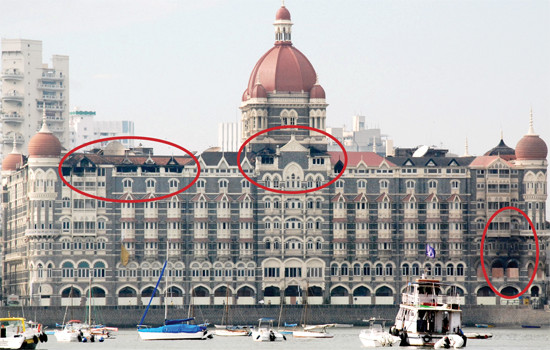
The Taj Mahal Palace Hotel with ravaged areas circled in red
Despite being a workaholic to whom his office was a temple, "he was always there for the family, a pillar,” states Mehernavaz on behalf of their surviving parents Baji and Dolly, Rohinton’s wife Nikki, daughter Nairika and son Arshaan. Although "most helpful by nature, there were some who felt he was unapproachable because he would refuse to tolerate any inefficiency, dishonesty or lackadaisical approach… He was always two steps ahead of you,” points out Mehernavaz. As one who always believed in being honest he preferred to miss out on opportunities where the dealings were not straightforward. "He believed that if one has worked for life, one should also live life to the fullest.” Jazz music, fast cars and Formula 1 racing were his abiding passions. Respectful of all religions, he would regularly visit the fire temples, the Sai Baba mandir and of late had started showing an interest in the path of peace propagated by Buddhism. (Maloo’s subscription renewal form for Parsiana was received by our office on November 29, the day of his funeral.) Whatever he studied, he insisted on mastering, and with his innate understanding of technological developments, it was a family joke to refer to him as master of technology.
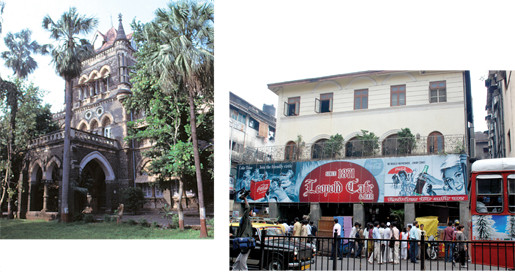
Cafe Leopold and Cama and Albless Hospital
Dinshaw’s fitness drive
During the 25 years he served as martial arts and fitness instructor operating from 11 centers in Bombay, Dinshaw must have trained nearly one lakh students, including members of the armed forces. Presently in the 25th year in this profession he was "planning to reinvent himself, focus on an alternative way of lifestyle,” mentions his student and second in command Sweta Dugar. "There was nobody who met him and came away being unimpressed,” she adds, describing him as being "extremely intense.”
Besides running a martial arts school — Combat Center; a fitness academy — Bodyline; and an adventure camping instititute — Eco-venturers, he found time to share his knowledge of the subject at workshops that he regularly conducted and also through books on martial arts, fitness and adventure that he authored.
In his last book Bodyline: Savage the body, civilize the mind he had shared his knowledge, experience, research and personal experimentation with "total fitness.” In the book he sought to impress, "If the mind is stronger you push harder and injuries follow, while if the mind is weaker you give up easily and the body gives in to lethargy.”
Veteran athlete Rohinton Mehta who had reviewed Dinshaw’s book for Parsiana, had interacted with Dinshaw when the latter was conducting his karate classes at Priyadarshini Park. Describing him as a "very known face in South Bombay,” Mehta referred to his "genuine interest in the field…he knew his technique well.”
A fourth degree black belt, he had trained under leading masters in USA, Japan and Europe, notes an introduction to Dinshaw in one of his books. Among the other books he had authored were Code of Bushido and Bushi: the warrior.
Theo Braganza of Marine Sports, a sports bookseller in Dadar who had published five books by Dinshaw was quoted in the Mid-Day of November 29, "He approached me in 1987 with a karate book. His book has substance I thought. I also saw that he had a magnificent physique, almost like Bruce Lee.” Besides being impressed with the "good instruction manuals,” Braganza "saw him interact with his students, he was a very good teacher.”
Part of a clutch of karate black belts who opened their own classes, Dinshaw would be spotted jogging at the Mahalaxmi racecourse quite often, saying in conversation on one occasion to Hemal Ashar of Mid-Day, "I used to break my teeth so often in karate combat, visits to the dentist became very expensive.”
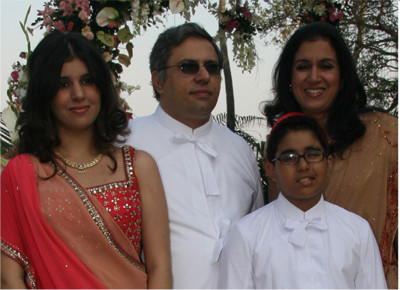
From left : Daughter Nairika, Rohinton, wife Nikki and son Arshaan Maloo
Chef Kaizad brought cheer
"He wanted to become the best chef in the (Taj) hotel,” recalled Hemant Oberoi, corporate executive chef at the Taj Group who considered Kamdin’s death as akin to "losing a family member.”
As per inputs on Kamdin received from Pesi Anklesaria of Poona, in 2003 when the then Prime Minister, Atal Behari Bajpai, was undergoing knee replacement surgery at the Breach Candy Hospital, the catering for the Prime Minister and his entire retinue of officials, staff and security was entrusted to the Taj Mahal Hotel. Chef Kaizad was handpicked by the Taj to personally cater to and wait on the Prime Minister at meal times. His quiet, caring, unobtrusive and totally professional service did not go unnoticed by the Prime Minister who appreciated his efforts by gifting him a gold watch with a commendatory letter from the Prime Minister’s private secretary stating: "The meals were so delicious and nourishing that the Prime Minister and his team rarely felt homesick on this count. I would like to particularly thank Shri Kaizad Kamdin and Shri Santosh Kumar of Taj Kitchen for their excellent and diligent service.” Thereafter Kaizad was deployed on many assignments for prestigious clients even at locations abroad. However Chef Kaizad was unassuming and always underplayed his achievements.
Kaizad schooled at St Vincent’s High School, Poona, and completed his Junior College from S. M. Chowksey Junior College. In school, Kaizad was a quiet and reserved person who had a few but extremely close group of friends. He loved playing hockey and was goal-keeper. He was 6’5” tall and had a large frame which earned him the affectionate nickname "gentle giant” which was used by all those who loved him well. He had a mind of his own and early on in life decided to pursue a career in the hospitality industry.
Straight after his XIIth standard he joined the Indian Institute of Hotel Management, Aurangabad from where he obtained a diploma in the Culinary Arts Course. He was picked up by the Taj Group from the campus even before he completed his course. He was passionate about his vocation and his friends describe him as a perfectionist. He was known to be an exacting task master to his juniors and had a reputation of making them repeat a dish several times over till they had mastered it just so. However, once he was off duty he made for a very committed friend, almost like an elder brother, and a mentor to those younger than him. Many people have come forward and acknowledged to his parents how he helped them financially — be it a colleague at work who needed funds for his wife who was undergoing cancer treatment, or a school friend who was struggling to start a business. About two years ago Kaizad joined the Freemasonic Lodge Beamon 1069 SC.
After working with the Taj for five years he opted to go back to the Indian Institute of Hotel Management, Aurangabad, to do a top-up one-year course which would earn him a Bachelor in Hotel Management from the University of Huddersfield in UK, as it was his father’s dream that he should obtain a degree. His father Noshir was then the managing director of ThyssenKrupp Industries India, mother Navaz is a yoga teacher and completing the family is younger brother Astad towards whom Kaizad was known to be very protective. The Taj Group gave him study leave for one year for which he felt indebted to the Hotel. He loved the organization he worked for and they in turn appreciated his honesty, loyalty and integrity towards them.
It is his absolute and unflinching devotion to duty that by a perverse twist of fate cost him his life.
Right from the lowest rung of the ladder to the topmost — from the junior most kitchen hand to the senior management, almost 300 staff members of the Taj Hotel lined the pathway as Kaizad’s mortal remains were carried to the Tower of Silence.
◆ ◆ ◆
From the archive