
Rememberance
Anniversary of anguish
A year after the murderous terror attacks in south Bombay the media turns its focus on those who were directly affected by the incident and how they have coped
One year after a handful of well trained and heavily armed terrorists gunned down over a hundred unsuspecting people in south Bombay, the city has not forgotten the trauma of the night of November 26, 2008. For the families and friends of those slain, struggling to come to terms with their loss, it has been an anniversary of anguish.
The focal points of the carnage were the busy concourse of the Victoria Terminus station, the Cama Hospital, The Taj Mahal Palace and Tower hotel, Leopold Café at Colaba Causeway, the Trident (Oberoi) hotel, and Nariman House in Colaba, an international Jewish religious center. A semblance of normalcy was restored to most of these places within days of the attack, mirroring the resilience of the citizenry. As columnist Shernaaz Engineer wrote in the Afternoon Despatch and Courier (ADC) on November 26, 2009, "Scores have found within themselves the strength to pull through one long year after loss... So many have taken the devastating personal blow in their stride and have demonstrated the courage not just to cope, but even to hope. It is their spirit we salute today.”
When asked by the media what they planned to do to commemorate 26/11, the Oberoi and Trident said they would hold an all day affair where those who wished to pay homage to the guests and staff who lost their lives could do so by lighting a candle; the Taj replied that it would be functioning as normal, with only a solemn internal affair where senior management and staff would come together to remember those who were killed within their premises; Leopold Café was to have a minute’s silence at 9.40 p.m., the time of the attack, light candles and offer condolences to the families of the departed.
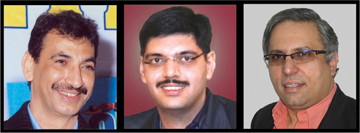
(From left) Farokh Dinshaw, Kaizad Kamdin and Rohinton Maloo;
The students of karate instructor Farokh Dinshaw who was gunned down in the lobby of the Trident, keep his memory alive by continuing to train because their teacher believed that the show must go on, reported Mid Day on November 4, 2009. "Nobody can fight bullets, but if Sensei (teacher) had any chance, he would have fought back or saved himself during the terror attack. Unfortunately, it was too sudden,” student Kamal Bhatia informed the evening tabloid. Reflecting the commitment and discipline that Dinshaw had taught them, the students resumed karate classes the day after their teacher’s funeral. To mark the anniversary of his passing they planned to have a kiai (martial arts war-cry) resounding in the dojo (class), saying: "Teacher you left us in body, but not in soul,” the Mid Day report reveals.
Though devastated by their loss, Poona-based Nawaz and Noshir Kamdin, parents of Kaizad, slain banquet chef of the Taj, told The Times of India (TOI) of November 26, 2009 that their hearts are filled with pride that their boy put duty above self. Kaizad was a perfectionist who wanted to be "the best chef ever,” they recalled. "The Taj was his life. And we must admit that they have been marvelous to us,” said Noshir. "Everyone from the topmost management to Kaizad’s colleagues have reached out to us. The sense of belonging that we feel toward the Taj family is immense,” he added.
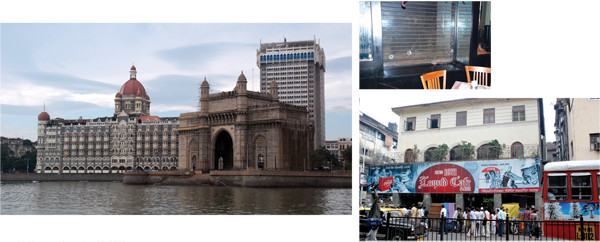
(From top right): bullet marks at Café; Leopold Café; the Taj
A teary eyed Nawaz recalled to TOI a story about her son’s sense of humor, demonstrated in his reply to executive chef Hemant Oberoi during his final interview. "You are too tall for the work tables in my kitchen,” Oberoi said to him. To this Kaizad had responded, "No problem. I will simply place one on top of the other.” Nothing escaped his attention, Kaizad’s mother told TOI, he used his height to his advantage, standing in a corner and keeping an eye on his team and the sequence of work.
A caring friend, a hockey player who excelled as goal keeper, a keen foodie who would give his mother little birthday cards with a list of what he would like to eat and instruct her on the menu to be served at parties... these are memories of a promising life wantonly cut short, reported in TOI. Kaizad, who would have completed 29 years this October, has left a vacuum in many lives.
Among the plethora of tributes that appeared in the newspapers for the departed was a large notice in TOI on the first anniversary of the death of 48-year-old slain media tycoon Rohinton Maloo who was dining at Kandahar at the Trident. He was fondly remembered by family and friends who lamented: "No farewell words were spoken, no time to say goodbye,/ you were gone before we knew it and only God knows why.”
At Nariman House a multi-faith prayer meet was organized by the Art of Living Foundation and US-based Jewish NGO (nongovernmental organization) Simon Wiesenthal Foundation to mark the first anniversary of the terror attack according to the Jewish calendar on November 17, reported The Indian Express (IE) on November 18, 2009. Among the religious leaders who participated along with rabbis, swamis, imams and Catholic priests was Ervad (Dr) Ramiyar Karanjia, principal of the Dadar Athornan Institute.
Rabbi Avraham Berkowitz, director of the Chabad Mumbai Relief Fund said on the occasion: "We will not be afraid, we will not be deterred, we will rebuild our institutions, stronger than before.” He commended the bravery of Sandra Samuel, the nanny who saved baby Moshe Holtzberg the night his parents, the resident Rabbi Gavriel and his pregnant wife Rivka, were mercilessly murdered and mutilated by the militants.
Colaba Causeway’s well known restaurant and watering hole Leopold Café, which had been put on the international map by various tourist guides, and especially after former Australian bank robber and heroin addict Gregory Davis Robert’s novel Shantaram became a bestseller, was one of the first places that the terrorists targeted "letting loose a wave of death and destruction,” wrote The Economic Times (ET) on November 3, 2009. One year later Farzad Jehani, one of the owners, told ET that Leopold, which reopened for business within three days of the attack, is now part of history which is why the restaurant’s interiors have not been refurbished and still have bullet marked walls and windows. "People visit Leopold to see what we suffered, how can I take that away from them?” he told the newspaper.
TOI reported in its edition of November 16, 2009 that the shattered glass and bullet hole at the entrance of the Café have been carefully preserved. "If people have not yet seen what happened here, they will get a feel of it,” another partner, Farhang Jehani told that newspaper. Though 10 people, including two waiters were killed in the attack, in a show of solidarity patrons continue to return in large numbers to enjoy the eatery’s ambiance and food. "I was back at Leopold’s for a meal a few weeks after the terror attacks,” Kaizad Bamboat, 29, a frequent visitor informed TOI.
Hindustan Times (HT) dated November 26, 2009 mentions that "a year after the attacks Leo’s, as it is affectionately known, is bustling with the usual mix of back-packers, office-goers on a lunch break and collegians packing the tables” with Leopold T-shirts priced at Rs 450 selling briskly at the cash counter. The Café allegedly has not shied away from taking advantage of sentimentality and monetizing its moment in history by creating memorabilia that customers can buy, mentions ET. It has been selling coffee mugs with the image of a bullet shot for Rs 300 apiece. In its edition of November 25, 2009 Daily News and Analysis (DNA) reports that coffee mugs in memory of the National Security Guards, police and other agencies who combated the terrorists, bearing their names and images, roused the ire of the Shiv Sena whose men went to the Café to check them out. "It seems that the Sena had some misconception of beer being served in these mugs at the Café,” said Farzad, who reassured them that the mugs were for display and sale. As a measure of caution he added: "We have withdrawn the mugs... as we do not want to get into any controversy.”
In December 2008 the owners of the Café were "pleasantly surprised” to receive a certificate from the governor of Maryland, US, commending them for their courage and determination in opening shop within three days of the attack, especially since none of the guests on that eventful day was from Maryland. A copy of the certificate hangs framed on the wall. Artists Anuraadha Punjabi, Rani M. and Parul Mehta jointly created a painting which they gifted to the management of Leopold to mark one month of the incident, according to ET dated November 3. The different techniques of each artist highlight "emotions of anger, anguish, hope, courage, shock as well as the media’s reaction to the incident.”
The Jehanis, however, can’t help but be tired of the media attention. "Having to recall the same things over and over makes it tougher,” Farhang admitted to ADC on November 20, 2009. Media persons from all over the world have visited the eatery demanding to see him and he has at times had to give six to seven interviews in a single day, dealing with the BBC, CNN, The Guardian, New York Times and Al Jazeera. Now he asks his manager Eric Anthony, who was also present at the time of the incident, to talk to the media. "I realize that the media has to do its job, but all the questions are the same. In fact, I have been avoiding the media as far as possible,” Farhang confesses. There is also an element of "fear” now. "Whenever I hear a loud bang my first thought is to hit the ground,” he admits.
A tourist at the Café pointed out to TOI (November 16) that road accidents are a lot more frequent than terrorist attacks. "So should we be terrified of crossing the road?” A young Bombayite who was doing her master’s program in London at the time of the attack admits that the incident "shatters one’s sense of safety.” But that did not deter her from visiting Leopold soon after her return to the city.
◆ ◆ ◆
From the archive