
Cover Story
Heat and dust at the Elections
A report on the first four days of the Bombay Parsi Punchayet trusteeship elections
"It just doesn’t make sense. Any plan to do wrong must make sense to the wrongdoer, at least!” Adult Franchise for Progress (AFP) candidate Nadir Modi commented on the brouhaha that ensued at the Khareghat Colony on the first day of the Bombay Parsi Punchayet (BPP) trusteeship elections.
Four marked ballots were mistakenly handed out by the president of the election Rustom Hormuzdiyar to handicapped voters at the entrance to the Muncherji Khareghat Hall building where a ballot station had been specifically rigged for them. As he juggled with fresh and marked ballots, racing up the flight of stairs to the Hall where ample tables and the ballot box awaited the voters, the octogenarian president had handed out the envelopes from the wrong pocket.
It was assumed that the marked ballots were in favor of AFP and, moreover, that the BPP staff were knowingly handing them out. Elections, of course, invariably exacerbate Parsi cantankerousness. It was noon, the sun was hot, the queue seemed never ending and people were restive. The opposition made the most of the situation, loudly calling for canceling the election and demanding a change of president. The World Alliance of Parsi Irani Zarthoshtis (WAPIZ) had been unhappy with the choice of Hormuzdiyar from the inception (see "Everyone has to be vigilant,” Parsiana, September 21, 2008) and tried to turn the situation to their advantage. The next day (October 5, 2008) the Sunday Times of India headlined its story "Scuffle, charges of rigging mar Parsi Punchayet polls.” The report goes on to note, "(Another) event that had the voters up in arms involved BPP officials issuing ballots already marked in favor of AFP candidates to a few senior citizens who had trouble with their eyesight…Dinshaw Mehta, an independent candidate and former trustee, says four such ballots were confiscated.”
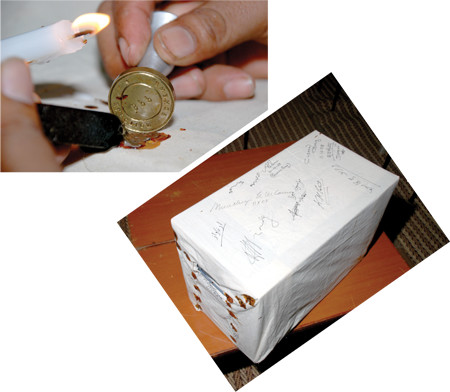
Sealing the ballot box (Photos: Homyar Mistry)
One of the handicapped people to whom a marked ballot was mistakenly handed was attended by her daughter Meher Banaji, director of the Happy Home and School for the Blind. In her letter published in the Jam-e-Jamshed she notes, "It is regretted that the allegations and charges of rigging have been deliberately magnified with malafide intent…Perhaps Mr Dinshaw Mehta could enlighten the public with details of the four ballots allegedly confiscated. I can vouch for one such ballot paper….While I was trying to clarify the matter with the election commissioner, Dinshaw Mehta rudely interrupts and shouts, ‘Open the envelope and confiscate it; this is a malpractice.’ What business did Mr Mehta have to interfere in a situation which was being handled politely by an upright and able administrator?”
The venue, which had served earlier trustee elections well when 600 to 800 people voted in the course of the whole day, proved too restrictive for the mammoth turnout. Despite the bottlenecks — voters were required to present their registration certificate at the tables on the ground floor, then climb to the first floor to mark and cast their ballot paper — 553 people had voted by 12.20 p.m.
Later that afternoon another tamasha ensued. Recounting "what happened to the 25-year-old daughter of Firoza Punthakey Mistree and religious scholar Khojeste Mistree,” the Sunday Times reports, "Firoza Mistree says that when (her daughter) stood on a chair to film an altercation taking place between members of two rival groups, Zeree Jehangirji, a member of the AFP and one of those involved in the fight, roughly pulled her off the chair. ‘He could have said, "Please get down,”’ says Mistree. ‘My daughter was screaming, "Let me go.” She’s now hurt her back and we’ve sent her to the hospital for an x-ray…We Parsis have a wonderful reputation of gentlemanliness. These people have shown none.’ The Mistrees filed a complaint at the Gamdevi police station.”
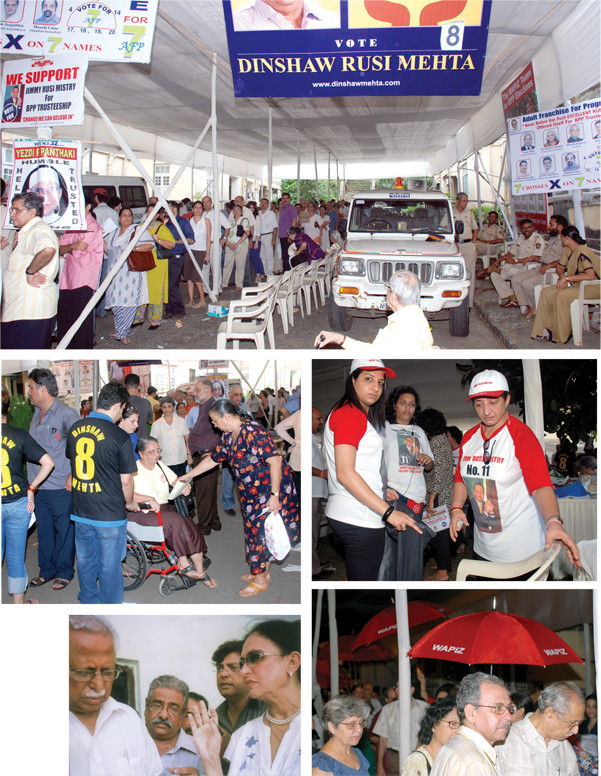
Top and center left: Voters, vehicles and wheel chairs at Khareghat Colony. Center right: Busy volunteers at Cusrow Baug. Bottom (left): Rustom Hormuzdiyar, Dinshaw Mehta, Meher Banaji and (right) WAPIZ umbrellas at Khareghat Colony
On October 7 this reporter received an SMS from the AFP saying, "Khojeste has lied about the scuffle involving his daughter and wife. AFP has proof on camera that Khojeste’s daughter jumped off the chair herself and because she lost her balance Zeree Jehangirji tried to help her. But WAPIZ twisted this whole issue to cast AFP in bad light …” Apparently, the CCTV installed by the BPP at all the polling stations caught the action as it happened.
A week later the Sunday Times (October 12, 2008) presented Jehangirji’s side of the story: "Denying the charge Jehangirji says that the girl was standing on one of the chairs that was barricading the polling booth. A large crowd had gathered and she was in danger of being jostled off the chair. ‘I said, "Please get down.”’ He says, ‘She got down. When she realized I was from the opposite camp, she started to scream.’
"Jehangirji added that he had not received any summons from the police. The duty officer at the Gamdevi police station confirmed to TOI that no complaint had been lodged against him.
"As a result of these allegations, Jehangirji says his reputation has been ruined. Members of the rival group, he says, have been humiliating him in Parsi colonies by shouting insults on loudspeakers. He says passers-by in Dadar Parsi Colony where he lives have been heckling his children with taunts such as ‘son of rapist father.’ ‘They are absolutely traumatized,’ says Jehangirji.” (See "Allegations unacceptable” pg 22 for a detailed exchange of correspondence between Firoza Mistree and chairman of the Bombay Parsi Punchayet Minoo Shroff).
Polls on the following day (October 5) were held at Rustom Baug as per schedule. Unhampered by space constraints the operation flowed smoothly, so much so that people from Dadar Parsi Colony availed of the facility rather than wait their turn for voting at the J. B. Vachha Girls High School on October 19. Learning from the Khareghat Colony experience, the BPP announced a change of venues: on October 11 from the J. J. School on Dadabhai Naoroji Road to Cusrow Baug and on October 19 from the J. B. Vachha School to the Dadar Parsi Colony Gymkhana grounds.
On October 11 the Cusrow Baug Pavilion and lawn were perfectly adequate for the demand. So many posters and banners festooned the Baug, one could have imagined it was a national election! But the mood was peaceable except for advocate Tehmurasp Mogul taking exception to one of the candidates sitting on a chair at the entrance to the Pavilion. He insisted loudly that they should be moving around! However BPP chairman Minoo Shroff managed to pacify him.
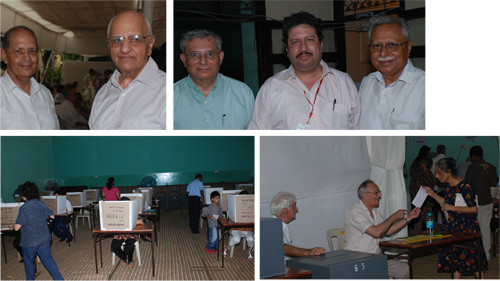
( Top row L to R): Nadir Modi and Minoo Shroff at Khareghat Colony; Cawas Panthaky, Mehli Colah and Rustom Hormuzdiyar at Cusrow Baug; Bottom Left: Balloting stations at Cusrow Baug. Right: Scrutineers Ratan Lalkaka and Rustom Jasoomoney with a voter
On October 12 the polling was scheduled for Bharucha Baug in Andheri and according to one of the polling officers, the BPP team was aghast to find that the hall where the ballot tables and box were to be placed had been taken over by the candidates, their supporters and their tables! "There was 15 to 20 minutes of bedlam” with Dinshaw Mehta expressing his annoyance at high decibel levels. Then it was business as usual.
At the end of four days of voting about 10,118 ballots have been cast according to BPP CEO Mehli Colah: 2,405 at Khareghat Colony, 2,478 at Rustom Baug, 2,834 at Cusrow Baug and 2,401 at Bharucha Baug.
A day before the first polling began at Khareghat Colony, columnist and consulting editor Bachi Karkaria had noted in The Times of India (October 3, 2008), "Parsis must exercise their hard-won franchise with head and heart. Whom they choose will determine whether the community will rise again to write its chapter in the New India story or whether it will become a footnote of history, self-destructed by fear and bigotry.
"Unfortunately, clarity of thought has become the first casualty of the dirty war in which this election is mired. There is no debate, only charge and counter-charge, and at a level of ugliness that has left decent, open-minded Parsis stunned in disbelief – and shame. Inboxes burn with the abuse of rivals while the supported candidate is painted as nothing short of the saviour sent to redeem the community and revive the true faith…Noise is quite different from sound sense, but the din seems to have shouted down reason.”
Lawyer and WAPIZ trustee Homi Ranina, in an article featured alongside Jehangirji’s clarification in the Sunday Times of India (October 12, 2008), states soberly: "This first election campaign has been generally conducted with dignity and decorum. Once the dust of the campaign settles, the successful candidates must rise to the challenges before them and heal the wounds of division…”
◆ ◆ ◆
From the archive