
Zoroastrians Abroad
Sacred and secular service
Ervad (Dr) Peshotan Katrak, head priest of the Australian Zoroastrian Association, recounts the milestones in its growth over the past 30 years
"I had been initiated as a navar and martab during my younger days in India but had not performed any formal religious ceremonies. For the first navjote and jashan I had to write to my father for help and obtained detailed instructions from Rustomji Panthaki, principal of the Athornan Boarding Madressa in Dadar. Subsequently, on every visit home I would visit Rustomji, who was also a family friend, to get any questions answered and to have a new pugree made to bring back with me.”
Ervad (Dr) Peshotan Katrak, head priest of the Australian Zoroastrian Association (AZA) of New South Wales (NSW), recalled his early days in Sydney when he was for several years the only practicing Zoroastrian priest around. "Now we have over 10 mobeds who perform religious ceremonies from time to time. Amongst these are three young men from my Sunday School who had their navar ceremony performed in India,” he adds with justifiable pride.
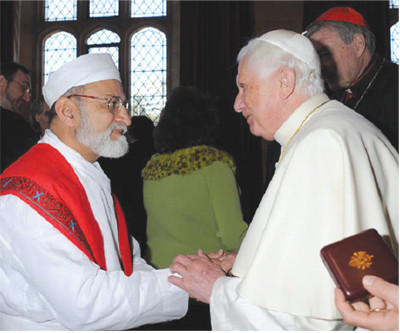
The growth in the number of practicing mobeds in NSW is one indicator of the growth of that Zoroastrian outpost, the largest in Australasia, the earliest Zoroastrian migrants from India and Iran having arrived in the 1960s. Later they were joined by others from Ceylon and Pakistan, as notes Katrak. The Zoroastrian presence there has been increasingly recognized in official circles, as attested by the invitation from Cardinal George Pell to Katrak to meet Pope Benedict XVI at the Interfaith Meeting held on July 18, 2008 during the Pope’s visit to Sydney for the World Youth Day. Attired in the ceremonial jamo, with young dagli-clad mobed Karl Desai in tow, they fielded media interviews and queries from other religious representatives. And while average Australians were dumbfounded by the mention of the Zoroastrian religion, the Pope acknowledged their presence with the remark that Zoroastrianism is an ancient religion, states the AZA newsletter Manashni.
A committed member of the community since his arrival in 1975, publicity-shy Katrak has been witness to the many changes there. "Membership in AZA has grown steadily with the arrival of new migrants primarily from India and Pakistan but also from Iran,” he informed Parsiana in the course of an e-mail interview, adding, "Parsi and Iranian Zoroastrians have always had a very cordial relationship here. We are all part of one Association. We frequently have one or more Iranian Zoroastrian on the management committee; our current president, — Fariborz Jamshidi Kalantary is from Iran.” Katrak has enjoyed several stints on the managing committee including president in 1981/82.
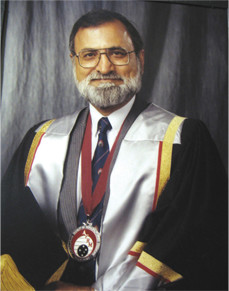
Above: Peshotan Katrak at FAAPMR investiture and (top) with Pope Benedict XVI
Though the decision to acquire a ‘place of our own’ spawned a funds collection drive in 1978, it was only when the Ostowari family, amongst the earliest settlers in Sydney, donated $60,000 towards it that they were able to purchase a five-acre property in Annangrove on the north western outskirts of Sydney in December 1985, writes Katrak who was then chairman of the building fund committee. The inaugural jashan was performed the following February, and a year later the congregation presented a shawl to Katrak honoring him for his services as priest to the community.
"Some years later we received a substantial donation from the Guiv Foundation that helped to erect a new building on the Association’s property. As per the terms of this donation the building is named the Arbab Rostam and Morvarid Guiv Darbe Meher but is still commonly referred to as AZA House,” writes Katrak who led the inaugural jashan on July 24, 1994. "This property has fulfilled our original dream of having a focal point for the community, especially the younger generation. Our monthly Sunday School attended by 30 to 40 children is held there as are other community activities including a monthly Seniors’ Day, several jashans each year as well as periodic navjotes and weddings.”
The community had numbered over 40 individuals when they formed the Australian Zoroastrian Association of NSW registered under the Charitable Collections Act of NSW in 1971. But Sunday School began with Katrak in 1977. In 2002 it celebrated its silver jubilee.
"Intermarriage of Zoroastrians with others is an accepted fact of life here and is not an issue for debate. It is a personal decision for individuals and their families,” states Katrak adding, "Under our constitution the non-Zoroastrian spouse of a Zoroastrian member and their children are considered full members of the Association. Consequently non-Zoroastrian spouses are welcome at all our functions and ceremonies; and in fact many of them are often very involved in the Association’s activities and have served in executive roles on our management committees.”
On the question of the acceptance of the children of intermarried couples, Katrak notes, "During my early years as a mobed I did not perform the navjote of a child whose father was not a Zoroastrian. However in the early 1980s after much deliberation I arrived at a personal decision that the community feeling in Australia and elsewhere in the western world warranted that all children of inter-married Zoroastrians be accepted into the faith. I would stress that this is a decision that individual Zoroastrian mobeds make, based on their personal beliefs, and I respect the view of some of our local mobeds who will perform a navjote only if the child’s father is a Zoroastrian.”
But Katrak draws the line at outright conversion, describing it as a "much more contentious” issue, adding, "I personally would not perform or facilitate a conversion.”
Bombay born Katrak acquired his MBBS from Baroda and MD from Bombay before proceeding for his post graduate medical training to London where he acquired his MRCP (Member of the Royal College of Physicians) registration. Subsequently, in California, USA he completed training in the specialty of Rehabilitation Medicine (FAAPMR). Arriving in Australia with postgraduate qualifications from three continents, Katrak says he found there were only a handful of fully qualified specialists there and no training program for young doctors in Rehabilitation Medicine.
So Katrak helped to set up a training program and establish a national medical college for doctors to become specialists in Rehabilitation Medicine in Australia and New Zealand, in 1981. For this he was awarded the Foundation Fellowship of the Australasian College of Rehabilitation Medicine and its subsequent incarnation, the Australasian Faculty of Rehabilitation Medicine (of the Royal Australasian College of Physicians). He served as honorary secretary to the Board of Censors of the Australasian College of Rehabilitation Medicine for the first 13 years and was elected president of the Australasian Faculty of Rehabilitation Medicine — the peak academic body of specialists in this field in Australia and New Zealand — from 1995 to 1997, as notes his bio data. Having worked as a Rehab Physician at the University of NSW teaching hospitals since 1977 Katrak has been actively involved in training more than 100 Registrars in Rehabilitation Medicine and in teaching undergraduate medical students over the last 30 years.
The son of Ervad Homi and Aiemai Katrak, Peshotan is happily married to Shernaz who "has provided unstinted support in all my work for the Association.” They have two boys in their 20s, Sohrab and Arash.
Apart from the prayer classes at the Sunday School which he has conducted over the past 30 years, the navjotes, weddings, funeral prayers and jashans for individual families he performs several times a year, Katrak volunteers with other members of the community in the monthly "working bee” sessions that help maintain AZA House and its grounds in good order. As most AZA activities are performed on weekends, they consume two to three Sundays each month, he writes.
All these activities still leave Katrak enough time and energy to play tennis, indulge his love of painting and creative sculpture. "I made a 1.5 meter wide farohar in clay for the entrance foyer of our Darbe Mehr and a meter high ‘flame’ in fiberglass for a pergola on the AZA property,” he notes in passing.
"The future for the Australian Zoroastrian Association as I see it is quite bright. We have a solid foundation for the organization with many good traditions that our younger generations have grown up with. Several pupils from our Sunday School of the early 1980s have returned to teach the newer generations and we have an active ‘youth group’ that is involved in the Association’s activities. Although time consuming, being a Zoroastrian priest ‘Down Under’ has been a very rewarding experience and I feel fortunate in having been able to play a small part in the establishment of our Zoroastrian community here. ..”
◆ ◆ ◆
From the archive