
Politics and Policy
The challenge that failed
Promoter of the Adult Franchise for Progress slate of contenders, Berjis Desai dissects the election results
"We expected an embarrassing victory. Instead we received an embarrassing defeat!” Solicitor Berjis Desai, main promoter of the Adult Franchise for Progress (AFP), the phalanx of outstanding Parsi professionals he had fielded for the first ever election of the full board of Bombay Parsi Punchayet (BPP) trustees, is nothing if not candid in his assessment of the results which he says were "a shock to everybody, including the opposition.”
The only AFP candidate to be elected was philanthropy expert Noshir Dadrawala, who came in at the seventh place. Two other AFP nominees — legal eagle Nadir Modi, cancer specialist Dr Ketayun Dinshaw — were next in line, in that order, each at intervals of about 30 to 50 votes.
In the course of an interview with Parsiana on November 1, 2008 at the Ballard Estate office of J. Sagar Associates, said to be one of the three biggest legal firms in the country, Desai, its managing partner, dissected the results of the election.
"AFP was sporting enough to admit it was free and fair,” maintains Desai. Though acknowledging that "the community was more orthodox than we thought,” Desai’s analysis invoked several other factors for the debacle. Describing the community’s choice as "individual centric,” he adds, "If the community was really orthodox, it would have voted for WAPIZ (World Alliance of Parsi Irani Zarthoshtis) en masse… You have to be well known in the community and connect with the voter as an individual… Despite WAPIZ’s systematic campaign, only the two high profile figures in the community (Khojeste Mistree and Yazdi Desai) won. The other two did not pick up.
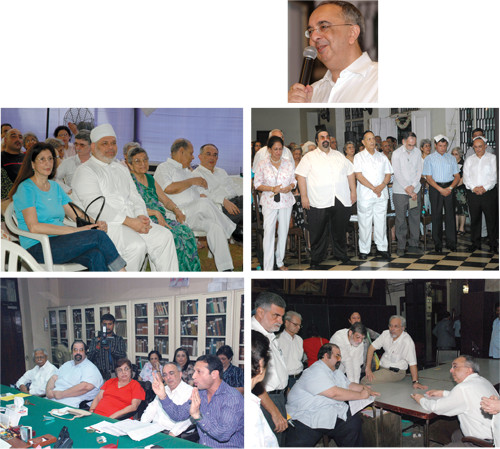
Berjis Desai (top) and (clockwise from top left) at Cusrow Baug and Dadar election meets (Photos: Homyar Mistry, Homz Prints) and in discussions at the BPP office
"In hindsight, AFP disregarded all conventional wisdom. We had no candidate from Dadar,” rues Berjis Desai, attributing Rustom Tirandaz’s election to the loyalty of the Dadar Parsi Colony. Tirandaz became a final contender only when the ballot box from Dadar was opened for counting.
Another factor according to Desai was WAPIZ’s organization at the ground level. When they formed what was popularly alleged as the ‘bogus’ anjuman committee (comprising two elected voters to every donor member but when no election ever took place), "2,500 people were registered. They (in turn) did a very good job of voter registration.” He describes interior decorator Jimmy Mistry’s campaign package as "extraordinary…really brilliant and again, individual centric.”
Moreover, "the winning candidates did vigorous campaigning — almost door-to- door. The AFP candidates were perceived as being ‘up there.’ HDFC Bank vice chairman and managing director Keki Mistry would hardly go round saying ‘vote for me.’ The big name theory has fallen flat.”
It is not a new phenomenon. "BPP history is replete with big names who lost” at trusteeship elections. AFP candidates now join the ranks of such community rejects as Sir Pherozeshah Mehta, considered the lion of Bombay, and economist A. D. Shroff who was one of India’s delegates to the Bretton Woods conference that established the international financial system by which the world has worked hitherto.
Though "politics has prevailed over meritocracy,” Desai says, "it is a gamble you have to take in universal adult franchise (UAF)…The results might have been different in a one-to-one contest.” He is also a bit sore at Phiroze Amroliwalla who "was a part of the AFP to the end… attended all AFP steering committee meetings” and then stood as an independent hiving off 2,719 votes which according to Desai might have come AFP’s way.
Desai with then BPP chairman Minoo Shroff
"Perhaps we approached with too much brain power when what was required was ground level contact,” ruminates Desai. Also, he avers, the community was "more interested in the dinner box” handed out to the audience at the end of the electoral meets. Several people mentioned to Parsiana that the same people came again and again to the various venues and collected their dinner boxes. According to Desai, "The helpline got calls asking ‘what’s in the dinner box?’”
At Parsiana’s suggestion Desai compares and contrasts the two general elections which heralded a sea-change in the community: the anjuman committee election of 1981 where the newly formed CER (Committee for Electoral Rights) won a landslide victory and the UAF of 2008. In both cases Desai had been an electoral strategist. "The two situations were entirely different, in terms of time — separated by nearly 30 years — and also the facts and circumstances on the ground. The CER was essentially a movement for electoral reforms — not very radical reforms. It was supported across the board by several eminent Parsis. Though it did have opposition from the Committee of United Zoroastrians (CUZ), it was an unequal fight. Thirty years later the AFP also had the support of eminent Parsis, perhaps more so, but it faced a very well organized opposition.”
By and large Desai is happy with the electoral practices that were instituted this year, specifically the logistics and security of the ballot boxes, the use of indelible ink, mandatory photo identification of voters with old registration certificates that did not carry a photograph on them, the computerized counting of the ballots. "Despite a lot of hue and cry, things went fairly smoothly even though our opponents had started creating issues at the start with Rustom Hormuzdiyar’s appointment.” WAPIZ, Dinshaw Mehta and some independents had objected to Hormuzdiyar’s appointment as president of the election — a job he had performed with integrity at two anjuman committee and innumerable trustee elections since 1981.
Desai had gone out on a limb persuading Parsi professionals to offer themselves for BPP trusteeship, using professional and personal contacts and goodwill. It had been a difficult exercise, he conceded. "The tragedy of it is that a highly literate community like the Parsis was unable to appreciate” the quality of the offer. "They don’t want to be served caviar. They are more comfortable with masur pav,” he notes, hiding his disappointment behind the caustic comment. "At the end of the day, the fact remains that the panel was outstanding for managing the trust.” He voices his concern for the future: "People like me won’t bother to bring such people together and secondly, such people will never come forward.” Long months of hard work and high expectations have taken their toll. Despite Desai’s stoic stance, traces of exasperation and rejection sometimes echo through the words though his cherubic, unlined face does not display the frustration he must feel.
.jpg)
AZA leader Kersi Randeria (standing) and BPP senior executive Cawas Panthaky in the BPP boardroom. Portrait of Sir Cowasji Jehangir in the background
He is also peeved at the way his writings in The Bombay Samachar’s "Parsi tari arsi” (PTA) column have been manipulated, quoted out of context, the humor bleached out of the words so that they mean what they were not meant to mean. "The level of ignorance in the community is mind boggling. None of the messages are going across. There is no moral fiber, no intelligence, forget intellect!” Desai notes sadly that the Parsis are becoming a community of clerks; the professional class is fading away. People are "no longer applying their mind!”
He says he has received the community’s message: Get on with life, forget about the Punchayet. "The AFP steering committee will decide” on the future of AFP. Desai says he has decided to opt out. But he will "absolutely” support the Alert Zoroastrians’ Association (AZA) which has assiduously tried to ensure that BPP charities, especially community accommodation, is allotted according to the wishes of the donors’ trust deeds. "I personally believe what they have done — at great personal cost and risk — few Parsis have achieved.”
The schism between long-standing friends and business partners BPP trustee and now chairman Dinshaw Mehta and Desai has been a strong undercurrent of this election. But Desai isn’t talking. Parsiana’s questions were stonewalled: "No comments on Dinshaw Mehta.”
Desai is representing Jamsheed Kanga, Dr Aspi Golwalla and Homi Khusrokhan in their appeal to the Bombay High Court for a bungli at Doongerwadi for the four-day death ceremonies of Parsis who opt for cremation instead of dakhmenashini and says he would "very much like to go ahead” with it. As for the religious rights of the children of Parsi mothers married outside the community, he says, "It is AIMZ (Association of InterMarried Zoroastrians) and ARZ (Association for the Revival of Zoroastrianism) who are fighting for these causes. If they want (legal) help, I’m available. But I will not initiate it as a crusade or cause.”
Berjis is an alumnus of the Bharda New High School, Elphinstone and Government Law Colleges. Completing his LLM from Cambridge University’s Trinity Hall thanks to the Rotary Scholarship he had won, he joined Bombay’s Crawford Bayley and Company (CBC) where he qualified as a solicitor. But the son of the late Minoo Desai, former editor of The Bombay Samachar and his wife Mani, a school teacher, says the predominant impact on him had been that of his father who had started the PTA column 50 years ago. Berjis had been a cub journalist — a stringer and sub-editor at The Samachar even in his teen years. So when solicitor Dadi Engineer, partner at CBC, introduced him to the CER, it was a case of duck to water.
A navar and maratab from Navsari, Desai says he is part of the original Desai family, his direct ancestor having constructed the Navsari Atash Behram. Hence the interest in and connection with the Zoroastrian faith. "I am fascinated by Zoroastrianism as a religion and want it to spread to all corners of the world,” he says, estimating the growing converts around the world and particularly in Eurasia at between two and three million. "This number will keep growing. There are only 1,00,000 Parsis…at the end of the day, basically a sect or tribe.”
The intensity of Desai’s involvement with the election and its results have led him to take an apocalyptic view of the event: "A collective call is often a sign of decay and impending doom. If you are genetically projected to perish, you take the wrong calls, make the wrong decisions.
"I made an honest attempt for the good of the community. It is obvious that the community does not want it, does not appreciate it. It is better not to persist, better to focus on other things.”
The concluding paragraph of his PTA column on November 2, 2008 is more philosophical: "The challenge of life is in the attempt, not in the victory. A victor often realizes that he has nothing more to look forward to in life. In a strange way, it’s the death of a dream.”
◆ ◆ ◆
From the archive