
Politics and Policy
“Vote with Vohuman”
The Adult Franchise for Progress panel addresses gatherings at Godrej, Panthaky and Bharucha Baugs
"In seven weeks we shall put seven crosses against the names of seven candidates who we will elect as our trustees for the next seven years,” announced Berjis Desai, the motivating force behind the Adult Franchise for Progress (AFP), when introducing the distinguished AFP-7 panel for the forthcoming Bombay Parsi Punchayet (BPP) trusteeship elections to the residents of Godrej Baug on the evening of Saturday, August 30, 2008. But his enthusiasm was apparently not shared by many for at the scheduled starting time of 7 p.m. barely one-fourth the number of chairs were occupied in the compound of the Jokhi Agiary despite the car with a well installed loud speaker making repeated rounds in the colony to remind residents of the ensuing meeting.
Nadir Modi, Sohrab Dastur, Maneck Engineer and Noshir Dadrawala of the AFP-7 sought to convince those present that it was only in the interests of the disillusioned community and the discredited apex body that they were offering their services. Dr Ketayun Dinshaw being away in Geneva to chair a radiation oncology meet, Keki Mistry having undergone an emergency surgery a day prior, and Byram Jeejeebhoy being summarily summoned to adjudicate at the Royal Western India Turf Club could not address the voters in person. So it was a film clip of these individuals that conveyed their areas of expertise and their pledge to serve the community.
"The AFP is not a political party. It will hopefully fade away after October (once the electorate has made its choice). Let us hope that we will all vote with Vohuman, our conscience, and not just be influenced by big names,” conveyed Desai who was happy to offer the AFP platform to Muncherji Cama, chairman and managing director of The Bombay Samachar, to announce his unexpected candidature for the forthcoming elections. Known to be a die-hard traditionalist who chose not to attend the funeral of his beloved father Nusserwanji who had opted for cremation, Muncherji yet believed in permitting everybody a right to their beliefs, attested Desai who as columnist of the weekly "Parsi tari arsi” column in the Samachar had not once encountered any interference from the owners.
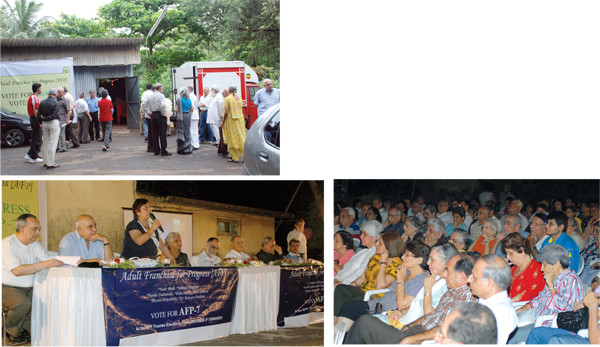
Clockwise from left: People gathered at Panthaky Baug, section of the audience at Godrej Baug (Photo: Homyar Mistry, Homz Prints), Mithoo Jesia addressing voters at Bharucha Baug
"I look forward to your support to restore the Parsi Punchayet to the status it once enjoyed,” announced Cama, alluding to his interest in the Punchayet that was aroused as a schoolboy when he overheard a then sitting trustee relate the uproar created by "a vaandro (monkey) at Khareghat Colony.” Even whilst the trustees were deliberating over whether to get him one vaandri or two, he chose to make a quiet exit! Once the "pride of the community and the envy of others, the BPP has lost luster which is not difficult to regain,” he stressed. "Parsis are besotted with brick and mortar…with material rather than human assets. We are not doing as much as we should in the fields of education and welfare… Commercializing charity is anathema to me although the Rent Act may allow it. What about the wishes of the donors and settlors who were only interested in helping the poor and the needy?” The Doong-erwadi land is not just "valuable…it is priceless. Our traditions and customs will survive as long as we have Doongerwadi.” He urged the voters to ensure that they elect "a custodian of property and not a liquidator of property.”
The program that evening which commenced after a delay of 20 minutes gained momentum following a humbandagi and the screening of a film to present the glorious past of the community largesse in Bombay and the prevailing dissatisfaction with the conduct of affairs at the BPP. The plight of the Hansotia couple, who are eking out a livelihood with difficulty in their pigeon-hole room in the sunset years of their life despite their long-standing housing application with the BPP, earned sympathy from the audience as the gentleman was a familiar figure to the Godrej Baug residents, selling his eats from door-to-door. But when the lights came on and Desai asked the audience (all the back rows being filled by then) to stand in silence for the Hansotias, grumbles of protest could be heard from the rear: "They are not dead;” "Kétli vakhat ooth bès karavsé (How many times will they make us stand and sit)?”
The oft-repeated stories of the BPP trustees and staff being insensitive to the woes of housing applicants were related once again by Desai with yet another tale of a newly married couple moving from sanatorium to sanatorium, asked to produce a child to earn sufficient merit points to deserve the allotment of a house. When the couple showed the birth certificate of their child, they were asked to bring the child to the BPP office. As luck would have it, on the day they were proceeding by train towards the BPP office with their five-month infant it started to pour incessantly with the train service disrupted midway and the trio only able to reach home the next afternoon. Fortunately the baby was being breastfed so it could survive. "Ladies and gentlemen, this is the true story of your (Godrej Baug Residents’ Welfare Association) president Urvax Dhanda and his wife Yasmin… the pain felt firsthand,” revealed Desai.
The Mission Statement of the AFP was presented to the audience as a slide show. It started with "No commercialization of charity” and ended with "Restore credibility of BPP.” The issues which earned applause from the audience were the references to change in housing policy with "immediate steps to consider converting existing leave and license agreements into tenancy (Godrej Baug flats being allotted on leave and license basis);” "seeking minority reservations for Parsis in higher education institutions including medicine, management and engineering;” and assurances "to preserve and protect dakhmenashini.”
Endorsing the AFP-7 panel, Zeree Jehangirji of the Alert Zoroastrians Association (AZA) reminded the gathering that whilst diverse individuals are only capable of raising issues without any solutions, "teamwork brings synergy.” He reiterated the need to collect voter certificates in due time from the Punchayet which had refused AZA help in distribution. Attested certificates bearing the photo of the voter will be recognized. Alternately, if there is no photograph affixed on the certificate, voters must carry proof of identification.
"Sukhi jeev né santaap maa kai naakhvu (why place a peaceful existence in troubled waters)?” was the initial response of Dadrawala when Desai approached him to join the AFP-7 panel. But on self introspection he felt that instead of criticizing others we need to ask, "What are we doing about it?” Knowing that one individual can have a limited reach as against Desai’s panel that has succeeded in bringing together "men of integrity without a single blot in their career,” Dadrawala hoped to bring about "social change in the community as trustee of funds and properties of the Punchayet.”
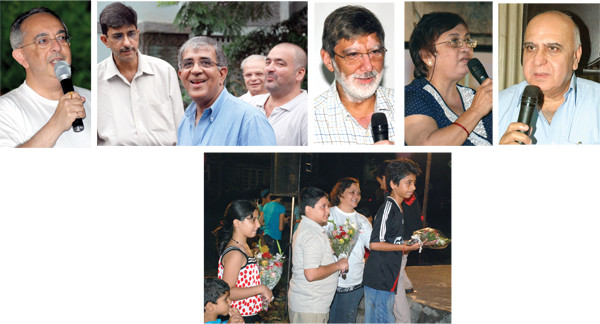
Top (from left): Berjis Desai (Photo: Homyar Mistry), Kersi Randeria (center in blue shirt), Zeree Jehangirji, Mithoo Jesia and Dinshaw Tamboly. Alongside: Bharucha Baug children with flowers for the speakers
To Dastur, education deserved more priority than housing. While the Punchayet ghér aapi saké (can give a house), education aapo tau maanas ghér banaavi saké (with education a person can build his own house),” he believed. He was also keen to see a sporting spirit cultivated in the community, comparing the scenario of 1962 when the Indian cricket team to the West Indies had four Parsis as against not a single Parsi featuring on the national scene at present. Irked by the constant bickering and throwing of mud at each other with the AFP being christened Altoo Faltoo Parsis by the World Alliance of Parsi Irani Zarthoshtis (WAPIZ), he said their weekly Page in the Free Press Journal (FPJ) could also be similarly dubbed Faltoo Parsiono Journal but "we don’t want to return something bad with something bad.” Instead of community members rushing to court to resolve issues where "the only beneficiaries are the community of lawyers who do not need your support,” Dastur was in favor of setting up a three-member arbitration committee that had to be necessarily approached, "not by law but by discipline.” To set at ease those critics who wonder how the nation’s most respected income tax authority would be able to spare time for the community he assured, "Time kaarvaani ability hovee joié (you must know how to create time).” Promising to keep himself free from 5-7 p.m. every Friday to interact with the community — not only to hear grievances but to learn from the advice offered — he urged, "We can all contest against each other but at the end we must cooperate with each other.”
"If people like me who have helped the community are not treated well by the Punchayet what could be the plight of those who seek help from the Punchayet?” queried five-year sitting trustee Maneck Engineer, explaining his resolve to contest the elections at the turn of the century. Referring to his sustained efforts to develop Godrej Baug since 1978 when the plot was used as an open-air defecating ground by the Simla House zopadpatti (hutments) he stated how, after years of building the colony, the Punchayet chose to get an outside architect to audit the expenditure and efforts put in by the House of Godrej though subsequent development was at double the price. Irked by this attitude Engineer said he had resolved never to step into the Punchayet office again unless elected trustee. Although his tenure has been teeming with controversies he would now like to work as one of the AFP team members. The Godrej Baug residents were happy to learn from him that "drawings are ready and we will be taking up work very shortly” for a pavilion/recreation center at Godrej Baug. He also explained the need for residents to cooperate with the Punchayet and contribute in the maintenance of buildings — starting with a basic wash of paint — since proximity to the sea air affects the RCC (reinforced cement concrete) structures.
"It is always better to under-promise and underachieve rather than over-promise and under-achieve,” declared Modi who had overheard one of the audience members commenting, "Joié garjéj tétla varséj ké (we’ll see whether AFP’s deeds are louder than their words). His age, 78, may have attracted the irritation of his critics, but as Dastur remarked, "It is better to be 70 years young than a jaded 40-year-old.” Modi is known to start his legal practice at 9 a.m. daily and drive home only at 8 p.m., putting in nearly 12-14 hours of work a day. "We may differ in views so long as we can work as friends,” advised Modi, preferring to "let the dead past bury itself.”
The half an hour set aside for question time proved to be a tame affair with barely a handful of questions being raised, Desai having forewarned the audience not to raise personal questions for the "AFP has been working with admirable restraint.” One query pertained to whether each of the candidates would step down after serving a single term of seven years or whether they were keen on two terms of five years each. Desai clarified that the candidates would serve only one single term of seven years, the five-year confusion having arisen because Desai had earlier made that suggestion as part of his proposed election scheme for consideration by the present board of trustees.
Another query pertained to the time each trustee would spare for Punchayet work and their views on earmarking a bungli at Doongerwadi for prayers of those who are cremated. "Every single trustee should be available 24x7… As many hours as are needed… No commitment can be given on the time factor as we cannot know what problems will arise at a particular time,” responded Modi but the lady not being satisfied with the answer, he continued, "When I took on the Dadar Parsi Colony case, I did not realize how much time I would have to put in…” When the question was reworded Modi replied, "Every single meeting has to be attended by the trustees. I categorically state that…”
Regarding the Doongerwadi bungli, Modi noted, "Trustees are bound by obligation to respect the terms laid down in the trust deed.” When it was pointed out that there are no separate deeds for the bunglis but only for the Doongerwadi land, Modi added, "What stands on the land belongs to the land so the law applicable to the land would apply to the bunglis…When duties take them into the field of religion (trustees will need to decide) for dharam vagar kaum nahi rahsé and kaum vagar dharam nahi rahsé (without religion the community can’t exist and without the community there will be no religion).”
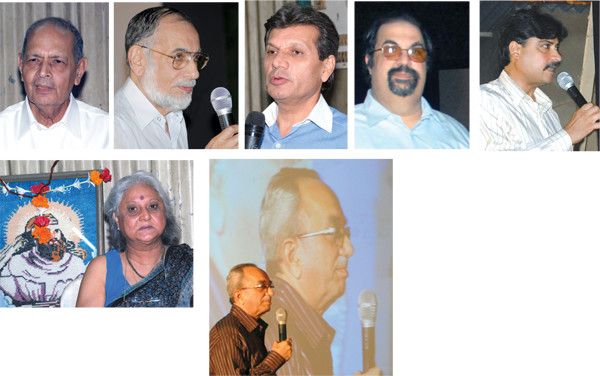
Clockwise from top left: Nadir Modi, Sohrab Dastur, Byram Jeejeebhoy, Muncherji Cama, Noshir Dadrawalla, Maneck Engineer and Dr Ketayun Dinshaw
"Vitality, not age”
"Panthaky Baug is very important to us,” announced AFP founder Desai explaining why the suburban sylvan Parsi/Irani colony was selected for the first AFP meet-the-candidates assembly for the October elections.
A total of 18 such meetings have been planned, explained the jurist on August 23, 2008 to a gathering of around 70 residents assembled in a tin shed that serves as the colony’s public meeting hall.
The AFP supporters spoke following the screening of an audiovisual presentation that was first shown at the AFP inaugural bash at the Y. B. Chavan auditorium on August 9, 2008, and a short movie on a Parsi couple who had applied for a flat many years earlier titled How long must the Hansotias wait?
BPP trustee Dinshaw Tamboly said he "supports and endorses each and every member of the panel… They are all individuals at the very top (of their careers/institutions). If they can deliver for their institution, they can deliver for the BPP.”
Amplifying the need to function "as a team,” Tamboly urged the voters to elect the entire panel of like-minded individuals.
Jehangirji who is also an AFP founder member told the gathering not to keep harping on the notion that the AFP panel members may not have the time to devote to the premier trust or were too old. They were fit and "said they have the time.” But they did not "have enough time to sit and hijack the trust.”
Mancherji Joshi Colony social activist Mithoo Jesia of Dadar said the AFP "is the only body that brings to you seven candidates.” She introduced the candidates one by one to the gathering.
Dastur stressed the importance of education. "People must be educated if they are to fund their own homes.” Promising to spend two hours once a week at the BPP office "to hear people’s grievances,” Dastur said "vitality, not age” is the criterion for judging candidates.
He recommended a committee of three eminent judges, two Parsis and one non-Parsi be formed to function as ombudsmen and resolvers of conflict. This may prevent costly litigation. "In court cases only the lawyers benefit and they are the least deserving,” quipped Dastur. "People make fun of us,” because we frequently engage in litigation.
Referring to the WAPIZ slur about AFP standing for "Altoo Faltoo Parsis,” Dastur said "the rest (of the candidates/community members) must be supermen to be doing better than these (AFP candidates) lady and gentlemen.”
Director of Tata Memorial Hospital, Dinshaw said, "The election is about change. We have to change… We are willing to give of our experience, put (our) talent together to make a change.”
Philanthropist Jeejeebhoy urged the crowd to elect the entire panel of seven otherwise "we may not be able to function as a team. Elect all.”
BPP trustee and construction expert Maneck Engineer spoke of the buildings in the colony "being in bad shape.” This was the case in many of the baugs. Adding more housing meant higher maintenance costs, he said he was "lucky to have been born and brought up in Cusrow Baug.” Now working for Godrej as a consultant "I can spend as much time as required” for the BPP, he noted.
"Dadar Parsi Colony would have been wiped out but for the gentleman to my right,” said Jesia referring to Modi. He spent "hours and hours” of his professional time fighting to preserve the Dadar Colony for Parsis/Irani residents only.
She bemoaned "the kind of muck that is being thrown around…. Parsi politics has reached an all time low. What are we doing to ourselves?” Referring to the hate letters and e-mails doing the rounds she exclaimed, "We are making laughing stocks of ourselves.”
Modi spoke of the "partnership between trustees and the community.” Both working together would ensure progress.
During the question answer session a member of the audience asked why the BPP was neglecting the suburbs. "Bandra onwards maanas nathi mokalta (BPP staff is not sent). Why are the suburbs so neglected? Why is there not a single candidate (in the AFP panel) from the suburbs? Is there no one competent, talented intelligent enough?”
A bearded gentleman in the audience explained that traditionally the Salsette Parsi Association looked after the suburban community’s interest. The BPP traditionally managed affairs till Mahim.
Dastur asked how many people from the suburbs offered themselves as candidates. "If someone stands we can support” them, he offered. In a lighter vein he noted that he had a home in Juhu and spent half his time there "so I’m half a suburbanite.”
If only four out of seven AFP candidates are elected how would the trustees function? Modi hoped the others would be "of the same mind.” Alternatively they would win them over and "move forward.”
Someone asked about dakhmenashini. Modi replied the "trustees are bound to obey the trust deed. Personal opinions do not matter at all.”
A member of the audience asked why there were no educationists in the panel. Modi replied he had spent 12 years as an educationist teaching English literature and law.
On the issue of interfaith marriages, what was the panel’s thinking? Modi: "Many Parsis want to marry Parsis” but don't get a chance to meet them. "Make youngsters meet. Nature (then) does its own work,” he added.
Audience watching audiovisual show at Panthaky Baug
"Review of Rent Act cases”
The same talks and film show was repeated at Sir Shapoorjee B. Bharucha Andheri Parsee Colony that night. Desai noted the Colony had 549 registered voters.
He said the AFP panel once elected would "review all the Rent Act cases (initiated by the BPP) in the first four months (in office) and withdraw all those cases that are without merit.”
When a tenant dies, the legal heir is entitled to the tenancy but instead the BPP was "forcing” them to accept a leave and license status. He promised the AFP panel would rectify the procedure "very, very fast… more burdensome conditions will not be imposed.” He promised a detailed policy would be drawn up and people would witness a "remarkable sea change” in the approach to housing.
A member of the audience, Vispi Jokhi, said the reason there were some empty chairs at the venue was because many of the Colony’s residents were elderly and could not venture out. "We have severe water problems… people get up in the morning and there is no water.”
Engineer had noted earlier that there was "a water shortage” in several baugs. The Bombay Municipal Corporation had been consulted and a "proper scheme” was being drawn up to tackle the problem.
◆ ◆ ◆
From the archive