
Politics and Policy
“Everyone has to be vigilant”
At the all candidates meet electoral modalities were heatedly debated
"Let us keep changing, refining. Every contingency cannot be anticipated. What we need is self-discipline: not just go by the rules but by self-discipline,” urged Bombay Parsi Punchayet (BPP) chairman Minoo Shroff seeking to calm the frayed tempers and hostility that marked the ‘meet the candidates’ event hosted by the Punchayet at the Khareghat Colony’s Muncherji Khareghat Hall on September 9, 2008. Though not all candidates participated in the free-for-all, the more contentious ones made it plain that they did not think the BPP trustees really knew what they were doing in the matter of holding these historic elections next month — historic not only for the first ever participation of the entire adult community but also the first occasion for a full board of seven trustees to be elected at one go. As journalist Maneck Davar — not a candidate but friend and supporter of sitting trustee and candidate Dinshaw Mehta — repeated more than once, "You have huge problems. Don’t let the first adult franchise election be historical for the wrong reasons.”
Davar advocated consultation with a retired Indian Administrative Service (IAS) officer who has worked with the election commission to iron out the "confusion” plaguing the BPP.
On the heels of Shroff’s opening remarks advocating restraint and discipline as "the national press and other communities are looking on with eager interest on how we conduct ourselves,” and his invitation to the candidates to announce themselves, lawyer Sohrab Parakh fired the opening salvo, on behalf of the World Alliance of Parsi Irani Zarthoshtis (WAPIZ) candidate Shirin Choksey, against Rustom Hormazdiyar who has been appointed president of the elections by the trustees under the rules governing the conduct of the elections. "He can’t be fair. He appeared before the charity commissioner (CC) in the proceedings for removal of all trustees, supported AZA (Alert Zoroastrians Association) allotments.”
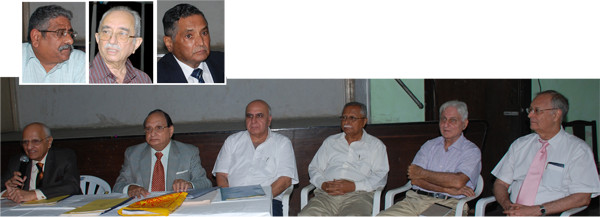
Below from left: Minoo Shroff, Dadi Engineer, Dinshaw Tamboly, Rustom Hormazdiyar, Ratan Lalkaka and Rustom Jasoomoney (inset) Dinshaw Mehta, Maneck Engineer and Burjor Antia
Though Parakh was silenced when there were general objections and insistence that only the candidates should speak, it may be noted that the octogenarian Hormazdiyar — a veteran who has presided, without any aspersion on his integrity, over innumerable BPP elections beginning with the Anjuman Committee (AC) elections of 1981 when he was appointed to the position by that orthodox icon, the late B. K. Bomanbehram, and the Committee for Electoral Rights (CER) came in with a landslide majority — has been a member of the BPP’s Housing Advisory Committee consisting of some well-known community activists. He had intervened in the case pursued by the AZA as amicus curiae in the CC’s court where the BPP was prevailed upon to grant about 70 flats to long pending deserving cases.
WAPIZ founder member and trusteeship candidate Khojeste Mistree demanded, "In all fairness record that where the president of the election and the scrutineers have sided with one side or another there is potential conflict of interest…This gentleman whom I’ve never met before is not suitable to conduct the elections.” In the interests of clarity it may be pertinent to point out here that Hormazdiyar is not (and has never been) a BPP employee as made out in The Times of India (September 12, 2008) report on the event.
While Adult Franchise for Progress (AFP) candidate Muncherji Cama disagreed, noting, "The president of the election under the scheme of the High Court has to be appointed by the trustees. This is not the forum to raise the issue,” candidates Farrokh Munsiff, Dr Viraf Kapadia and Phiroze Amroliwalla declared themselves against the appointment of Hormazdiyar. Amroliwalla hedged his criticism: "I have nothing against Hormazdiyar …He’s a very fair person. I do not have any objection … but it is relevant and important that if any one single candidate has doubts, he should step down.”
Candidate Dr Kuresh Zorabi raised the issue of a code of conduct for the elections which worried many of the candidates. "Has the High Court been informed of the dates of voting? Who takes responsibility for the ballot box over three weekends? Is there a cut-off date for electioneering?” he asked, applying normal political election practices to the community situation as "anything can happen” between the three weekends over which the election has been spread.
Shroff sought to allay his fears, noting that the president of the election and trustees of the Punchayet accept the responsibility. During earlier AC elections (in 1981and 1992) over 10,000 ballots had been involved, he reminded the gathering. "Everyone has to be vigilant. The issue is not controllable by the trustees alone.” As Zorabi who claimed some experience with political elections persisted with his reservations regarding "loopholes” in the BPP system, Shroff responded, "Malpractices are brought out by vigilantes bringing them to the notice of the president.”
Amroliwalla joined issue: "It’s your responsibility. You are responsible for the ballot boxes.” Davar interjected, "Get advice from an IAS officer who has conducted elections to stop malpractices. The Election Commission monitors every single naya paisa spent. There is a feeling that we are all floundering; 48 hours before the election the campaigning stops. If the election is over three weeks, when do you stop it?”
Invoking "past (BPP) tradition that campaigning goes on till the voter enters the booth,” Amroliwalla declared there can be "no compulsion or restraint on campaigning or expense. The Representation of People Act is not applicable to a trust.” Cama emphasized the primacy of the High Court scheme governing the elections. It does not have a clause restraining campaigning, he noted.
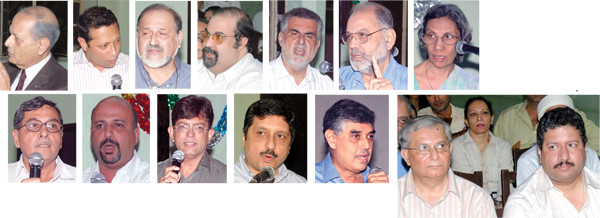
Top row from left: Candidates Nadir Modi, Jimmy Mistry, Khojeste Mistree, Muncherji Cama, Rustom Tirandaz, Phiroze Amroliwalla and Shirin Choksey; Bottom: From left: Dr. Syrus Irani, Dr. Kuresh Zorabi, Tehmtan Dumasia. Supporters: Maneck Davar, Sohrab Parakh. BPP’s Cawas Panthaky, CEO Mehli Colah
"This point has been debated by the trustees. We came to the conclusion that campaigning can continue throughout... The principles of natural justice and the principles of the Representation of People Act are applicable. Not the Act itself,” stated BPP trustee and noted solicitor Dadi Engineer, adding, "If all candidates agree, we could consider suggestions.” Trusts are not covered by the Act, clarified Shroff and Engineer.
Amroliwalla stated, "This consultation should have taken place before the elections were announced. We should have had a debate, ironed out differences including the appointment of the president.” Candidate Dr Syrus Irani suggested that the trustees be given more time to frame the rules for this first adult franchise election. "We shouldn’t fight over small points. Let the trustees decide over the next 15 days,” he said. "Let the tradition continue,” reiterated Amroliwalla. "It should continue,” interposed candidate Jimmy Mistry "because we would not be able to control door-to-door canvassing.”
"The elections have to be governed by the (High Court) scheme. If we seek to add to it now, we’ll be in trouble. Amend it later,” advised counsel Nadir Modi.
Idealist Tehmasp Mogul got to the microphone — "We all belong to the Parsi community. We shouldn’t argue over small points…decide on seven persons (as trustees) from among ourselves…” — and was reluctant to heed the trustees’ request to return to his seat.
Tehmasp Mogul addressing the crowd
Dinshaw Mehta, who came in late and joined his colleagues at the BPP table, vented his anger on AZA’s Kersi Randeria and three of his fellow trustees and long-term critics: "Randeria has filed (his petition with the CC) to remove me alone. Neither he (pointing to fellow trustee and election candidate Maneck Engineer who had been sitting with the audience and moved over to sit at the BPP table), Minoo Shroff or Dinshaw Tamboly can sit here because they have all been campaigning. They are a part of the AFP campaign team; they are AFP campaign managers.”
Stating that "this meeting is not going in the right direction,” Jimmy Mistry asked for "standard operating procedures in four to five days” from the Punchayet, adding, "We can respond to them in seven or eight days.”
"Let us have constructive suggestions. Please maintain decorum,” requested Shroff as the hall was abuzz with contentions apart from the arguments prevailing in the front section. Candidate Ervad Yezdi Panthaki tried to remind the gathering that "peace and harmony have been the hallmark of the community.” Panthaki’s "genuine questions” were fielded by senior BPP executive Cavas Panthaky:
How does the list of candidates feature on the ballot paper? Answer: Alphabetically, by first name, in English and Gujarati.
Is an identity card required (for old certificates which do not bear a photograph)? A: No.
What is the last date for collection of voter registration certificates? A: October 1, 2008.
WAPIZ candidate Bomi Kavina wanted to know what would happen to the certificates applied for but not collected by the voters. "How do we know they will remain safe with you?” "If there is general lethargy or people have relocated, what can we do?” countered Shroff. A suggestion made that letters be sent to all those who had registered but not collected the certificate was agreed to by the BPP.
"Cancel the names of those whose certificates have not been collected from the voter register,” suggested Davar. Reiterating his earlier suggestion that the uncollected certificates be dispatched by post, Amroliwalla pointed out, "Passports are sent by courier. The BPP certificate is no more valuable than a passport!”
In the midst of these concerns Kavina dropped another red herring: "Are you going to keep minutes (of this stormy meeting) and send a copy to the candidates?”
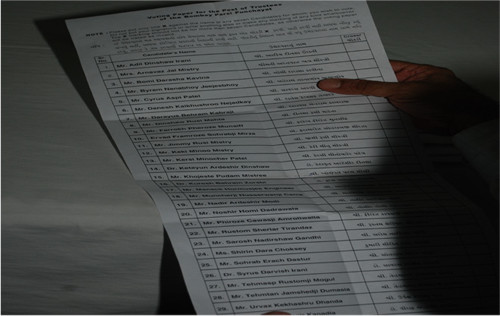
Sample of ballot paper
Highlighting a parallel concern regarding bogus votes, Kapadia stated that a donor member of the BPP had received a letter asking the person to collect his general register certificate.
"I sense a lot of hostility. We are not here for heat but for light. All of us want to prevent bogus votes, impersonation, ballot tampering. Note your suggestions and move on,” noted a somewhat exasperated Modi, adding, "It is easier to conduct government of India elections than BPP elections!” He listed his suggestions for conducting the latter which he also submitted in writing to the BPP:
The use of indelible ink, costly as it may be, to prevent the same voter from casting duplicate votes as the elections would be held over three consecutive weekends.
Have photo identity for old photoless certificates as the High Court had stipulated that new certificates must bear the voter’s photograph. Otherwise it would be a discriminatory practice "which no court will sustain.” He advocated the use of a passport, driving license, PAN card, election commission card, bank issued credit card or government issued senior citizen photo card and no other card for this purpose.
Where a duplicate certificate has been issued, and the original certificate is found later, the original should not be allowed.
Every care should be taken that ballot boxes are tamper-proof. Candidates’ representatives can keep 24x7 vigil to ensure ballot boxes are not tampered with.
Dinshaw Mehta’s suggestion that they be locked in a cupboard of the BPP, the cupboard sealed and the keys kept in the custody of the president was vehemently rejected by the gathering.
Cama "fully endorsed what Modi said,” adding that Mistry had compiled a list of duplicate and triplicate certificate holders. Hence "indelible ink was a must.” He also demanded closed circuit television (CCTV) surveillance at the polling sites and firm action against wrong doers. "Regarding the ballot box and storage, every candidate should be given a chance to sign over it.” While candidate and former BPP trustee Rustom Tirandaz felt that one "can’t insist on photo IDs for old people,” noting that his 92-year-old-mother and others like her had no photo identification papers, Cama supported the demand. "Clause 8 of the High Court scheme says every certificate will include a photograph. Older certificates do not carry photographs. From the spirit of the High Court scheme it is very clear that we need photo IDs for older certificates. Otherwise it is discrimination…(I) insist on it.”
Candidate Tehmtan Dumasia said he knew of a family where the ladies had got certificates in their maiden name as also in their married name. Amroliwalla seconded him noting that the same name appears more than once on the register.
AFP candidate Noshir Dadrawala suggested that ballot papers be printed at a national press known for its integrity.
Shroff bewailed the lack of indelible ink that would endure for three weeks. He was supported by Tirandaz: "No indelible ink except a tattoo will survive for three weeks.” According to Tirandaz there were duplicate certificates in the system because "people innocently thought that they need separate certificates as donors and as members of the general register. In every election (Tirandaz has stood for four BPP elections, in one of which he was successful, apart from his earlier forays in the Bombay municipal elections) at the eleventh hour there are lists of voters who are dead.” He sought such an addendum from the BPP. He also registered "immense confidence in the president elect of the election and in the ballot boxes requisitioned by the BPP…There are many lacunae in the election rules. (Ask) the chief election commissioner of Maharashtra to revise our rules. The most important thing is to clean up the electoral roll before the end of the week.”
"How will you filter donor votes from the general (register) votes? Will you have different colored ballot paper for each?” Amroliwalla queried. He was referring to the High Court scheme which allotted two votes per donor member as against a single vote for members of the general register. "At the time of voting how do we know that the general voter hasn’t been given a donor ballot paper?” He was told that the donor register is always maintained on a separate table. He was also in favor of a video recording of happenings at the time of voting as well as the presence of two representatives per candidate at the time of counting of votes.
"These are knee-jerk reactions. Standard operating procedures, in writing, should reach every candidate,” reiterated Mistry. A lady who identified herself as Ms Rabadi likewise demanded the rules "in black and white. Answer our questions so we all know what is the final decision.”
In the prevailing pandemonium, the gentle Arnavaz Mistry, an independent candidate who was invited to say her piece, had to wait a long time to get in a few words. "Voting should be transparency based …Parsis won’t cheat,” she said, urging people to vote for the best candidates.
◆ ◆ ◆
From the archive