
Zoroastrians Abroad
Spreading the good word
Public relations professional Jim Engineer talks of the need for communication skills to promote community causes
"The survival mentality is passé,” says Chicago based public relations (PR) professional Jim Engineer. "There are six associations in North America looking for funding for new centers…FEZANA (Federation of Zoroastrian Associations of North America) is seeking to set up its own office in Washington DC or New York. Chicago, New York, Toronto have been major centers. They have led the way, providing the constitution, ironing out sensitive issues. Now FEZANA is providing the base for small associations like in North Texas and Arizona. … You need energy to build a community center. But it is what provides information to kids growing up.”
Appointed chair of the FEZANA Public Relations Committee last January, Engineer’s primary goal is elevating Zoroastrian awareness, perception and reputation on the North American continent. "We are working hard with member associations and their respective media markets to increase and facilitate accurate communication about Zoroastrians in North America to the public at large. We help promote North American Zoroastrian Congresses and other FEZANA initiatives, as well as ensure accuracy in text books and media reports,” he notes.
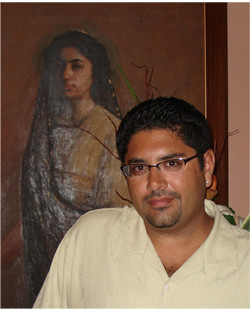
Jim Engineer: "Work through disagreements”
According to Engineer, the North American Congress in Chicago in 2003, aimed at "bridging generations,” helped to "take the torch forward.” The 40 to 50-year-olds now at the helm of affairs have set three priorities for FEZANA: to be more proactive, build and unify Zoroastrian communities in North America; make Zarathushti presence an integral part of the landscape; develop a viable infrastructure, notes Engineer.
Engineer feels that one reason why the community is floundering is because of ineffective communication, whether in North America or India. The other communities "don’t know who we are. They read once a year about how we are dying out” or about the dakhmas not working – "all negative issues.” He suggests the provision of regular news releases, the creation of templates to communicate effectively with the local Press. The issues that led to the resignation of four trustees of the Bombay Parsi Punchayet could have been so presented to the community as to create a consensus with respect and understanding from different points of view, without the resignation drama, he contends. A similar need to improve communication was pinpointed by the Doongerwadi controversy and the pictures that made the rounds. "There was widespread concern that an adjunct crematorium was required. People want a way to improve the process (of disposal of the body). In these days of instant communication, there is need to be proactive, to be well informed…package more news, cultivate the ability to work through disagreements… We have brilliant minds but politics (gets in the way).”
Appreciating the efforts of community activists like Homi Gandhi, president of the Zoroastrian Association of Greater New York, Rohinton Rivetna, founder president of FEZANA and Behram Pastakia based in Washington DC who have consistently represented Zoroastrians at interfaith meets as well as at the United Nations, Engineer says, their effort has been to "talk about ourselves, but there is not much awareness of who we are.” Now what is more relevant is to "take a look at what the textbooks write about us, respond to publishing houses and newspapers who describe us inaccurately. We must try to eliminate discrepancies in the public domain.”
Engineer sees Zoroastrian entry into public office in North America as another key to unlock awareness about the community among the local people. "Political office could help us advance our own causes. Communication is integral to an organization, for good things to be communicated to the population at large,” he believes.
The Iranians tend to view FEZANA as a very Parsi organization, feel left out at the organizational level in the associations, notes Engineer. "There is a large Iranian presence in Chicago but they don’t come (for the association’s events) except for a few stalwarts… On the other hand, Parsis think FEZANA is too liberal because of its inclusive approach!” Admitting to situations when Gujarati or Farsi expressions are interspersed when people are making a speech, he emphasizes that when "more Zoroastrians than ever before are coming in from Iran, we need to recruit more Iranians on our committees,” suggesting a need to overcome cultural and cuisine differences, to unify and celebrate what’s in both sections of the Zoroastrian community, in order to "face the strong Bible community in North America together.” Acknowledging the contribution of Iranians like Dr Jerry Kheradi, chair of FEZANA’s financial committee and philanthropist Mehraban Zartoshty who "have helped build the NA community,” Engineer states that FEZANA president Rustom Kevala also believes that there should be equal representation of both branches of the community by recruiting more Iranians to leadership positions to eliminate their "feeling of disenfranchisement.” Another way is through the use of the infrastructure provided by the World Zarathushti Chamber of Commerce (WZCC). "There are more successful businesses than ever before. Through the WZCC they can give back more to the community.” And business can be the bridge of prosperity between the old countries and the diaspora, he implies.
The son of Adel Engineer, a leading technical writer for EMI Medical, and Firoza (née Mehta) Jim was born in London but spent some time in Bombay as a kid, attending Blossoms School before the family migrated to the US in 1982. "In the UK they made fun of me because of my color and in India they made fun of my British accent,” laughs Jim. The family settled in the Chicago area and Jim completed his graduation in journalism from the Northern Illinois University. He worked with media and completed three internships with the Naperville Sun newspapers, Leo Burnett in advertising and Margie Korshak and Associates in public relations (PR) while he was in college which he says helped shape his professional career considerably.
"There is no such thing as complete objectivity,” he avers, pointing out, "you can bury a quote or show it up.” Having always loved writing and the media, he thought, "Why not write to promote, to influence?” He garnered six to seven years of experience in promoting industry, learning the fundamentals of marketing at Edelman Public Relations which he says is the world’s largest industrial PR firm, and during three years in Mellon Financial.
Then in June 1999 he set up his own firm, e-Rainmaker Public Relations, a boutique company based on Zoroastrian principles and ethics which promotes emerging technology companies mainly in the information security industry and has earned an award for innovative public relations from the Public Relations Society of America’s (PRSA) Philadelphia Chapter. He is happy he can devote resources to FEZANA, has the freedom to attend meets. "The freedom to do things on your own time and schedule is very empowering. It is very difficult when you are not making money,” he notes, recalling the years in the early 1990s when he was chair of FEZANA’s public relations committee under then president Dolly Dastoor. "Entrepreneurship is so important to success and growth; without financial resources nothing can happen.”
Engineer says he became conscious of the community’s polarizing issues at the Second North American Youth Congress in Chicago in 1988. He recalls that earlier he was "not allowed to comment or question basic things about conversion and acceptance.” Growing up with Rohinton and Roshan Rivetna as role models, he says he started writing in the FEZANA Journal column ‘Youthfully Speaking’ in 1989-90 and with Mazda Antia as co-chair started ZYNA (Zoroastrian Youth of North America) in 1995. The Second World Conference of Religions held in Chicago that year to mark the centenary of the first such event in 1895 "was an eye-opening experience” for this youth delegate. With Rohinton Rivetna as one of the prime organizers Engineer glimpsed the importance of interfaith dialog. "We shared an understanding of what we all believe.” He says it impacted his writing for the FEZANA Journal.
"Philosophy is so important to religion. Rohinton has taken such initiative, he has empowered future generations, paved the way. His goal is consensus. He wants to see middle-of-the-road progress,” and contrasts the scene in Chicago with the "edicts” in Bombay.
"Zoroastrians in North America are tied to rules and culture from India. (Some of them) are more traditional than people here. There are more women married out here…because Parsi boys left here are not considered capable of providing a good life,” he notes. This happens more often when kids are under compulsion to marry within the community, he avers, adding, "Those not forced have married Parsis out of preference.” But he contrasts the higher death rate in India with the higher birth rate in North America. "We are growing well. We want to reach out to Zoroastrians in all continents,” he says, adding, "Fundamentally, in North America the children of women married out are accepted. The rules from Bombay are only as good as can be enforced…The basics of the religion are lost and manmade rules dominate the conversion debate. The spirituality of the religion must be perpetuated.” Referring to out-married couples, Engineer says many of them want to make the connection with Bombay "to show the beauty of the religion to the spouse, but are turned out.” Engineer is wishing that the next generation of Bombay youth "realize it’s OK to question and share ideas and discuss. Without that you don’t have a truly democratic society.”
Though the mindset of most orthodox Parsis is that "we’d rather die than mingle,” Engineer respects leaders from both sides of the great Zoroastrian divide — Ali Jafarey, Kersey Antia, Khojeste Mistree — all of whom are "passionate about their beliefs.” He says he "can’t stand fence sitters.” Nonetheless, he feels the community needs to work on middle ground. "If you put your views aside and work for community interest, you can get a lot done.”
The interview with Parsiana on February 12, 2007 was held over the dining table in Jim’s grandmother Khorshed Mehta’s flat at Churchgate where a portrait of his maternal great-grandmother Perin Bhedwar dominates the room. Engineer recalls that his great-grandfather Sorab Bhedwar, a leading architect of his time, had built the Eros cinema and other art deco buildings in the locality. Jim is married to Kiku (Japanese for chrysanthemum), daughter of 12th degree black belter Pervez Mistry and Mehroo. Kiku sells Indian contemporary art in Chicago, Jim tells us. Their family includes Winston, their English bulldog.
"Things are moving in the right direction in India and Bombay (the Tata acquisition of Corus had been very much in the news at that point in time). Wish it were the same for Parsis!” He is convinced that "no one has the right to stop people from learning about us; you can’t deny, can’t excommunicate them. Jafarey and his followers are devout, committed people…they are operating in reality, accepting the situation, only adding different points of view. There is a huge middle ground because we cannot ever lose the Parsi tradition though we may lose people in Bombay.”
◆ ◆ ◆
From the archive