
Books
“Culture is a rainbow”
"Even today the Atash Behram in Navsari is a classic in terms of its architecture, layout — a ‘must see’ thing for Zoroastrians from abroad,” noted Bombay Parsi Punchayet chairman and management guru Minoo Shroff as he released Capt Hor-mazdiar Desai’s History of the Parsis of Navsari at the K. R. Cama Oriental Insti-tute’s (KRCOI) Dr Sir J. J. Modi Hall on June 12, 2008. He recalled the "great halcyon days of Parsi culture” when Navsari was its center for almost 600 years, spawning such community legends as Dastur Meherji Rana, Jamsetji Jejeebhoy, Jamsetji Tata, Dadabhai Naoroji and more recently, Shapurji Jokhi who donated crores of rupees to Bombay’s B. D. Petit Parsee General Hospital, adding that the book is a "good historical remembrance for days to come.” But he noted sadly that "none of the scions of these stalwarts have done too much…Their place of birth remains derelict.”
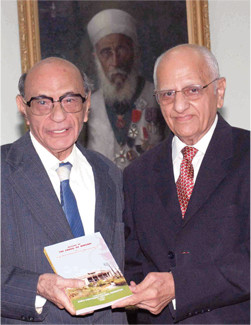
Above: Capt Hormazdiar Desai (left) and Minoo Shroff releasing book
The History has been published by the 10-year-old World Zarathushti Cultural Foundation (WZCF), set up by scholar Dr Homi Dhalla to revive the cultural dimensions of the community. The preservation and publication of books and libraries is one of its aims, the other activities centering round the archeological excavations in Sanjan, the preservation of the Bahrot Caves, the revival of the arts of calligraphy and kusti weaving, the singing of monajats and the inculcation of the Gujarati language in Parsi children, fast losing out to western/English cultural mores. The book is dedicated to the memory of Framji Hormusji Bomanji Settna and Maneckji Framji Settna thanks to a "very handsome donation” towards its publication by the trustees of the Framji H. B. Settna Legacy Trust (HBSLT), as noted Dhalla.
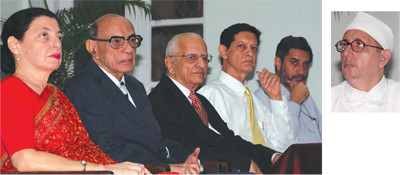
From left: Homai Modi, Desai, Shroff, Homi Dhalla and Rustom Vakil; Right: Ervad (Dr) Rooyintan Peer
"We imagine that we only came from Iran with our religion. But we also brought our culture. Culture is a rainbow whose one important strand is religion,” noted Dhalla. "Is globalization invading our culture?” he asked and stated, "But we find Indians everywhere trying to keep Indian culture alive in the younger generation.” It pains him that when he sought to acquaint the community with the fact that the Bahrot Caves, where the Iranshah fire was lodged for 12 years in the 14th century, are crumbling, "nobody, no trust was interested.” He said it took nine years and endless letters to the Archeological Survey of India (ASI) to do something for Bahrot. "Now the ASI has written to the Maharashtra government to build an access road to the caves.” The WZCF’s other major endeavor, the archeological finds in Sanjan, "throw immense light on our history.” Responding to Shroff’s comment on the lack of interest in the places of birth of the Parsi stalwarts, Dhalla announced that work on Jamestji Jejeebhoy’s home in Navsari was close to completion and the centre was scheduled to open later this year.
Desai welcomed Shroff, praising his "outstanding leadership and expert man management.” Attributing the success of the function to "Dhalla’s energetic steps,” the self-effacing author noted, "All I did was prepare the script and submitted it to him. I did nothing thereafter. May you continue to nurse the community,” he told the scholar. Continuing in similar vein Desai said, "It is easy to write a book but laborious to write the index” for which he was profuse in his thanks to scholar priest Ervad (Dr) Rooyintan Peer. The nonagenarian recalled Peer’s late "distinguished father, Ervad (Dr) Peshotan Peer who was always present at a function at this institute.” Desai who was the KRCOI’s trustee secretary for 16 years has an abiding interest in its functioning and complimented his joint honorary trustee secretary Homai Modi, who he described as his friend, philosopher and guide, as one living by "Zarathushtra’s philosophy of good thoughts, good words, good deeds, helping those who need help, supporting innumerable causes.”
Modi introduced the "friend” with whom she has interacted ever since her own inception at the KRCOI in 1982 as "very stubborn but a thorough gentleman, the likes of whom we do not see any more. It is my regret that he started his research work only after he left this institution.” Desai who has authored nine books has been a diligent reader and remains a source of knowledge and aid to the KRCOI staff. He used the occasion to graciously present two copies of his book to Modi and her devoted assistant Yasmin Khan.
Noting that "history is a link between the past and the future,” HBSLT trustee Rustom Vakil urged the audience to draw lessons from the past, extending his congratulations to Dhalla for highlighting various aspects of the community’s culture. Ruing the way its institutions have splintered, he noted that the time had come to put its funds and energies together for a common purpose and work in harmony towards it. "Our needs are greater, our resources scarcer” as education, old age homes, hospitals et al demand increasing commitment. "Let some agency be created to bring our resources together so that they are not frittered away” solicited Vakil and suggested that some chapters from Desai’s History be studied in Parsi schools.
A slick audio-visual presentation on the various on-going activities of the WZCF brought the evening to a close.
◆ ◆ ◆
From the archive