
In Memoriam
Commendable civilian
"I dedicate these last lines to you who are alive
After I have crossed the great divide:
Do not mourn for me as one who has gone
For I shall always be by your side.”
This verse was addressed by Barjor Behramji Paymaster, one of the seniormost members of the Indian Civil Service (ICS), to his daughter Deenaz Coachbuilder a few years before he passed away at the age of 95 at his residence in Bombay.
Till the end Paymaster kept himself busy: "He was passionate about books and read up to 2 a.m. every day. He had a rare collection of books… He also enjoyed chatting with his loyal friends… and kept himself abreast of happenings in the world,” noted a tribute by Rameshchandra Kanade in Harmony, November 2006 after the passing away of the former chief secretary to the Government of Maharashtra on November 5. Kanade also gave Paymaster credit for being "an outstanding individual, noted for his unimpeachable integrity and quiet efficiency... He was a very warm person, something that put others immediately at ease. He would recall with a remarkable ease his days in Sind and later in Bombay.”
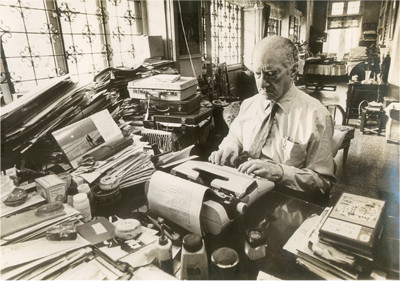
Barjor Paymaster in his study: "passionate about books” Photo: Girish Dikshit
Belonging to the ICS batch of 1934, he did one year probationership at the London School of Oriental Studies and on his return to India took up his first posting as assistant collector in Sind, then a part of the old Bombay province. In his account titled Some Experiences of a Civilian in Sind as reprinted in Enduring Legacy: Parsis of the 20th century — Vol II he wrote, "During the first years of my service I did not have a care and I did my touring on (steed) Alexander. This meant riding 20-30 miles day after day. Alexander was always game and seemed to be inexhaustible. I purchased a good Swiss cottage type of tent for Rs 400 and my caravan of seven or eight camels set out at night to the tinkling of bells, laden with the office kit, the office tent and my own baggage with the servants balanced on top…Heat, dust and sand pervaded everything in Sind.”
The only ICS officer who was transferred from the executive to the judiciary and then back again to the executive, for over four decades Paymaster took up responsibilities as assistant judge in Bombay and Sind, district and sessions judge at Sukkur, joint judge and additional sessions judge at Poona, district and sessions judge at Nasik. Although trained as an economist he had pursued his interest in law by joining the Middle Temple and completing the Bar examinations. In his words, "I had always had a bent for law and my magisterial work had throughout been commented on favorably by the High Courts. Further, under the British dispensation, a judge could afford to be more independent and enjoy a greater freedom of conscience than his Indian colleague in the executive. I therefore decided to opt for the judiciary.” During his years as a judicial officer in Sind he is known to have dealt with 250 session’s cases involving murder, dacoity or robbery.
"Then came a thunderbolt in the shape of a demi-official letter from the chief secretary…informing me that the then State Government (the Congress Government which included Balasaheb Kher and Morarji Desai) had taken a decision not to appoint ICS judges as High Court judges in future so would I agree to being shifted to the executive side and sent to Delhi for appointment as a deputy secretary in the central secretariat?” Paymaster refers to the Hobson’s choice in Some Experiences of a Civilian.
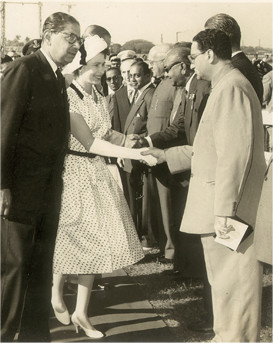
Greeting Queen Elizabeth
Photo: Counsic Bros.
Perforce he had to return to executive duties where he worked as deputy secretary in the ministry of works, mines and power, housing and supply in Delhi and later as joint secretary in the ministry of production. He was reportedly instrumental in drafting and getting approval to the Mines and Minerals (Regulation and Development) Act, 1948 and the Petroleum Concession Rules. He wrote a report on salt works and production. In fact when India attained Independence his posting was in Delhi. He felt privileged too to have been associated with Dr B. R. Ambedkar and Kakasaheb Gadgil, as reported in Eminent Parsis.
In Poona he worked as collector, later director of Local Authorities of Central Division, divisional officer and divisional commissioner. He was appointed chairman of the Ownership Flats Inquiry Committee whose report led to the passing of the Ownership Flats Act, served as secretary in various departments including home, and as additional chief secretary in the general administration department. He was a member and eventually chairman of the Services Board of the Reserve Bank of India and subsequently served as chairman of the ad hoc selection board of the Industrial Development Bank of India before he was made chief secretary to the Government of Maharashtra.
A father figure to many Indian Administrative Service officers, he had evoked the admiration of many of his juniors for his willingness to support those who had evoked the wrath of a minister. Former municipal commissioner of Bombay, Jamsheed Kanga recalled in Harmony, February 2007, "Once a minister reprimanded me because he did not relish my objections to his proposal.” When Kanga mentioned this to Paymaster, after studying the file he recorded a one-page note stating that Kanga’s advice was exactly as per the law and how he had always impressed on his officers to give their frank opinions fearlessly to enable the minister to make a wise decision.
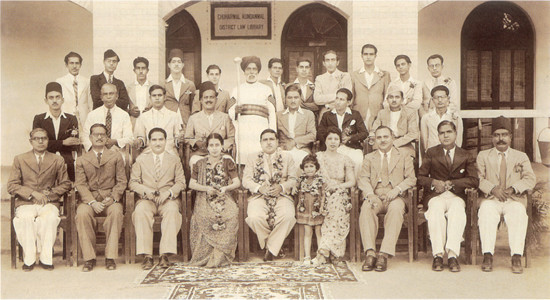
A group of civil servants and others in Sind (seated 3rd from left): B. B. Paymaster, Aloo Kapadia, Jamshed Kapadia and Freiny Paymaster
Photo: Enduring Legacy
"It is very rarely that one comes across a kind and understanding superior. I shall always remember with profound gratitude the warmth and the help that the chief secretary B. B. Paymaster gave me in my career in the services,” commented N. S. Kulkarni who was chairman cum managing director of Cotton Corporation of India, ministry of textiles in his article in Harmony, February 2005.
Certain police officers too would vouch for Paymaster’s shroud which protected them from unfair harassment and departmental enquiries by the Inspector General of Police. He had thus made "many devoted friends and colleagues who doted on him,” commented Kanga.
He prided himself on being able to state facts honestly, speak fearlessly and advise his ministers without any hesitation. "It was not as if there was no corruption. But it was not that bad. We could vouch for the integrity of many people. But can we say that now?” Paymaster had queried. At the time of his retirement he declared, "I had always spoken out my mind and never compromised with my conscience. I often found myself being overruled, but in my hierarchy, orders from above had to be obeyed, otherwise anarchy would result. Though I might not have been able to influence many important matters of policy, I could truthfully tell my colleagues that I had been able to prevent many grave injustices being perpetrated, and that too was some achievement.”
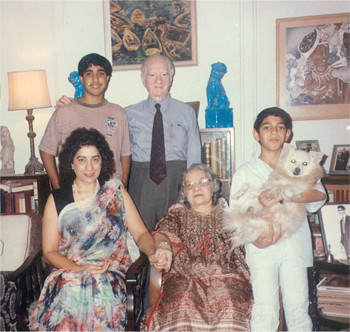
Paymaster with daughter Deenaz Coachbuilder (seated left), wife Freiny and grandsons
Son of a doctor in the British Army and grandson of a paymaster in the Navy, Barjor matriculated from Panchgani’s Billimoria High School, then studied in Deccan College, Poona and did his BSc in Economics with honors from the London School of Economics intending to make a career in academics. He was later made a Fellow of the Royal Economic Society.
"Often through long discussions at the dining table, ‘Let’s examine the pros and cons,’ or during walks through the wooded paths of Matheran, ‘What is poetry?’ my horizons were continuously stretched,” stated Coachbuilder in her Thanksgiving carried in the January 2004 issue of Harmony. Author of several books of poems, his deeply felt experiences and reflections were conveyed in The Last Farewell and Other Poems, Farewell Again and the two-volume anthology of poems The Human Predicament.
A respected philatelist of Bombay who had served as president of the Philatelic Society of India for 16 years, he donated his personal collection to the Postal Museum and as acknowledged Abdeali Haji, "He helped many philatelists and institutions to develop the hobby.”
The lover of arts had an impressive collection of Indian, Chinese and Japanese sculptures and handicrafts in metal, paint and ceramics. Even in his 90s he could effortlessly recall the age and antecedents of different pieces and enjoyed being in their presence.
His wife Freiny, daughter of Nawab Erach Yar Jung Bahadur of Secunderabad having predeceased him and their 22-year-old son Shahrukh having perished in a drowning accident in Mahableshwar in 1968, the humane officer is survived by his daughter Deenaz Coachbuilder.
◆ ◆ ◆
From the archive