
Comment
Queen of causes
Queenie Captain tirelessly raised funds for the National Association for the Blind and other projects
The doyen of social workers in Bombay, Queenie Captain will long be remembered for her splendid humanitarian work, assisting many deserving causes. When the National Association for the Blind (NAB) needed a capable social worker who could chair its Finance Raising Committee, Captain willingly took charge as she was already deeply involved in promoting the cause of the blind.
At a meeting of leading social workers convened in April 1956 at the Darbar Hall of Government House, Bombay, the then governor Dr Harekrushna Mahatab, made a prophetic statement: "I am sure the Finance Raising Committee will bring large amounts to the National Association for the Blind because its destiny is in safe, sound and strong hands.” The governor was not only paying rich tributes to Captain but also acknowledging and thanking her for her unsurpassed contribution in promoting several deserving causes in the city.
Captain firmly believed that the blind should not merely be given charity but should be helped to adjust to their blindness, given rehabilitation and training, leading to their self employment. She wholeheartedly supported the starting of a workshop for the blind. The first committee raising funds for construction of the workshop was chaired by Hirabai M. D. D. Gilder and raised over one lakh rupees. Thereafter Captain chaired the committee and raised a couple of lakhs. Even so, the amount fell short by nearly five lakhs. Captain thought of appealing to the then chief minister of Bombay Morarji Desai to sanction a special race meeting, the proceeds of which would go towards completion of the workshop building with residential facilities for the blind. She led the delegation to Desai who was known to be a stickler for rules. At first he pointed out the difficulties, but her gentle persuasion and convincing arguments won him over.
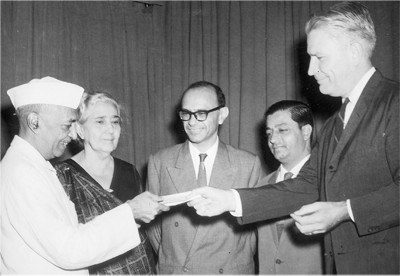
Shantilal Shah, law and labor minister of Maharashtra (ext left) receiving a cheque from P. Ritwick of the US Department of Health, Education and Welfare while (from left) Queenie Captain, Hormazdiar Desai and Lt Govind Nardekar look on
We raised nearly four-and-a-half lakh rupees from the Special Charity Race Meeting. This helped Navroji and Zal Gobhai to complete the Workshop for the Blind building at Worli.
Reading of Helen Keller’s proposed visit to Japan the author of this piece wrote to the director, American Foundation for Overseas Blind, that it would be wonderful if, on her return journey, Keller could spend some time in India. Prompt was the reply that she visited countries only when invited as a State guest. We then urged Pandit Nehru, the then Prime Minister to invite Keller as a State guest. His sister Vijaylaxmi Pandit was then India’s Ambassador in the USA. She too strongly recommended that Keller be invited as a State guest.
Keller’s visit took Bombay by storm. It was most successful in raising consciousness among the masses in India and awakening them to consider the blind — nay all persons with physical or mental disability — as their own with the State evolving an infrastructure for the rehabilitation and training of the disabled leading to their happy settlement in family, social and economic life of the community. During this visit Keller laid the foundation stone of the Worli Workshop for the Blind with Desai presiding.
The first chairman of the Workshop was Homi J. H. Taleyarkhan. When he was appointed India’s Ambassador to Italy by Indira Gandhi, Vijay Merchant took over for a brief spell to be succeeded by Captain who was greatly involved in the construction of the building. This was the first institution in Asia to train the blind in highly skilled mechanical and electrical operations. It is ranked internationally today as one of the finest institutions of its type in the world. An appeal was made to the trustees to name the auditorium there after Captain. This auditorium is in great demand by the public for marriages and for a variety of functions and meetings. It also ensures a steady income for the institution.
As leader of the Indian delegation to the General Assembly meeting of the World Council for the Welfare of the Blind held at Rome in 1959, Captain received the highest honor which the Council conferred, its honorary life membership. The citation read: "In tribute to your many years of devoted and faithful service to our common cause the world over and deeply mindful of the affection and esteem in which you are held throughout our profession, we now, in grateful acknowledgment, confer upon you honorary life membership of the World Council for the Welfare of the Blind.” A well deserved tribute to a great worker at the national and international level.
There were other causes too which Captain championed. During World War II she was chairman of the War Gift Fund Committee and the Lady Linlithgo Silver Trinket Fund Committee. Her services in promoting the welfare of our Jawans were greatly appreciated.
She was associated very actively with the Girl Guides movement from 1957 onwards. She rose from the rank of patrol leader to become the chief commissioner, Girl Guides, India. Early in her career, she took the pioneering lead in organizing a Girl Guides unit for blind girls of the Dadar School for the Blind.
As chairman of the prestigious Bel Air TB Sanatorium Funds Committee and chairman of the Cheshire Home Welfare Committee, Captain did a splendid job assisting patients suffering in their twilight years, rendering directly or indirectly, service to suffering humanity. To her, service to suffering humanity was service to God.
We all greatly enjoyed the meetings held at Captain’s residence. She was married to Homi H. C. Captain, chairman of the Central Bank of India, under whose able leadership the Bank made rapid progress with branches spread all over India. After the meetings, we had most sumptuous repasts. At one such meeting, Captain was requested to sing her favorite song Que Sera Sera. Her voice, even at an advanced age, was melodious.
Eminent social workers — particularly women — often work in tandem. Queenie Captain’s constant companion was Lady Jena Duggan. Where Captain was chairman, Duggan was invariably the honorary treasurer. Meticulous in keeping day-to-day accounts, Duggan was also reputed for keeping track of funds sanctioned and ensuring that they were used for the purpose intended.
Captain hand picked her workers. She knew precisely what work should be entrusted to whom. She always appointed appropriate committees, with the right persons as office bearers. The fund raising committee, the souvenir committee, the entertainment and publicity committees were some of them. She knew how to delegate power. Though Captain had not studied books on modern management techniques, she had inherent organizational skills, motivating all those who were privileged to work with and for her.
Sir John Cockcroft had rightly observed: "Human progress has always depended on the achievement of a few individuals of outstanding ability and creativeness.” Captain richly contributed to human progress in several fields. She believed with Voltaire that "happiness is a wondrous commodity; the more you give the more you get.”
To her service was love in action. She exuded love. She believed that wherever there is a human being there is an opportunity for kindness. "When love and skill work together, expect a masterpiece,” said John Ruskin. May India produce many noble souls like Captain so that suffering humanity gets substantial relief. Truly, Queenie was the queen of our hearts.
Capt Hormazdiar Desai retired from the Indian Administrative Service as joint secretary, finance, Maharashtra state. Thereafter he served many charitable causes, working as honorary secretary of the National Association for the Blind and as founder member of the National Society for Equal Opportunities for the Handicapped. He was joint honorary secretary and trustee of the K. R. Cama Oriental Institute and has been associated with religious institutions like the Anjuman Atash Behram and Sorabji Ranji Agiary as governing council member/trustee.
◆ ◆ ◆
From the archive