
Zoroastrians Abroad
Tombs that tell a tale
The mother-son Parsi duo in Burma are left with nearly 200 tombstones in their care
"I will like some parsis in INDIA to now about me. I will like have the histry of the parsis people book and photos because. I will like the (children) in Burma (current Myanmar) to now about parsis histry…I Request you to send me some more parsiana magazine books…” These excerpts from Jamshed JEE JEE Bhoy’s letters, sent by airmail to the editor of Parsiana, reflect his eagerness to establish contacts with the community as also his struggle with the English language.
In response to his letter dated August 13, 2013, Parsiana sent him some complimentary copies and five months later, on January 10, 2014, he wrote another letter, repeating every word that appeared in his earlier letter although it was neither a xerox nor a carbon copy. Alongside the complimentary closing in both the letters — "Your most obedienty and respectfully” — appears a rubber stamp reading "For The Parsee Fire Temple & Burial Ground Trusts” with "Managing Trustee” in the space below, to indicate that the signatory Jee Jee Bhoy holds this post.
In response to his letter dated August 13, 2013, Parsiana sent him some complimentary copies and five months later, on January 10, 2014, he wrote another letter, repeating every word that appeared in his earlier letter although it was neither a xerox nor a carbon copy. Alongside the complimentary closing in both the letters — "Your most obedienty and respectfully” — appears a rubber stamp reading "For The Parsee Fire Temple & Burial Ground Trusts” with "Managing Trustee” in the space below, to indicate that the signatory Jee Jee Bhoy holds this post.
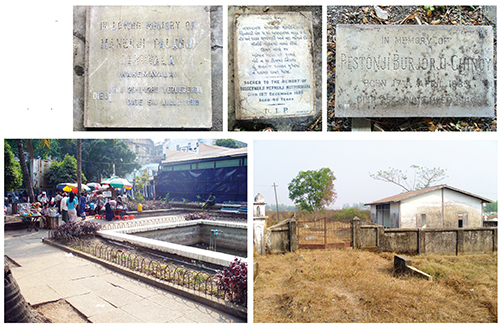
Tombstones in Rangoon;
site of old Parsi burial ground (left) and new burial plot that bears two graves
When Parsiana urged him to share details of his life, the community history and the condition of the Parsi properties in Burma, he responded by sending a copy of the article "Finding Parsis in Burma” written by Mitra Sharafi in Hamazor (Issue 1, 2007), the quarterly publication of the World Zoroastrian Organisation (WZO). He had approached some of the office bearers of WZO like chairman Sammy Bhiwandiwalla in London and Dadi Mistry in Delhi when he found their contacts in a 1981 booklet detailing the Organisation’s founding articles. Our attempts to get current updates have not been successful as Sharafi, assistant professor of law at the University of Wisconsin Law School — Madison, USA, revealed that her subsequent emails to him have generated no response. She knew though that a retired art historian of Southeast Asian temple art Donald Stadtner of California had interacted with Jamshed more recently. "He photographed some of the Parsi tombstones Jamshed cares for, and wanted to go back and do a proper, thorough documentation project” if he has the funds and time, stated Sharafi.
As related by Sharafi in the Hamazor article and the detailed report that she had submitted to WZO in 2007, Jamshed and his mother are the last two Parsis left in Rangoon(current Yangon) and Burma, neither of whom have been initiated as Zoroastrians although their two-room apartment had framed photographs of Zarathushtra hanging above two doorways. Jamshed, then 25, told her that he had learnt of Zoroastrian practices from his grandmother and accordingly he breaks loban and offers it before the fire when he prays.
Although it is common for non-Burmese communities to adopt Burmese names, as has Jamshed’s mother Boma whose Burmese name is Than Than May, Jamshed has not done so. Yet his family name Jee Jee Bhoy has been cut into three separate words in keeping with Burmese conventions. Rather than wear the longyi (lungi) as do most men in Burma, he has adopted trousers, observed Sharafi. Whilst he did odd jobs for a construction company in Yangon, his father Framroze who died unexpectedly of a heart attack at the age of 48, was a radio repairman. With no ancestral wealth, Jamshed, then 15, had to leave school to find a job to support his family which then included his mother and grandmother. Jamshed claimed to be the great-great-grandson of Merwanjee Cowasjee "Captain,” known as the "Grand Old Man of Burma” for his multifarious responsibilities as a first-class magistrate, a municipal commissioner and the one credited with leading the lawsuit in the famous Saklat vs Bella case that went up to the Privy Council.
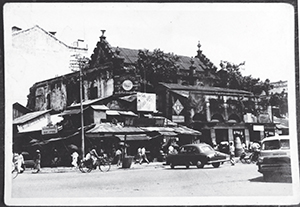
Rangoon fire temple in 1960
The fire temple in Rangoon, to which little Bella, the adopted daughter of Merwanjee’s brother Shapurji was denied entry, was destroyed prior to Jamshed’s birth, the afringan though is reportedly in his safekeeping. On the fire temple land occupying prime real estate in Rangoon, there now stands a four-storey apartment block of flats and shops, earning an annual income of $ 40 by rent, he told Sharafi. A group of Buddhists have allegedly encroached on a portion of the land by building a shrine and a supporting structure. To ward off further encroachment, Jamshed is keen to build another smaller structure on the plot that is owned by the trust should he be able to raise funds.
The old Parsi cemetery in the heart of Rangoonbeing confiscated by the government in 1995 with only two weeks’ notice, Jamshed and his father managed to save 150-200 of over 300 tombstones that are now stored at the new Parsi burial ground, on a one-acre plot on the outskirts of Rangoongiven to the Jee Jee Bhoys in exchange by the government, related the lone Parsi trustee. Jamshed would like to see these restored and reaffixed on the new plot, a job estimated to cost $ 150-200. On this site, until 2007 only Jamshed’s father and grandmother lay buried. He has erected a two-room structure and an open-air platform there and claims to maintain it from his personal earnings. He also referred to supporting 15-20 poor villagers living outside of Rangoonwho, according to him, have descended from a Parsi ancestor but have Burmese names and appearance, and do not observe any Zoroastrian practices.
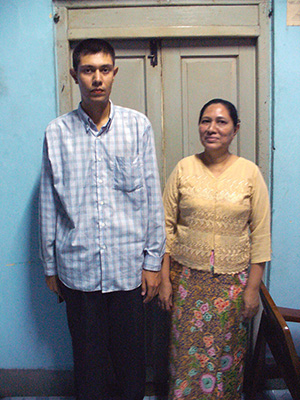
Jamshed and Boma Jee Jee Bhoy in Burma
On behalf of WZO, Sharafi had given him $ 300. Thereafter around three times a year he would send financial appeals to Toxy Cowasjee, editor of Hamazor. In response to Parsiana’s queries, Cowasjee recalled that two years ago when she and Aban Rustomji of Houston went to Burma, they were disappointed that after confirming the date and time of their meeting, Jee Jee Bhoy did not come to meet them but sent in his stead, his wife, sister-in-law and a man who could not speak English to collect money on his behalf. Stated Cowasjee, "Most people in Burma speak English, at least a smattering of it, and definitely comprehend quite well. These three were a total blank.” As conveyed by his secretary who spoke English, Jamshed had gone to another town. Realizing that the two ladies had, no intention of making any payment the secretary then called Jamshed on his mobile. On the phone, Jamshed once again reiterated his need for money. "I just told him that we were sorry but would be unable to help,” mentioned Cowasjee. She also stated that Shahin Bekhradnia of London had planned a visit to Burma in February 2014 and was hoping to meet him then.
◆ ◆ ◆
From the archive