
Zoroastrians Abroad
“Let the universe guide you”
Resident conductor of the Chicago Philharmonic Orchestra, Farobag Cooper speaks of music, prayer and community service
"The defining moment of an orchestra is provided by the conductor,” says Farobag Cooper, resident conductor of the Chicago Philharmonic Orchestra. "The musicians are all very proficient. (It depends on) how you motivate them, how you interpret the score. If you think the score is the blueprint, you don’t get much from it. The defining moment comes when the musicians are inspired. You see it in the eyes, in the body language. You need to look at each individual, connect with their soul.”
The Zoroastrian Orchestra that performed at the XIV North American Zoroastrian Congress in Toronto on July 1, 2007 had had a total rehearsal time of only four hours for the entire program, yet it delivered with a high level of proficiency, he noted happily the following morning.
The 60-piece orchestra had only 15 Zoroastrian musicians. The rest were professionals from the Toronto Symphony Orchestra. In Houston in 2000, the Zoroastrian Orchestra’s maiden appearance had included 25 Zoroastrian musicians, notes Cooper. On both occasions the funding had been provided by the Federation of Zoroastrian Associations of North America (FEZANA) though private funding too had a part to play in Toronto.
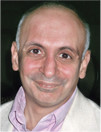
Farobag Coo-per: "retain the spark”
"In our community, though we have the wherewithal to involve our children in music, we don’t prod them to keep up their practice…Our community is professionally inclined in general. If music is imparted (along with the other fields of instruction), if they listen to music all their lives, it would increase their creativity,” says Cooper to whom "music is meditation.” He feels that pop music and rock culture — a feature of Zoroastrian youth today — impinges on their time to introspect.
Noting that "our bodies have a frequency — the heart beats at the rate of 60 to 72 beats a minute,” Cooper believes that music can control high blood pressure and various other ailments. But the healing needs to come from within and the spiritual part is lacking in the community in general, he feels. "We need to pray musically; every word in our prayers has resonance if you sing it,” he states, the fact having come home to him when he heard Ervad Jamshed Ravji pray. "When I heard him, I started to emulate him. The Gathas are songs of the divine. Therefore Parizad Irani’s Suite from Zarathustra is so apt…She is a fabulous composer with a spark of the divine. She has far to go.” Cooper, a behdin, wants to be a paramobed and says, "To pray is to impart blessings. In turn they come right back to us.”
Cooper is keen to bring a group of musicians to perform in Bombay, Delhi, Karachi. He had wanted to take an ensemble to Karachi as a sign of togetherness after the earthquake that devastated Sind a few years ago, but the project fizzled out. "If I can get a couple of Zoroastrian kids to come to the concert and listen, get a spark into them…It is so very important to reach out.”
Son of the late Homi whose career lay in banking and finance and Perween, a retired homeopath, Farobag came to North America in 1964 when he was all of seven years old. He recalls that his kindergarten school teacher at the convent in his native Karachi had noticed his attraction for the piano and told his parents he could have an affinity for it. His dad started him on piano lessons and did not stint on them when the family came to New York and later relocated in Connecticut. In course of time he studied at the Eastman School of Music in Rochester, New York, specializing in the piano though he also took philosophy and mathematics alongside. Thereafter he realized an affinity for theory, learning how music is composed. "You have to have a foundation discipline plus inspiration to write music, gradually conceive new creative venues. That is why there are not too many great composers,” he tells us.
From 1981 to 1984 Farobag was conductor of the University of Chicago Wind Ensemble. In 1985 he was appointed conductor of the Chicago Philharmonic. Music has also impacted the life of his sister Piroozi who plays the oboe professionally in New Jersey. His other sister Roshanee is a nurse in California.
The Chicago Philharmonic performs once a month during the season, September to June, notes Cooper. There are 11 soloists who are master players and the programs may also be renditions of chamber or baroque music. During the summer months the musicians go away to participate in the various music festivals in the country.
"Zoroastrian soloists are top rated but they need an outlet to propel themselves into the professional world,” says Cooper, adding, "It is very hard to make a mark initially.” He refers to soprano Tara Jamshidian who already has a degree in musicology and the 20-year-old soprano and beauty queen Meher Pavri, a student who wants to go into music professionally, saying he will help them as best he can. Cooper also speaks about tenor Dinyar Vania who received the Dinshaw Joshi Memorial Award for Excellence in the performing arts at the Congress. The young soloist from Chicago is built on the massive lines of Luciano Pavarotti. Cooper tells us that space in the body is crucial for the reverberation of sound. There is also Sorab Wania, the tenor vocalist who had performed in Houston along with Cooper. Wania has a part to play in the stage musical Oklahoma, says Cooper, adding, "My vision is to inspire all of them.” His own field as an orchestra conductor is a highly competitive one, "harder than being an instrumentalist” to break into, he tells us.
Married to Ashees (née Bhada) in Karachi in January 2006, Cooper realized his dream of getting a Zoroastrian wife. "It started on e-mail, progressed on Yahoo messenger and gelled when she came to Chicago,” he smiles. He says they have a vibrational link — not infatuation: "love emanates from the soul.”
Zoroastrians as a community "need to define their objectives, search within if they’re on the right track,” says this "proponent of Zoroastrianism” who believes that by "refining your course you can make a vast difference.” Noting that egotistical attitudes breed problems rather than bonding, Cooper says he admires the way Hindus have bonded together, creating "multivalue temples.”
"Many of us are not doing enough for our community,” continues Cooper, but he also refers to the "inertia and static if not outright condemnation” which faces those who volunteer to work for the community. Having served as treasurer for the Zoroastrian Association of Metropolitan Chicago for two years, he says he felt "burnt out” at the end of the term. "Many are not ready for a new approach…Associations are based on the premise that we must support each other and our children but with so much infighting we have to see if succeeding generations will be able to do anything with the dar-e-mehers. We have to progress, from elder statesmen to younger generations. We have to give them a chance to make mistakes. Every mistake is a learning situation. In any field one learns on the job, through mistakes. (We need to) retain the spark while redefining the field.”
Decrying the "modern American culture” with its disregard for older people, putting aged parents into nursing homes, Cooper upholds the need for care, for learning from all cultures and is "sad” that many Zoroastrian youngsters tend to veer in the wrong direction. He is also a strong proponent of an inclusive society where the young and old, Iranians and Parsis can co-exist respectfully. "People are wary of each other because of differences of language, cuisine and culture. But we too are of Persian descent. It doesn’t hurt to examine our values.”
Harking back to his happy, personal experience, Cooper says, "Let the universe guide you. Like I wanted a Zoroastrian wife. If you relax, things come to you…”
"Doing right the first time”
"Dear High Achiever, Congratulations! As a result of your excellent academic progress, we would like to invite you to become an international ambassador for UWS (University of Western Sydney) by participating in the UWS International Exchange Program… Currently, UWS Exchange Programs extend to almost 100 universities throughout North America, Asia, Europe, Scandinavia and the United Kingdom,” wrote Prof John Ingleson, deputy vice chancellor, Division of International and Development — UWS to Dr Sharouk Anklesaria who has just completed his masters in public health with distinction from the University of Wollongong in New South Wales, Australia.
Anklesaria, 37, who had completed his postgraduate diploma in gynecology and obstetrics (G&O) from Dublin University’s Trinity College, standing at the top of his class in 2005, had earlier earned encomiums from the head of the G&O department of the Christian Fellowship Hospital in Tamil Nadu.
What made the son of Furdoon and Homai Anklesaria of Bangalore who has been in the G&O field for some time now, change track and go into public health administration? "As a medical student being exposed to health care being provided in government hospitals and later in mission hospitals in rural India,” Anklesaria tells us that he amassed some valuable experience. "In mission hospital work I witnessed some outstanding work being done. Here were highly qualified, extremely competent doctors practicing amongst the poor for a small fraction of the salary that they might have earned had they chosen to work in big cities. The work was incredibly hard, some of the doctors and nurses were incredibly conscientious, the pay is minute, but the rewards and the sense of achievement enormous — up to a point. Nothing can diminish, in any way, the tremendous sacrifice being made both by doctors and nurses and their families who of their own will have chosen to do missionary work amongst the poor and offer very good medical care. But I felt that better health outcomes could be achieved if more efficient hospital systems were built into place,” writes Anklesaria in response to Parsiana’s queries.
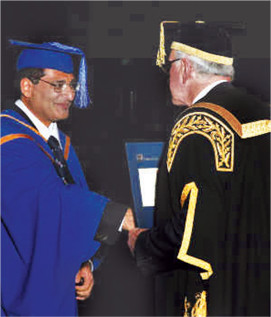
Sharouk Anklesaria (left) being felicitated by the University Chancellor
This belief, he says, has been strengthened by his study of "the pristine structure of the human body” during his time as a teacher of human anatomy at the Christian Medical College, Ludhiana in 1998 where, he notes, he was very happy and greatly loved by his students who to this day remember him fondly as he was able to "make them see meaning in what was otherwise a dead subject.”
Anklesaria believes that everything in the body is there for a purpose: "Structure begats function down to the tiniest detail. The myriad functions that the human body can perform stem from the most perfectly engineered structure of its bones, muscles and tendons, organs and so forth.”
Why couldn’t the same principle be applied to the proper functioning of
hospitals? he wondered. "Would perfect functioning in hospitals follow perfect structuring and lead to better health outcomes? This is a question that grew large on me with every passing year as I gained more and more in experience. Mistakes occur, people get hurt. Then there is an inquiry and nurses, doctors and other hospital staff get blamed, reprimanded, punished… Another
person comes in, some time later, and guess what — the same mistake happens again. Another patient gets hurt. Most often it is good people trying to do
their best (or others behaving rashly) who achieve bad outcomes because they
are functioning within an ill-constructed system.”
Anklesaria states that he took up public health in Australia with a focus on hospital management as he was convinced beyond any doubt that quality in healthcare is highly profitable both in terms of health outcomes and monetary profit. "What is costly — very costly — is a poorly managed system that allows bad medicine to be practiced,” he writes.
"Thus my aim now is to specialize in hospital management and focus on quality management in healthcare. And then put all this theory into practice to construct a sound hospital system.”
Anklesaria’s hopes to work with an international organization such as the World Health Organization or the United Nations Children’s Fund which will give him the power and the means to implement useful changes in medicare even in the face of almost certain opposition to change. He writes, "All my time and effort here is being spent in learning how to do things right, and do them right the first time.”
◆ ◆ ◆
From the archive