
History
Conversion by the sword
For a hundred years the Iranian monarchs warred unsuccessfully to convert Armenian Christians to Zoroastrianism
Conversion by the sword was not the prerogative of the Christian crusaders or the followers of Islam. Zoroastrians also took to battle to ensure the spread of the religion.
This little known past, as far as the majority of Zoroastrians are concerned, is an important part of Armenian history. Nuvart Parseghian Mehta, an Armenian Christian married to a Parsi, the late Nariman Framji Mehta, writes of the battle in her autobiography Short Stories from a Long Life: "There was a bit of (a) hue and cry to my marriage from my family, devout Armenian Christians. They remembered the religious wars of the fifth century in Iran. Zoroastrianism, the faith of my husband to be, and Armenians had clashed in the fifth century when the former tried to convert by the sword. The enemy was 220,000 strong. Armenians mustered 66,000 soldiers. The general, Vartan (or Vardan), in spite of a small army, saved the faith. To this day he is honored as a saint in the month of February.”

Vartan: Armenian savior
Courtesy: armenianhistory.info
As the Encylopaedia Britannica (EB) notes, Shapur II resumed a policy of fierce intolerance toward non-Zoroastrians which had been initiated by the high priest Kartin in the reign of Bahram I and singled out Christians for fierce persecution. He "sought to unite his empire by enforcing Zoroastrian orthodoxy on frequently unwilling subjects,” states EB.
Scholar Alan Williams in his article "Zoroastrianism and Christianity” (published in A Zoroastrian Tapestry) states that accounts of the persecutions are known from the Christian Syriac "Acts of the Martyrs” detailing 29 martyrdoms during the reign of Shapur II. According to these texts Shapur and Mobad Adurbad hounded the Christians ruthlessly in the last 40 years of his reign (339-379 CE — Christian Era).
The second period of persecution according to Williams was during the latter years of Yazdegird I and in the early years of his successor Bahram V under the influence of the infamous Mihr-Narseh, PM, Commander-in-Chief and scourge of the Christians.
Under Yazdegird II (439-457 CE) there was a spate of persecution in 446-448 CE followed by the attempt, most unusual in the history of Zoroastrianism, to convert Christian Armenia to Zoroastrianism by force, says Williams.
Bloody history
Nestled between Georgia on the north, Azerbaijan on the east and Turkey on the west and south, this 11,500 square mile country has a bloody history.
Alternatively plundered and occupied by both Rome and Persia for almost 1,000 years, the Armenians are descendants of a branch of the Indo-Europeans, according to the Greek historians, states EB. The Armenians as "represented by the ancient Greek historians Herodotus and Eudoxus of Rhodes (are) related to the Phoygians who entered Asia Minor from Thrace.”
According to the website armen-ianhistory.info: "Immodestly, Armenians consider themselves direct descendants of Noah, survivors of the Biblical flood. According to Genesis, the boat came to rest on a mountain in the Ararat range. Ararat, located in the heart of Armenia, was a holy mountain for the peoples of the ancient world. Many ancient scriptures placed the Biblical Garden of Eden in the Land of Armenia, also called the Land of Ararat.”
The Armenians warred with the neighboring Assyrians till the Assyrians were destroyed by the Medes. "Some 50 years later, King Tigranes I in alliance with Cyrus the Great, founder of the Achae-menid dynasty, conquered the lands controlled by the Medes and reinforced the Armenian kingdom.” armenianhistory notes, Persia ruled over Armenia from the sixth century until the fourth century BC. Its culture and Zoroastrian religion greatly influenced the spiritual life of the Armenian people who absorbed features of Zoroastrianism into their polytheistic (belief in a worship of more than one God) and animistic (attribution of conscious life to nature or natural objects) indigenous beliefs.
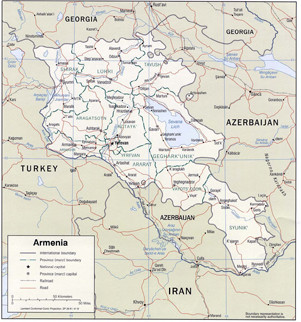
Map of Armenia
Courtesy: www.lib.utexas.edu
The armenianhis-tory continues, "The era of peace ended as a number of weak and insignificant kings ruled Armenia over the following years, and finally the country became tributary to Persia. An inscription on a rock (around 520 BC) called the Behestun Stone, found in Iran, mentioned Armenia in the list of countries Darius I controlled... the kings of Armenia were henceforward anointed by the Persian kings. During the following centuries the Armenian cavalry was well known for its valor. Vahe, the last offspring of the Hayk dynasty, was killed in 331 BC, fighting for Darius in a battle against Alexander the Great... Armenia regained independence after the death of Alexander the Macedonian.”
But by 69 BC the Romans advanced into Armenia and by 55 BC Armenia became a vassal state of the Roman Empire.
But the Armenians fought back and transported their kingdom to the city of Edessa. From here the ruler Algar heard of Jesus Christ and invited him to Edessa. Christ declined the invitation but his followers visited Edessa, narrates armenianhistory.
By 301CE "King Tiridates established Christianity as the sole religion of Armenia... Thus Armenia became the first Christian state in the history of the world,” notes the website.
"The adoption of Christianity put an end to the pagan traditions and abolished the secular fine arts and poetry. The Persian influence was still very strong in Armenia, but now Armenia and Persia worshipped different Gods. The political consequences of the evolution were tragic. A series of wars weakened Armenia during the rule of Arshak II. The Persian King Shapur II succeeded in sowing discord between Arshak II and his principal feudal lords, called Nakharars. Some of the lords defected to Shapur. The Armenian King was summoned to Persia and then imprisoned for life in the Castle of Oblivion. His wife, Queen Parandzem, led the Armenian defense in the Artagers castle, but after 14 months of siege was also imprisoned, taken to Persia and then killed,” says armenianhistory.
Historical first
Once Armenia lost its independence, over the next 200 years the eastern provinces were ruled by the Persians. "A number of insurrections took place during that period,” states the website. "The most famous among them was the so-called Vardanank, War of St Vardan in 451... The Persian King Yazdegird II tried to put an end to Christianity in Armenia, and to disseminate the doctrine of Zoroaster. Armenians revolted when the numerous Persian priests were sent to Armenia to build temples and conduct fire worship.
"On May 6, 451 a horrifically bloody battle took place (at) Avarair... Sixty-six thousand Armenians heroically fought the overwhelmingly superior Persian troops. Most of the Armenian lords including St Vardan fell in battle, but Armenia undoubtedly won a great moral victory. Over 60 thousand Persian soldiers were killed, and Yazdegird’s hopes were dashed. That was the first known war for Christian faith in history.”
The website mousaler.com/armenia also refers to this battle between ‘Yeze-gird II’ and the Armenians:
"When the Persian King Yezegird II (Hazgerd II) ordered the Armenians to become Zoroastrian fire worshipers, they replied: ‘No one can dislodge us from this faith; neither angels nor men, not even the fire or the sword or any horrible torture... your sword and our necks.’
"When Vartan Mamikonian, the Commander-in-Chief of the Armenian army, led his men to the battlefield of Avarair, in Ancient Armenia, he drew his sword and declared: ‘In the name of our Fatherland and our Faith, forward.’ At his side was Ghevont Yeretz, cross in his hand. Yeretz was the representative of the Armenian Church.
"Among thousands who were destined to make the supreme sacrifice was the chief defender of the faith — Vartan Mamikonian himself. The sacrifice however, was not in vain, because thereupon the Persians renounced their plans to convert the Armenians by force.
"The Armenians lost the unequal battle, but secured...the survival of the Armenian race and its religion — now the oldest Christian nation in the world.
"In 885 CE the kingdom of Armenia was reestablished under Ashod Pakraduni, who was followed by Gagik Pakraduni (989-1020 CE). The Pakraduni kingdom ushered in a golden age in Armenia in which culture, learning, trade and commerce prospered, but there followed a new conquest and the Armenian kingdom once again came to an end.”
Thus it can be seen that Zoroastrians went about converting others regardless of whether they were Mazdayasnis or not. The orthodox argue that Zoroaster ‘converted’ Mazdayasnis and no one else into Mazdayasni Zoroastrian faith. Hence the religion was a closed shop. But the Armenian episode (and there may be other such examples) indicates that even those with polytheistic and animistic beliefs were converted. And when they in turn converted to Chris-tianity, the Zoroastrians took up arms against them.
History shows that while there were periods when Zoroastrianism flourished, the religion was not able to hold its own against Christianity and, later, Islam. An analysis of that failure may be a worthwhile undertaking to ensure that the mistakes of the past are not repeated with the few remaining followers of this ancient but vulnerable faith.
◆ ◆ ◆
From the archive