
Politics and Policy
"An integrated personality"
Aside from possessing all the required personality traits, a trustee has basically to follow the wishes of the settlors
A trustee, by definition, is a male or female member of a board, given possession of property, with legal obligation to administer it solely for the purposes specified. In other words, a trustee is one of a team of members required to possess team spirit, syntality (togetherness), cordiality, a cooperative attitude and coordinating skill which, in short, means having solidarity among the members. The basic elements of solidarity are identity of interests, clarity of vision, honesty of intent and oneness of purpose, without which the team cannot function fully. These are the bare minimum qualifications to look for in a trustee.
The second half of the definition, namely, possession of property with legal obligation to administer it solely for the purposes specified clearly indicates that a trustee is appointed in good faith to administer the property for a stipulated period of time. Further, the trustee is legally obliged to follow verbatim the will of the proprietor and is not at liberty to manipulate it for any other cause. He must respect the terms and conditions of the trust deed and keep reminding himself that he has only to administer the property while in office, for the specific period of time.
We will now consider what the requirements of a Parsi Punchayet trustee would be in terms of education, professional standing, qualities and experience to hold the prestigious office as an akabar.
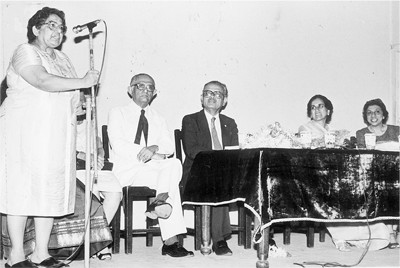
Mehroo Bengalee addressing a gathering when she was a BPP trustee
The individual must be a faithful Zoroastrian, following all the religious diktats of the Prophet, praying twice a day, wearing sudreh and kusti and having a fair knowledge of the rites and rituals of Zoroastrianism. He should be leading a good moral life woven round good thoughts, good words and good deeds, holding respect in the community, and living in peace and harmony with the neighbors. He should know the high priest of his locality and be willing to discuss religious problems with scholars of repute. He should be a known figure in his locality, helpful to all around him, with a kind demeanor and deep concern for the needy, aged, handicapped and bedridden.
Regarding qualifications, he should have acquired a high position in any field of activity, holding a respectable occupation worthy of emulation. He must possess maturity and be congruent, not laboring under any problem himself. To the extent that he has sincerity of purpose and transparency, he can resolve the problems of others, easily and successfully. He must develop empathy and understanding for all who come to him for advice and be an active listener, giving all the time that is expected of him. He cannot be high-handed or rude or misuse his powers in any way, however small the person he may be dealing with.
He must play a leading role in community matters and be looked up to by members of the community. He must play a proactive role rather than interactive, initiating a number of welfare activities for the young and old alike. He must give justice to all the different committees that he may be heading and prove an asset to the board, as a whole.
He should be able to work out a five-year plan for the all-round progress of the community, considering the current problems faced by it with regard to education, employment, marriage and nurturing family ties. He should be concerned with the health of the community, both physical and mental, and plan ways and means of eradicating known ailments among Parsis.
He must exemplify an impeccable character, with active and creative mind, be a role model for youngsters, be humane in all his dealings and lovingly kind in behavior. He must have a positive attitude towards all his fellowmen, be caring and concerned for their welfare.
A trustee must be an educated individual, emotionally balanced, courageous and committed in spirit, curious and critical in thought and creative and caring in action — an integrated personality.
It is indeed tragic that: "With all the resources at our command,/With all the gifts with which we are endowed,/With all the powers that we have developed,/With the traditions of good will with all the communities,/Yet we are unable to live in peace and harmony.”
May Ahura Mazda protect and guide us always.
Former vice chancellor of the Bombay University and erstwhile member of the Maharashtra State Minorities Commission, Dr Mehroo Bengalee is the new Zoroastrian member of the National Commission for Minorities. Previously a trustee of the Bombay Parsi Punchayet, Bengalee was also founder member of the orthodox World Alliance of Parsi Irani Zarthoshtis.
◆ ◆ ◆
From the archive