
XIV NAZC
The game of sink or swim
Every successful entrepreneur fights frustration before he succeeds
"We are all sitting on a pool of talent. Rohinton Rivetna thought about the WZCC (World Zarathushti Chamber of Commerce) and its network. We need to use our talents to advantage. As individuals we are far too educated and therefore not able to dovetail into the ideas and talents of others. We have to share skills and be ready to accept the skills of others…Learn to manage opportunities; it is the first step in managing business.”
President of the WZCC international board Bomy Boyce shared the organization’s global perspective and motivation at the full day event organized by WZCC Ontario at the Sheraton Parkway Toronto North Hotel and Conference Centre on June 29, 2007. The program, aimed at firing young graduates and community members disenchanted with working for others, was a mix of talks and interaction. A business simulation game to explore the community’s entrepreneurial potential was facilitated by Andrew Reid of Big Fish Interactive, one of Canada’s leading trainers in innovation, management and entrepreneurial development, as described the WZCC news release.
Zareen Karani Araoz, on the WZCC international board as director for global external relations and manager of zchamber, the e-communication arm of WZCC, started the ball rolling: "What is your passion, your dream? How can you help the WZCC? How can the WZCC help you?”
"Most of us are those who have received in life. We are now at the stage where we can give. It brings us here to see how we can contribute to the prosperity of the community,” responded WZCC director and former Federation of Zoroastrian Associations of North America (FEZANA) president Firdosh Mehta. Most of the North American directors on WZCC’s international board present that day proffered help: Natalie Wania Gandhi, a founder member of the Chicago chapter who has now moved to New York, offered her experience in entrepreneurship and investment; realtor Russy Gandhi, founding chapter chair of New York offered help with investment in properties; Hosi Mehta, successful entrepreneur and president of the Zoroastrian Association of Metropolitan Chicago offered to help with getting a business idea across and was willing to provide mentorship, inspire confidence; former president of FEZANA Framroze Patel, said to be the only Zoroastrian in the American Institute of Business Appraisers, offered his accounting skills; Rustom Engineer of Texas described himself as a "franchise consultant” who helps people find the right type of business, puts clients in touch with the right people; cinema owner Alayar Dabestani with 20 years’ experience in the field in 100 locations said he is now trying to get out of the theater business but professed willingness to help others get in.
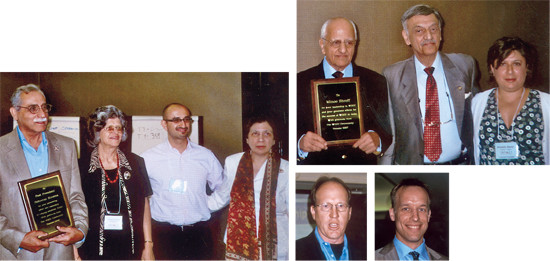
Above: Rohinton and Roshan Rivetna, Sam Meer and Zareen Karani Araoz ; Top right: Minoo Shroff, Bomy Boyce, Armaity Bamji ; Bottom right: Steven Gedeon and (right); Andrew Reid
Disappointingly, there were only two people who expressed a desire to do something new. Garage owner Hosi Mehta said he would "love to start a school to teach people how to think in the right way, (provide) basic principles to follow in everyday life.” Young architect Cyrus Rivetna professed a "passion to design beautiful buildings – especially, appropriate Zoroastrian community centers in North America, build at least one fire temple.”
"How can we make WZCC dynamic?” queried Araoz and the Big Fish took over after a brief introduction from Ontario chapter chair Sam Meer. Promising some "black and white moments” in the game of sink or swim, Reid, who had started working in a hardware store at the age of 14, enunciated his basic idea: "What do I need to be optimal everyday?” Noting that maximizing one’s resources, including people, is "one of the trickiest things,” Reid asked, "How do you estimate your potential?” adding, "You can’t be super successful alone.” So the next question was "What kind of dream team do you need?” and the advice, "Trust and support the people you are connected to.”
Noting that everyone has a certain area of capability in which one is comfortable, Reid advocated the need to push those boundaries, recognize that "edgy feeling,” which can lead to exponential growth once the optimal state is achieved, for "so long as you stay safe and comfortable, nothing can be achieved.” Very often, frustration dogs the entrepreneur before he becomes successful, cautioned Reid, but one who has "a template of needs and a hunger for getting those needs fed,” can make it to the promised land. An intense sportsperson has the mindset for taking risks, a facility one often brings to business. There is also the need to complete things. A successful entrepreneur gives his team members the freedom to complete their projects, he added.
Between coffee break and lunch the audience was organized in teams of eight and given time to create a start-up business where they competed with other teams to develop business plans, marketing strategies, take production decisions, negotiate contracts and win market share in a fast moving environment. Of course, the entrepreneurs among the audience had a head start. The game, preceded by visuals, also worked as an icebreaker, as novices and professionals rubbed shoulders in the effort to maximize paper profits.
At the end of the hectic parlaying Reid emphasized some of the lessons the game sought to teach. Beginning with the need for focus and clarity, he noted patterns of behavior and choice — whether, for example, one holds on to the line of action initially adopted or switches to another. "If clarity (to see one’s path to the defined goal) is missing, the entrepreneur will replicate the same mistakes.” Being able to accept the challenge of fresh thinking, cultivating the gift of foresight, the ability to decide whether what one has is sustainable or not, a willingness to share the pie with others, were some of the personality factors that could make or break an entrepreneur, noted Reid. Out of box thinking and the ability to relinquish even what was originally deemed essential, were other attributes of a successful entrepreneur, according to Reid. "Be prepared to seek help — it is easy to get marginalized. Skip conventional wisdom: it is only a reference point. Successful people write their own story.” Alluding to a picture of two people balancing each other on a tight rope flashed on the screen earlier, Reid noted, "Edginess can be a life enhancing experience.”
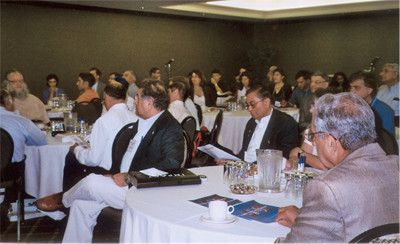
Avid listeners — or entrepreneurs in the making?
Concluding this part of the program Meer, vice president of Devencore Realties Corporation Canada, a worldwide broker in real estate, noted, "You don’t get what you deserve; you get what you negotiate. Ask for it and fight for it. Remember, you don’t get it if you don’t ask for it!”
In the post lunch session Boyce spoke about his interface with WZCC’s chapters in India as well as individual entrepreneurs, urging the international community to connect with each other "not only in terms of concepts but of practicality.” Referring to the recently established Calorie Care — a concern aimed at providing individual meals within a personalized health framework set up in India by Cyrus Driver — Boyce noted that a venture capital firm had taken a minority stake in the firm. (Driver of Calorie Care later told Parsiana that the investment by Culbro was enabling him to expand his operations into Bangalore and Delhi.) "Can we transpose the concept to Canada?” he wondered.
Extolling the "power of imagination,” Boyce suggested the group maintain an "inventory of ideas…Success is relative” depending on the speed of establishment and communication. Money, according to him, was not a restrictive factor in business. "There are two kinds of money,” he said. "The fees of WZCC members is one kind. The other is Zoroastrian connections with the chief executive officers of Indian banks. (We can persuade them) to look upon Zoroastrian entrepreneurs as not fly-by-night. But first, (up coming entrepreneurs) should bounce their business plans off other businesses. Bank managers are not entrepreneurs…but they are looking for business units which are innovative (to invest in). You are not alone. We are prepared to walk with you but we won’t prepare your business plan,” Boyce indicated the periphery of aid that a new entrepreneur could expect from the WZCC. Stating that the success of WZCC will be measured by the number of businesses it can help start in the next three years, Boyce urged WZCC members to make connections with statewise and national chambers of commerce and representative bodies of various industries.
"Leaders who enable others to act are the best leaders,” noted Araoz, the day’s MC, even as she urged would-be entrepreneurs to pick out a mentor. A strong proponent of regular communication between members in the interests of business, she also advocated they subscribe to zchamber (any Zoroastrian — not only WZCC members — can subscribe by sending a blank email to <zchamber-subscribe@yahoogroups. com>) which she described as "the blood circulation of WZCC.”
Continuing Boyce’s recount of global WZCC initiatives, economist and management expert Minoo Shroff addressed the gathered members in his capacity as president of WZCC India. He noted that the Bombay chapter is the busiest of WZCC’s 21 units (the latest to join is Seattle) with an executive secretary and an office of its own (which no other chapter has) meeting every month. However, it was "not a happy role model, (being) trapped into semantics as in all Zoroastrian efforts,” he rued. He referred to the Zoroastrian Investment Corporation which funds new undertakings against equity participation and the Venture Capital Fund [both established by the Bombay Parsi Punchayet (BPP)] which provides soft loans at half the rate charged by commercial banks, referring to some businesses it had spawned. Jehan Bhujwala’s tiger reserve in Kanha has been a roaring success, enabling the owner to prepay his loan in eight months and to venture further into adventure tourism by creating a small aviation company and a landing strip for foreign tourists averse to India’s rough roads. "Parsis are good at activities that require individual attention,” noted Shroff speaking of a fitness chamber set up in Navsari (and the abovementioned Calorie Care) which to all accounts was doing well.
"We hear only success stories. But what about learning from mistakes?” queried Shroff, adding the need for a "bankable plan” — one which tells the banker the downside of the prospective business before speaking of its upside, thereby winning his trust.
Though the Tatas have offered training in entrepreneurship, the urge to own one’s own business has not caught on with enough gusto, especially outside Bombay, averred Shroff, commenting on the low energy levels in the community as also the allurement of remunerative jobs.
Ontario buinessman and WZCC member Xerxes Wania who bagged the WZCC’s Young Businessman of the Year award in 2005 had spoken then (in London) about his decision to found a company because "becoming a millionaire would take a few lifetimes” if he only depended on a salary paycheck. He said he was then four years out of school and yearned for the freedom and control his own establishment would give him. When he sold his electronics company Zentec Incorporated for 16 million dollars by the age of 37, he felt he was in a position to retire…until his young son questioned: "How come you are in pyjamas when I have to go to school?”
"I would like to see more people successful. If we could do that, more of our problems would fall into place,” observed Wania, adding, "Seek advice so you don’t get hurt.” He assured his listeners that good advisors, contacts, expertise and fresh thinking were some of the inputs the WZCC could provide.
Wania launched the Zoro Business Search 2007 contest, a Toronto-region initiative for budding entrepreneurs asked to submit executive summaries of their ideas to an investment panel that will make up to $ 100,000 available for seed financing for the right idea. Contest deadline: September 30, 2007.
Professor Steven A. Gedeon, a doctorate from the Massachusetts Institute of Technology (MIT) and an MBA from the University of Toronto among his qualifications, is said to have founded, turned around and/or led several private, public, venture capital and non-profit organizations and has written over 100 publications and patents. "It’s a little lonely at the top!” noted the professor who believed the employees take the cue from the company’s CEO whom they consider a father figure. "If you honor your commitments, your employees will do too.”
Gedeon’s talk, supported by an audiovisual, was a treatise on life and its values because "business is all about people — people true to values and beliefs.” Greatness he defined as something exceptional, measurable, consistent with constant improvements which requires commitment. Whatever you do, concentrate on your core competencies, improve on them through classes, coaching and practice. Conflicting values — "How many businessmen say they want to spend more time with their kids? But do they?” — detract, so be true to and in harmony with yourself, he advised.
Noting that "you are happy when your daily activities achieve your goals and values,” he demonstrated how goals are the "lynchpins/road map/milestones” of your endeavor. So your personal goals need to be founded on values and beliefs grounded in reality so that the skills and habits you acquire, the character you build is reflected in your daily tasks. Similarly, business plans and goals are based on the mission and vision of the enterprise which needs to meet market analysis and competition. Based on these goals, business processes and brand promises are made which dictate the daily tasks of the business.
How do you become motivated? Why do some people have what it takes and not others? It was Gedeon’s belief that the majority of people don’t plan their lives: life happens to them without their choosing. He defined a goal as a "planned conflict with the status quo.” And in that conflict time management has a major part to play. Illustrating the concept of time management with an analogy to accommodate rocks, pebbles and sand (where rocks stand for the most important issues) within a confined space, Gedeon advised, "get the rocks in first.” He also underlined the need to delegate work, emphasizing that the task of delegation has to be approached not at the fag end of the day but at peak activity time.
Rivetna expressed his thanks to all the WZCC directors — the founding team as well as the present one — for the growth and vitality of WZCC. Boyce had a word of appreciation for Meer and Armaity Bamji who "had worked very hard” to organize this special event. Bamji, an officer of the Royal Bank of Canada, who was being transferred to the Bank’s London office, would be much missed by the Ontario chapter, he noted.
"Stand and be counted”
"WZCC is a nice way to get involved (with the community) because you don’t have to deal with politics and agendas,” says chair of WZCC-Ontario, Sam Meer, adding, "If a good idea arises, it does so on merit. If people work hard, they can rise.”
The vice president of the Canadian arm of GVA Devencore, a worldwide realties corporation which brokers deals in real estate, Meer’s job is to "find clients, consult and help them develop their real estate investments, structure financial deals according to their needs.” A lot of his corporate clients prefer to lease the space they need, using their resources to generate business opportunities, says Meer. He helps them to "figure out the right time to restructure, negotiate the best deal.” Devencore "never represents landowners in order to avoid a conflict of interest. We don’t mind being a smaller player. We are purists in that regard,” he affirms.
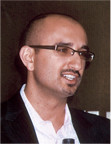
Sam Meer: "move with the winning idea”
Meer is equally clear-cut about community affairs. "We could do a better job in community affairs if we learn from our successes and failures,” he notes. "Forget the greater good,” he told Parsiana. "The youth and really effective people shy away from community service. (The community) would serve itself better by not focusing on the bickering.” One is hopeful that things will change so as to attract good people, but, Meer points out, "Change is something a lot of people are fearful of…People can’t function in business that way. That’s why business people can’t deal with social inertia.”
Critical of the "micromanagement” that prevails in community organizations, he says one requires very strong convictions together with an appreciation of the fact that he/she will be "constantly blasted by those who think otherwise,” to agree to serve there. "As a community we need to learn to deal effectively (with our problems),” he notes, adding that there is always a lot of misinformation around. "People can’t make honest decisions unless you communicate the facts. In a democracy we must move with the winning idea, but here there is no resolution…
"We are large enough to (be able to) accept dissent. If we want to do something new, we should do it… Whether members of the Zoroastrian Society of Ontario (ZSO) or the Ontario Zarathushti Community Foundation (OZCF), there are good people everywhere with individual idiosyncrasies…Everyone has the same ideals, to live according to the law of Asha. But we abandon it in our religious organizations… The elders are setting a pathetic example for the kids.”
The son of Minoo Meer and his wife Farida (née Divecha), the Karachi born Sam, then three years old, and his brothers Jehangir and Zubin moved as a family to Kuwait where their father was employed with the Bank of America for over 13 years. When the kids grew up, the family decided to move to Canada where they could stay together and be assured of a good education at the same time. Sam acquired his master of business administration in finance and international business. Jehangir has become a physician and Zubin is working for his PhD in post colonial literature.
Meer is married to Polish Canadian Joanna Czub, a psychology graduate, painter and teacher of fine arts who shares his love for dancing. They had met in a salsa class, he tells us. Both of them also enjoy rock climbing — not to be confused with mountain climbing, which needs a lot of focus, cautions Meer. An animal loving couple, the family for now includes a dog and cat.
Meer would love to have more people involved in the WZCC because the more there are, the more alive it would be as an organization. He is looking for individuals who "champion their own initiatives, stand and be counted.”
◆ ◆ ◆
From the archive