
XIV NAZC
“Keep things alive”
Voice over internet facility may be the answer to WZCC board members’ communications lapses
Two decisions taken by the directors of the World Zarathushti Chamber of Commerce (WZCC) are set to galvanize the body into more robust activity. Henceforth the directors will hold their regular meetings online, using the voice-over computer facilities provided free by Skype. The conference call connecting individual homes and offices will obviate the need for long distance travel as the international board comprises members from India, USA, Australia, Canada and the UK. The suggestion at the board meeting at the Sheraton Parkway Toronto North Hotel and Conference Centre on June 29, 2007 met with ready approval.
The early morning meet (continued in the evening after the special full day event organized by the WZCC’s Toronto Chapter — see "The game of sink or swim” page 102) saw international president Bomy Boyce propose the formation of a core fund that would enable WZCC directors and chapter chairs to work on the business of the chamber unhampered by personal financial constraints. With enlightened Zarathushti cinema owner Alayar Dabestani immediately pledging US $ 2,000 and a matching grant from Boyce, the fund became a reality, but not without a heated discussion. By the end of the day it was said that the fund had received pledges totalling US $ 10,000.
The board also discussed the possibility of the Zoroastrian Co-operative Bank in Bombay opening a branch in North America (NA) after establishing itself as a scheduled bank. If so, to what measure could the community in North America support the Bank and enable the Bank to help Zarathushti enterprise on this continent, was the question.
More mundane topics included the scheduling of the next annual general meeting, the choice of an honorary member, the formation of business cells, etc.
The core fund
Looking at WZCC activities in two parts — India and non-India — because "India has funding for what it is doing (from the BPP),” Boyce asked, "If a Houston man has to go to Chicago, what does he do?” Noting that there could be an external or internal source of funding, Boyce recommended that NA directors should be able to fund part of the region’s activities. The point he noted, was to set the amount of annual contribution and decide how it will be utilized. Other queries he raised were: "Where will the money lie? How will it be spent? Will the chapter chairs or the directors decide?” adding, "I am willing to put in the money to get the funding process going.”
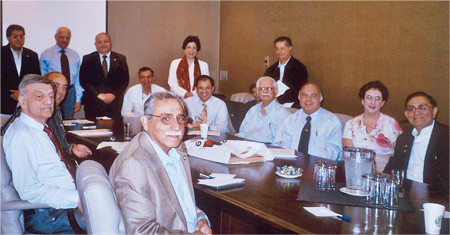
Clockwise from left front: Rohinton Rivetna, Bomy Boyce, Kobad Zarolia, Rustom Engineer, Minoo Shroff, Farokh Patel, Behram Pastakia, Zareen Araoz, Edul Daver, Framroze Patel, Alayar Dabestani, Firdosh Mehta, Natalie Wania and Russy Gandhi Photo: Arnavaz S. Mama
Edul Daver of New Jersey, who was officiating as secretary in the absence of designated secretary Zarin Commissariat of India, wanted to know whether the fund would cover operating needs or seed money for business. Firdosh Mehta of Texas was curious about the origin of the idea: "Was there any occasion when we needed operations funding but didn’t get it?” Rustom Engineer of Houston similarly asked for the reason behind the suggestion and the quantum of funding Boyce had in mind.
"Why are we shy of funding ourselves?” demanded Boyce. "If Firdosh has to go to Chicago to meet the chapter chair, does he fund the trip himself? If business centers become active (this may become necessary),” he countered.
Former FEZANA president Framroze Patel proved to be the strongest critic of the idea: "In FEZANA, officials finance their own expenses. Learn from that. We can’t go back to local associations to demand funding. We should allow the local chapters to thrive financially.”
Except for pointing to the differences between US and Canadian chapters in terms of tax liability and other legalities, Toronto’s Kobad Zarolia was in favor of such a fund. Decrying the "mentality of Parsis in NA,” Zarolia noted, "Some people can afford to fly around. But others? That’s the reason for the fund. Don’t put financial onus on the person who wants to serve the community.” But Patel persisted. "Financial contributions are willingly borne by presidents and others. That’s our tradition!...FEZANA’s 20-year history of sweat equity!”
Dabestani had come in a bit late but had listened to the discussion before noting, "Without funding many things cannot be done. I have a suggestion. I’ll match whatever anybody offers. Otherwise I offer $ 2,000.”
While Boyce pledged an equal $ 2,000 and sought Patel’s help to work on allocations, Roshan Rivetna had a word of thanks for Dabestani: "He was the first to come out in support of the WZCC (when the idea was mooted) and also today!”
Referring to the Indian experience, Minoo Shroff noted that BPP trustees had voluntarily subscribed to create a fund for the Indian chapter, "an initial effort of the founder directors,” as he called it, adding, "The surplus comes in handy for training entrepreneurs, organizing events. What Kobad says is everyone cannot afford to do this. We have to learn from experience…When WZCC-I sent delegations to Iran and Pakistan, some people needed to be sponsored. Establish guidelines, become self-reliant,” he counseled.
"I don’t want to put pressure on the chapters. I want ourselves to put in $ 1,000 a year or find a benevolent supporter. The arrangement can be fluid, but it is our responsibility to fund the WZCC... We will also need political connections. We will need to piggyback on the Chicago Chamber of Commerce or the Toronto Chamber of Commerce,” noted Boyce, suggesting the need to socialize with the officials of such organizations, promote fund raising events.
A Zoroastrian bank in NA?
"In North America the community is coming of age. There is money coming into endowments. These funds are invested and the income is used for awards, scholarships, etc,” noted Mehta before asking, "Can we use the incoming funds for business funding? Can we give it to the Zoroastrian Bank which is looking at setting up a branch in New York? Can we form a small group to facilitate its task, help the bank establish in North America? It could then help our community with seed money.”
"It should be able to give us rewards comparable to other banks,” said Boyce. Noting that it’s a cooperative bank and would need to change into a scheduled bank before it can open a branch in NA, Rohinton Rivetna said that such talk had been going on for five to six years. He also noted that banks require five million dollars in the kitty before they can go into business.
It emerged that what was driving Mehta on this topic was the knowledge that the Aga Khan had deposited five million dollars with the Royal Bank of Canada — a sum that was used as collateral with other banks to help the Ismailis get loans for business. Mehta hoped that with the advent of e-banking such a situation could be emulated by the Zoroastrian community to their benefit.
At the annual general meeting in Bombay in January 2007 Byram Avari, chairman of the Avari Hotels Group who had been elected honorary member — an honorific in the WZCC — had offered the use of his hotel in Karachi for the next AGM. The board of directors however was hesitant to accept Avari’s invitation in light of a communication from Commissariat doubting if many members from Bombay would be able to afford the air fare to Karachi. As noted Zareen Karani Araoz, the advice was to keep Bombay, Poona or Delhi as the venue.
While Boyce was in favor of combining the AGM with a trade mission to Karachi, the overall thinking was in favor of Poona. Daver was a major objector, noting "Bombay will always have more people. We should take the cycle further,” but the majority favored Poona. (Commissariat informed Parsiana in late July that Poona has been confirmed as the venue of the next WZCC AGM, currently scheduled for January 12 and 13, 2008.)
Araoz who maintains the e-mail link zchamber@yahoogroups.com for the WZCC, complained, "The e-mail communication has been very difficult. We need to keep things alive, we need interaction!” It was her contention that people do not respond to e-mail with the alacrity they should.
"Why can’t we have the meetings on-line?” ventured Natalie Wania Gandhy, the Chicago based WZCC activist who has now relocated in New York.
"By Skype?” asked Araoz, almost incredulously. And lo and behold, everyone agreed with hardly any argument! (It was also time to go home.)
◆ ◆ ◆
From the archive