
Events & Personalities
Where no guns boomed
"Once our street was full of Parsis. Now only a few remain,” says anesthetist Dr H. R. Mobedji who has lived all his life on Gunbow Street, in Bombay’s Fort area, as reported in the Hindustan Times (HT) of June 17, 2007 in its "Street Smart” column about Bombay’s quaint roads. Now 79 years of age, Mobedji complains of the increased noise levels which disturb his afternoon nap. Another grouse is that if he goes out on a weekday there is no space to park his car when he returns. "I have to park on some other road and go out late at night to bring it back” because his home is located right in the heart of the city’s business district.
Most people presume that the name of the street has something to do with an arms depot located there in a bygone age. Not so. The HT reporter explains that "the street’s name is an Anglicized version of Ganba Shett, after whom it is named. Ganba, a businessman, was the grandfather of philanthropist Jagannath ‘Nana’ Shankar Shett, himself immortalized in Nana Chowk.” However, for the postal department the street is Rustom Sidhwa Marg, named after a Karachi-based freedom fighter.
Gunbow Street is famous for the Fort Fire Brigade, which was once its centerpoint. Mobedji recalls, "When I was a boy, the fire officer in charge of the station was an Englishman called George Parker and I can still visualize him standing near the vehicle... In 1944, during the great explosion in the Victoria Docks, many firemen lost their lives, including the then officer-in-charge of this station, Rustom Palamkote.” The fire station, which has now been moved to the end of the street, still displays a roll of honor in memory of the martyrs.
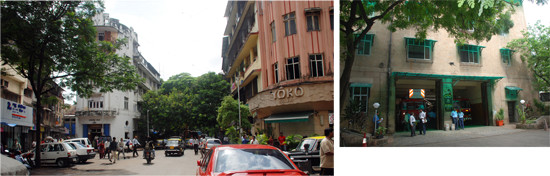
Gunbow Street today, and the Fort Fire Brigade (above)
Gunbow Street is most often frequented for its restaurants, the most famous being Ideal Corner where patrons drool over its reasonably priced Parsi delicacies, especially the mutton dhansak with kababs, available only on Mondays and Fridays. Other eateries include Brighton, Residency and the now defunct Irani restaurant Star of Asia (converted into a sizzler joint), Cremola and West Coast, a South Indian eatery. An adjoining khao galli (street of food vendors) helps meet the needs of the working class and poorer sections in the vicinity.
The street is mainly commercial, with offices and shops lining both sides, reveals HT. Among the establishments rubbing shoulders there are opticians, hardware dealers, stationery sellers and sweetmeat stores, makers of rubber stamps and Venetian blinds. Mobedji lives in one of the few residential apartments left on the street. Today there is no trace of Golwalla Classes, where Mobedji had his initial schooling. However, Gunbow Street’s transformation is far from over. At the far end yet another old building has been uprooted and the foundations of a new one are being dug on the plot.
◆ ◆ ◆
From the archive