
Media
Jamé’s journey
In its 175th year, the Jam-e-Jamshed still remains the community’s premier publication in India
When the Marzban family sold its share- holding in the Jam-e-Jamshed publication to Nanabhoy Jeejeebhoy, "my mother was totally heartbroken,” recalls Ardeshir (Adi) B. K. Dubash whose family currently owns the weekly journal.
Started in 1832, the paper remained with the Marzban family for over 150 years till 1980 when due to financial compulsions Adi Marzban sold his shares followed later by his brother Rustom. "Things began to unravel,” recalls Dubash. His mother Jer (née Marzban) "was very upset at the time.”
The three Marzban siblings’ mother, Ratanbai, was widowed at "very young age” and the children were brought up by their uncle, Nusserwanji Sethna, "on very short rations,” recalls Adi. "What sustained her was the pride (of their ownership) in the Jamé.”
"I was very fond of my grandmother” and that sense of self-esteem "came through to me.” So when a party approached Dubash and told him "there is this opportunity, I said yes.”
Seated in his third floor Ador House office on Kaikhushroo Dubash Marg (formerly Rampart Row) the jovial and rotund businessman believes "the owner (of the publication) shouldn’t interfere in the running of the paper. Otherwise he should take over and become the editor. The proprietors should direct the philosophy but not the day-to-day functioning.”
The Jamé was founded by Sir Jamsetjee Jejeebhoy, the then leader of the Bombay Parsi Punchayet (BPP) to counter the criticism leveled against the august trust by The Bombay Samachar. The paper was supposed to "give an insight into the activities of the Bombay Parsi Punchayet,” notes historian Dr Ratan Marshall ("Gujarati Journalism II: The orthodox and liberal voices,” Parsiana, May 2003).
Ironically, the founder of The Bombay Samachar Fardunji Marzban "ultimately came to (head the Jamé and) nurtured it with great care and made it a true mouthpiece of the Parsis,” wrote Marshall.
A successful businessman, Dubash sold his family’s stevedoring interest to his cousin, also an Adi Dubash, at the opportune time and invested the monies received in the stock market. At that time the present Prime Minister Dr Manmohan Singh was the finance minister and was ushering in economic liberalization. The money wisely invested multiplied manifold. Referring to the plethora of Ardeshirs and Maneks in the family, Dubash says they are so named to appease his grandparents, Ardeshir and Manekbai Dubash.
Coming from "a very orthodox family, our home still has a functioning prayer room and the muktads (annual ceremonies for the dead) are still performed there.” Dubash lives in a palatial family home Mount Nepean at Nepean Sea Road with his wife Kulsum and children Laleh and Feroz.
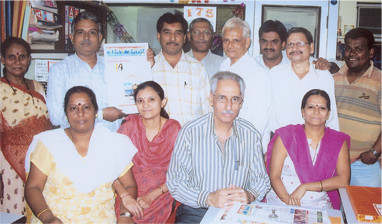
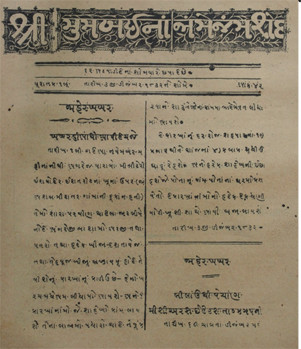
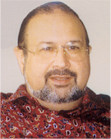
Above: Dhondie (seated center) along with the Jamé staff. center right: Ardeshir Dubash. top: Front page of 1832 Jamé issue
But he does not believe in people enforcing their religious point of view on others. He also believes it is wrong to discriminate against the children of Parsi women married to non-Parsis as versus Parsi men married out. "What applies to one should apply to the other,” he says.
The Dhondy connection
From Nanabhoy Jeejeebhoy the ownership of the Jamé moved into the hands of the Dhondy family around 1996, prior to being sold to Dubash in October 2000.
"At one stage Jeejeebhoy was planning to sell off the company,” recalls the current editor and former director of Jam-e-Jamshed Communications Private Limited. Rusi A. Dhondie (he recently changed the spelling of his surname). "The daily was making continuous losses. We printed around six to eight pages and people were not picking up copies,” he recalls. "We took a spot decision” around 1989 to turn it into a weekly, he says. "It was a good decision. The economies changed. We got more readers, better advertising and more time to plan out issues,” says the 56-year-old slim, moustached journalist. The interview took place during a car ride to Dadar to attend a voter registration planning meeting for the BPP trusteeship elections.
Around 60 percent of the weekly’s content is English and 40 percent Gujarati. "Even today we can’t afford to make it all English,” he remarks in reply to a query on the readership habits. "The Jamé has a distinct identity.” The Bombay readership favors English while the elderly readers in the city and elsewhere prefer Gujarati, he surmises.
Dhondie himself studied in the Gujarati medium till the fourth standard at the Cusrow Wadia School in Cusrow Baug. He then attended Campion School. After graduating from H. R. College with a bachelors degree in commerce in 1970, he interned with Kalyaniwalla and Mistry, completing his inter-CA exam. In 1974 he joined the multinational pharmaceutical company, Sandoz. Dhondie resides at Cusrow Baug with his wife Amy and son Nauzer.
His parents Adi and Jer were editorially employed with the Jamé and "Nanabhoy wanted me to come over.” The paper was a loss-making concern at that time.
He looked after the general administration of the paper. The then editor, dramatist and playwright Adi Marzban was "a great person to work with,” says Dhondie. Though Marzban "kept to himself… what I learned about (the editor’s work) I learned from him.”
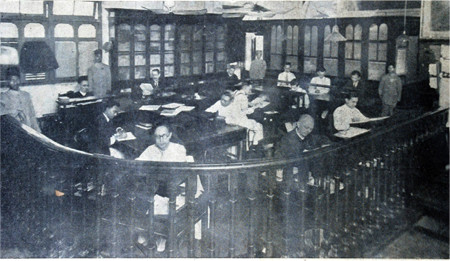
Editorial department (circa early 1900s)
Rusi’s father Adi started his journalistic career with Sanj Vartaman before switching to the Jamé. His mother "was the first Gujarati (speaking and writing) lady reporter,” recalls Dhondie.
His four sisters Khorshed, Gool, Bapsy and Vira have been involved with the publication at some time or the other in different capacities.
His father was "extremely orthodox” and against "smoking and drinking.” Rusi himself says he had "a blinkered vision.” He used to be "critical” of the liberal tone adopted by The Bombay Samachar daily and the Kaiser-E-Hind weekly.
Did adopting a more liberal tone affect the paper’s readership or advertising? "We didn’t receive a word of complaint,” says Dhondie. "We have not gone against orthodoxy.” But a few subscribers and advertisers did drop out, he adds.
As for his proprietors, Dhondie says they are "non-interfering” and he is "more than happy” to work for them. But sometimes when the strain of publishing a weekly tells on his health, he contemplates a quiet, retired life somewhere along the coast towards Gujarat devoting his time to social work.
◆ ◆ ◆
From the archive