
Books
Feast and felicity
Feast of Love: 50 Classic Menus by Bhicoo Manekshaw. Published in 2007 by the Penguin Group, Penguin Books India Private Limited, 11 Community Centre, Panchsheel Park, New Delhi 110017. Pp: xiii+360. Price: Rs 1,295.
"The most important ingredient in cooking is love…It is as important as having the right ingredients for a dish…Start then, by choosing the right materials. Go to the market yourself…Then with love and care nurse your meal right from its birth; hover over it in its infancy; keep tasting and correcting it so it doesn’t go wrong; guide it by applying the correct heat and seasoning to bring out the best flavor; stir it encouragingly when needed; and watch over the whole until it blossoms into a delicious meal,” advises Bhicoo Manekshaw in her introduction to Feast of Love: 50 Classic Menus.
"This book is not about quick 20-minute cooking: nor is it a book of easy, thrifty recipes. Some menus are light with a few dishes and some have more dishes… Let yourselves go and splurge a bit!” recommends the author who has little sympathy for those seeking shortcuts in cooking. As she candidly narrates in her bare-all style, at her first attempt at teaching cookery one young girl declared that she would not bother to make stock and use water instead. An aghast Manekshaw returned the fees to her and pointing to the door told her that with her attitude there was no place for her in the class. The bewildered girl won over her teacher by stating, "As long as I live I will never use water instead of stock. I have learned my very first important lesson. May I please stay?”
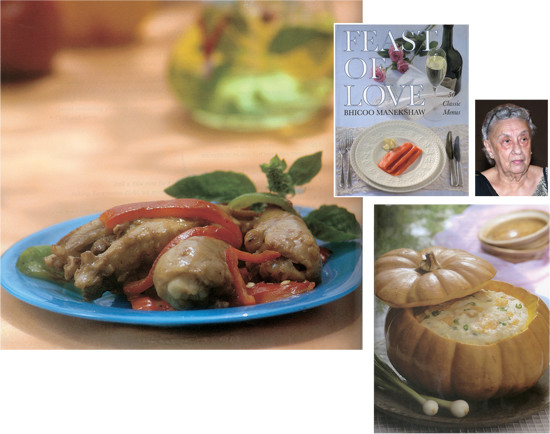
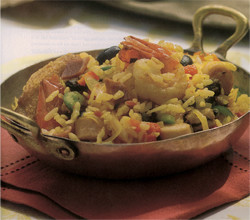
Bhicoo Manekshaw with Cin-derella Soup (below), Paëlla (bottom) and Italian Chicken
Every cook should realize the important role he/she plays, writes Manekshaw who would tell her husband who was a doctor that he saves lives while she sustains them. The first Indian to complete the Advance Certificate Course of the Cordon Bleu School of Cookery, London in 1963, as notes the jacket of the book, 15 years later Manekshaw completed the Intensive Refresher Course. An Air Force wife, Manekshaw progressed from catering for family and friends to serving as catering consultant at the Taj Mahal Hotel, Bombay, the West End Hotel and Raj Bhavan, Bangalore, Chef Air and Air India as also the India International Centre, Delhi. Since 1992 she has been creating and supervising the menus at Basil and Thyme, the well known restaurant in Delhi. This is the third of her cook books which the reader may relish or devour after sampling her first two, Traditional Recipes of India and Parsi Food and Customs.
The purist’s zest for perfection surfaces frequently over the pages of Feast of Love. To her food is not an item meant for quick munching and swallowing. There is almost a reverential tone when she talks of handling the ingredients with precision and care, and serving the dishes with propriety and punch. Manekshaw is known to have had the audacity to address Indira Gandhi one winter evening during the infamous Emergency, declaring, "Madam Prime Minister, a hot soufflé will not wait even for a prime minister.”
As she specifies in "The Makings of a Good Cook,” have the humility to learn from anyone and the honesty to give correct recipes to others, be precise and organized in the kitchen, economical, imaginative and scrupulously clean, start your children on different flavors as early as possible. In fact her section on "Boring Basics” which constitutes nearly a third of the book conveys her sentiments, "Basics are boring but they are essential in every discipline and that includes cooking. Learn the basics and they will help you understand a great art that sustains life…If you feel that this section…can be skipped over, shut the book and forget about cooking perfectly. Present it to someone who loves cooking…”
Any novice knows that herbs can change the flavor of a mediocre dish. But to learn the difference between chervil, chives and cilantro or Chinese parsley as coriander is known in other regions you would need to turn to "Boring Basics.” And if you thought why waste print on something as common as "Boiling,” just read on: "The greatest calamities happen when food is carelessly boiled. It can be over-boiled which is the commonest mistake or under-boiled.” Those who fumble in the kitchen may exclaim, "I can just about boil an egg.” But according to Manekshaw, "very few people know how to boil an egg perfectly. It is one of the most difficult ways of cooking an egg.” To best retain the color and nutritional qualities of raw materials, boiling (which requires the ingredients to be placed in cold, salted water, brought to boil and then left to simmer) is recommended in some cases, and the opposite process, blanching, in others (where the ingredients are first plunged into boiling, salted water and subsequently refreshed in cold water).
Even assuming that most cooks know the difference between a mousse (with its richer and creamier texture, made with egg yolks or whole eggs) and a soufflé (where the egg whites are separated, whisked till stiff and gently folded into the basic mixture), for tips on preparing exquisite hot and cold soufflés one must refer to "Boring Basics.” The highlight of this section may well be the topic of ‘Baking’ which includes charts on weights and measures as also recipes for breads, biscuits, cakes, pastries. And providing the ultimate icing is the ‘Icing’ whether it be Royal or American, Glaçe or Fondant.
Sandwiched between "Boring Basics” and the 50 classic menus is a section on "Celebrating Breakfast” which has a delightful assortment of flans and quiche, eggs and omelettes, crepes and fritters, and drinks with the right dash of cognac, vodka, or even champagne to justify consumption at breakfast time.
This hardback could be considered a necessary reference book for every student of cookery who wants to evolve on the culinary route. The 50 exotic menus that Manekshaw presents makes one wonder whether there continue to exist this breed of super-hosts who take the trouble to prepare such delectable meals. Don’t most conveniently fall back on the services of chefs, caterers and restaurants when they choose to entertain? "In this book I have described the basic techniques needed for Continental cuisine so that even someone completely unfamiliar with cooking should be able to serve up a haute cuisine menu,” states Manekshaw on the back cover. The menus which include a soup, salad, main dish and dessert are interlaced by the author’s remarks as to when the meal can be best enjoyed or how she learnt to prepare it or the exigencies which made her create it. Just the sound of some of them (e.g. "Aubergine with pomegranate – Farfalle with Gorgonzola – Roasted vegetables –Orange dessert” or another "Baked shell pasta with ratatouille – Fritto misto –Mushrooms with red bell pepper sauce – Lettuce, grapefruit and orange salad –Feta and tomato salad with cider vinaigrette – Plum and wine jelly – Lime cheesecake”) with tasteful photographs by Ashish Chawla makes one appreciate her statement, "Cooking is a combination of art, invention and science. It demands hard work, a sharp and intelligent mind and, most of all, common sense –very rare!”
◆ ◆ ◆
From the archive