
10WZC
Stories from the Shahnameh
Sponsored by Curiosity Furniture, Union Press, Cafe Universal, The World Zoroastrian Organisation Trust and Peekay Wines
JAMSHED
The next King to adorn the throne of ancient Iran was the radiant and glorious Jamshed. Not only the Mazdayasnis, but even the daevayasnis regarded him as their King. Though Firdausi refers to him as Tehmurasp’s son, the Avestan scriptures refer to him as the grandson of Tehmurasp and son of Vivanghan.
Vivanghan was the first person to perform the Haoma ceremony and invoke Hom Yazad as a result of which he was blessed with an illustrious son, Jamshed, who grew up to be a very devoted Yazdan-parast, that is, worshipper of one God.
He had great faith in other divine beings of the Mazdayasni belief system. He invoked the help of Avan Yazad, Ram Yazad and Mino Ashishwangh on different occasions and received boons whereby he could prosper God’s creations and overpower evil in the world.
The Golden Age
King Jamshed was a divinely inspired King. He had received the Kayanian Khoreh (divine glory for the royals) for his devotion and obedience to God and commitment towards his royal duties. His divinity was evident on his brilliant and pious face. So devoted was King Jamshed to the cause of furthering God’s good creations and upholding the Mazdayasni religion that he was offered prophetship by Ahura Mazda, which he politely declined, as he did not consider himself fit for that onerous task. Instead, he chose to further the progress of the material world.
Veritably, due to Jamshed’s just rule his subjects were very healthy and happy. Ill-health and vices had almost vanished from his kingdom. Nobody knew old age. Father and son looked alike. It seemed that even mother nature was helping King Jamshed in his task of giving maximum comfort to his people, since there was neither extreme heat nor cold in his kingdom. It was indeed a Golden Age in the history of Iran. As a result of abundant prosperity and healthy living conditions, the population of Iran increased manifold, and thrice King Jamshed increased the boundaries of his kingdom.
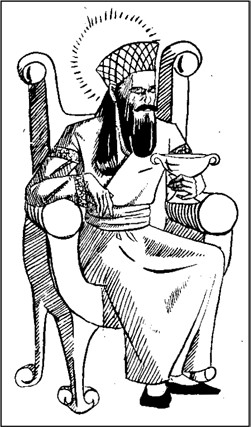
King Jamshed with Jam-i-Jamshed, a gadget which revealed the past and foretold the future
Human progress
People in King Jamshed’s reign were introduced to many new arts, skills and trades. King Jamshed introduced the art of brick-making and clay-plastering, which gave rise to the art of building houses and palaces. For the first time in the world, people started living in houses. King Jamshed also introduced the art of swimming and the craft of boat-making. Thus sea-faring was introduced to the people. From this started the ancillary arts of diving and pearl-fishing.
Mining started on a larger scale in King Jamshed’s time. Metals were made from ores and from metals several useful implements like the plough and the hoe were made. Apart from these implements, swords, spears, helmets and armors were made to be used during warfare. Horse-shoes were fitted to horses giving them greater mobility. Mining of precious metals and stones like gold, silver and diamonds was also initiated during the time of King Jamshed.
King Jamshed introduced his people to the concept of perfumes which were extracted from musk, amber and sweet-scented flowers like rose. King Jamshed taught his people the art of fumigation by the use of frankincense, amber, myrrh and camphor.
The art of cloth making was further developed in King Jamshed’s reign. Spinning, weaving, warping and woofing were developed. For the first time clothes from zari (golden and silvern threads) and silk were made. The art of sewing clothes was also improved to a great extent.
The idea of making musical instruments and composing music was also started during the time of King Jamshed.
King Jamshed introduced many medicinal plants and herbs by the use of which he was able to relieve many diseases and restore health. Many people started practicing medicine, and medicine as a profession started gaining acceptance among people.
Discovery of wine
The practice of using wine as a medicine started from King Jamshed’s time. There is an interesting story about the discovery of wine during King Jamshed’s reign. There were huge orchards and vineyards in the palace and fruits from the trees were plucked and stored in gigantic vats.
Once, a maid from the palace was suffering from an incurable disease. Her colleagues and peers in the palace did not only ostracize her, but even her family members shunned her. The maid was in great suffering on account of the disease, and the desertion by her own people, so she decided to end her life.
It had so happened that out of the vats of stored fruits, one vat of grapes had fermented. On account of the foul smell emanating from it, the King and his physicians labelled it as poison. It was kept aside in a desolate place, to be disposed of later on. When the ill maid saw this vat, she decided to drink its contents with the view of ending her life. She drank a cupful from that vat and soon was inebriated and fell asleep. When she awoke, she was not sure as to where she was.
She thought she was in heaven, as much of her pain and discomfort had vanished. However, to her surprise, she realised that she was breathing and very much alive. Not sure about the cause of her well-being, once again she drank a cupful from the vat and again she felt dizzy and went to sleep. This time, when she awoke she was feeling healthier. Her pain and most of the symptoms of her illness had vanished. She was jubilant and decided to inform the king about the miraculous property of the drink in the vat.
The following day the maid went to the King and said, "O King of the World, I have wonderful news for you, but before I disclose it, I ask your forgiveness for disobeying an order of yours.” The King was puzzled at this enigmatic statement and told the maid to clarify her statement. The maid recounted the story of her illness and her miraculous cure. Immediately the King sent his personal physicians to have the brew in the vat tested. The miraculous curative properties of the brew were confirmed and thereafter started the practice of taking wine in moderate quantities as a rejuvenating drink.
Four professional groups
King Jamshed divided his subjects into four professional groups Athornans "priests,” Ratheshtars "warriors,” Vastriyosh "farmers” and Hutaokhsh "craftsmen and artisans.” One of the reasons for this fourfold division was to enhance the work quality, as the respective trades would be handed over from father to son, which would provide an opportunity of learning the trades early in life, perfecting them and then passing over the superior techniques to the following generation resulting in greater efficiency.
A few highly devout Athornans were specially required to reside on mountains. They had to devote their time to prayers and invoking the blessings of God and other divine beings to ward off evil from the kingdom. So exalted was the position of priests during King Jamshed’s reign, that the King regarded himself as a ruler as well as a priest. He said:
Manam goft bâ farra-e Izadi
Hamam shahryâri o ham mubadi
[I am the one with Divine Energy,
I am the king and also a Mubed (priest).]
While describing the four professional groups, Firdausi gives a maxim for keeping oneself occupied: "Beware of lethargy, for it has made free man a slave.”
King Jamshed had developed a gadget known as jam, by which, he was able to know the past and the future. This contraption was known as the Jam-i-Jamshed. Though the word jam literally means a goblet, it was probably a gadget, somewhat like a modern telescope. It may even have been a full-fledged observatory from which King Jamshed was able to see the heavenly bodies and using the art of astrology know the past and predict the future by divining the stars, planets and constellations.
King Jamshed was greatly favored by God and other divine beings on account of his piety and benevolent activities. God often guided him through Sarosh Yazad, the Yazata bringing intuition. It was through one such insight from Sarosh Yazad that King Jamshed introduced the practice of tying the kusti (the sacred girdle) on the waist. According to Firdausi the rationale behind this practice was to protect the wearer against evil influences and attracting goodness by leading a life of moderation. Even today, the kusti is worn on the waist by Zoroastrians to signify moderation in all actions. The kusti also acts as an indicator of the right path.
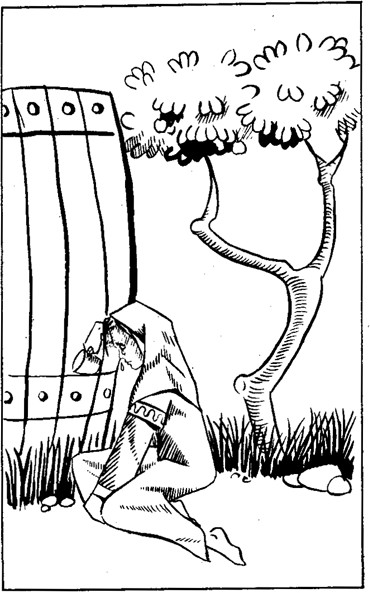
The maid drank fermented grapes from the vat and fell asleep, anticipating death
The world is submerged
Once God guided King Jamshed through Sarosh Yazad about the arrival of a terrible snow-storm which would submerge the entire world under snow. King Jamshed was not only forewarned of this catastrophe, he was also advised to take a pair of each species and create a Vara "an enclosure” on a mountain to save himself and other good creations from this great catastrophe.
King Jamshed went on a mountain taking with him a pair of most of the species of animals and plants and established a settlement which came to be known as Var-e-Jam-Kard "the enclosure made by Jamshed.” In this Vara, King Jamshed was coronated on the new year day, that is, the day on which the sun enters the house of Aries. It was also the day which heralded spring. King Jamshed sat on a jewel-studded throne wearing a golden crown. He established his benevolent reign and completely subjugated the daevayasnis. So complete was his sway over them, that he sat on his throne and made them lift it and carry him to distant places whenever he desired.
Jamshedi Navroz
A jashan was celebrated to commemorate King Jamshed’s ascension to the throne. Everywhere there was celebration with wine, music and singing. This day came to be known as Jamshedi Navroz and was announced as a day of rest and festivity. Even today the festival of Jamshedi Navroz is celebrated with great joy and revelry. In the kingdom of King Jamshed there was health and happiness all around as everything was in plenty. Hunger and thirst were not known. People were healthy and radiant. There was no aging, debility and disease.
Pride and fall
By and by King Jamshed completed his reign of more than seven centuries. But as time went by, the prosperity and plenty in the kingdom made the king proud of his achievements. One day he summoned his subjects and elders of the court and proclaimed, "I have realised that there is none in the world like me. I have improved the world and relieved pain and suffering from it. The skills and trades in the world are because of me. Your life and consciousness owe me their existence. What more, the very clothes that you wear and the food you eat is by my grace. So now it is in fitness of things that you call me your God.”
As soon as King Jamshed uttered these words his divine glory fled, flying away in the form of a bird. His subjects lost respect and regard for him as their King. Within a period of 23 years his entire army deserted him. It was as if God Himself had turned his face away from him. When King Jamshed realised his folly, it was too late to amend.
The people of Iran were thoroughly disillusioned by their King, and went in search for a new king. They found one in Babylon by the name of Zohak. In their eagerness to overthrow their King, they did not realise what they were getting into when they invited Zohak to come to Iran, assuring him their full support.
Zohak sent a messenger to King Jamshed asking him to surrender. Though King Jamshed was terrified by this message, he challenged Zohak for a battle. Zohak came to Iran with his army and a battle ensued between the two armies, which lasted for 40 days. In this battle King Jamshed proved stronger. However, the crafty Zohak changed the pattern of the battle to a duel between the two Kings, which he won by using treacherous means.
King Jamshed flees Iran
Having lost the duel, King Jamshed had to flee Iran to save his life. He changed his identity and wandered from place to place for several years. He took to wearing black clothes as a sign of repentance for his pride which led to his fall.
Meanwhile Zohak had Jamshed’s face circulated amongst people by embossing it on metals and printing it on cloth. He even proclaimed a reward of tax and revenue exemption for life to anyone who caught Jamshed.
Princess Samannâz
When Jamshed came to know about this proclamation, he changed his identity. Wandering from place to place, he reached Zabulistan, on the border of Afghanistan and Hindustan where King Kurang ruled. Kurang had a beautiful daughter by the name Samannâz. Many suitors had asked for her hand in marriage, but she had rejected all considering none to be worthy enough to be her husband.
One day, Jamshed wandered into the princess’s camp asking for food and water. The princess immediately recognised him and gave him food and wine. Then she asked him his identity. Jamshed concealed his identity and introduced himself as Mâhân Kuhi.
Samannâz was sure about the true identity of Jamshed. She was totally heartbroken when Jamshed, whom she held in high esteem, lied to her. She confessed that she had been waiting since a long time for his arrival and wanted to marry him. Finally, Jamshed revealed his identity and said that he had to lie for his safety as everywhere people were searching him in expectancy of the reward offered by Zohak. Samannâz promised Jamshed that she would not utter a word about the secret to anyone, and so they married secretly.
After some time Samannâz was expecting a baby. When her father King Kurang came to know about the secret marriage he was furious, but he soon calmed down when he came to know that his son-in-law was none other than Jamshed, former King of Iran. However, the real reason for his happiness was not due to the former greatness of Jamshed, but his desire to hand him over to Zohak to get the reward, and be in the good books of the new king of Iran. With great difficulty the princess was able to dissuade her father from having Jamshed arrested by Zohak.
In the course of time, a charming son was born to Samannâz. The child’s resemblance to his father was so conspicuous, that King Kurang had to persuade Jamshed to leave the palace lest Zohak have any suspicion due to the likeness of his grandson to the former king of Iran, and attack him. Jamshed too realised that it was too dangerous to prolong his stay in Zabulistan, and so, with a heavy heart he left Samannâz and his son Tur in Kurang’s care and set off for Hindustan.
Jamshed went in hiding, moving from one place to another. Finally he was located in China by none other than his own half brother Spityur who reported him to Zohak, who ordered to have Jamshed mercilessly killed by having him split into two. Thus ended in utter ignomity the life of one of the greatest Kings of Iran.
King Jamshed is said to have enjoyed a very long life. Though the exact extent of his life and reign is not certain, different texts report it from between 700 years to 1,000 years.
Reprinted from the book Serialized Stories from the Iranian Epic Shahnameh.
◆ ◆ ◆
From the archive