
Professions
Rewards of retirement
Former chief of the Indian Air Force Fali Major serves in several advisory roles
"The very first morning and day after your retirement is the most challenging — almost mechanically, you bathe and automatically reach for your uniform! This is when it hits you that you are never going to wear it again... and it sort of puts you off,” recalled Fali Major after his term as Air Chief Marshal (ACM) of the Indian Air Force (IAF) concluded. "But after a few days, things fall into place and a new routine takes root. The more you read, play golf, socialize and travel immediately after retirement, the better it is. I did just that for a good six months and once the retirement syndrome got over, I considered giving back to the country — which had given me so much and had reposed great trust and faith in me,” he continued.
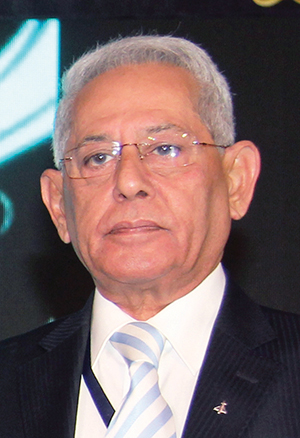
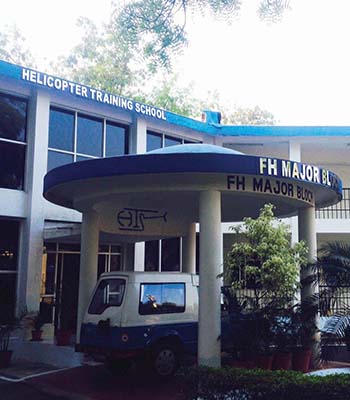
The Hyderabad Helicopter Training School named after him
Major recollects his last day in service, May 31, 2009, after glorious 43 years and 10 months from the day he reported for training to the IAF. "After an impressive ceremonial guard of honor and a solemn handing/taking over ceremony, I handed over the reins of the IAF to my successor. As per Air Force traditions, I drove out of Air Headquarters to Air House, picked up my wife Zareen and drove straight to the Palam air base (in Delhi) to board the IAF Embraer for our flight back to Bangalore. This was the last flight that used the call sign ‘Indian Air Force One’ with me on board!” A very poignant moment indeed.
Post retirement, Major, a graduate of the National Defence College (New Delhi), Institute of Strategic and Security Studies, Hawaii (USA) and the Army War College (Mhow), has been a member of two expert groups appointed by the government of India: one on the restructuring of Hindustan Aeronautics Limited and the other on energizing small and medium aerospace industries. "I have been a jury member for three consecutive years with Times Group to select ‘Amazing Indians.’ I also keep active in the strategic, aerospace and military seminar/lecture circuits — in India and abroad. I was appointed by the government to be member, National Security Advisory Board (NSAB) in January 2013 and finished my two-year tenure in February 2015,” Major reveals. "The many strategic, security, environmental, scientific, economic and social aspects that contribute in making a credible national security strategy are deliberated, debated and recommendations are made to the PMO (Prime Minister’s Office). Given each member’s past experience, knowledge, exposure, positions held and domain expertise, the NSAB gives robust and transparent advice to the government on national security issues.”
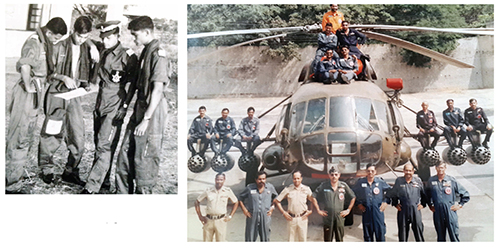
Far left: Flight Cadet Major (with cap); (alongside) Commanding MI-17 Squadron during Indo-Pak war 1971
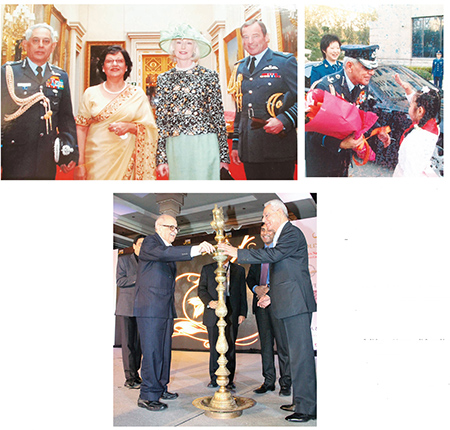
Top: Fali and Zareen Major with UK Air Chief Marshal Sir Glenn and Lady Torpy; Major in China, 2008;
Fali Nariman and Major (right) lighting the inaugural lamp at Enterprise Dubai, 2014 Photo: Jasmine D. Driver
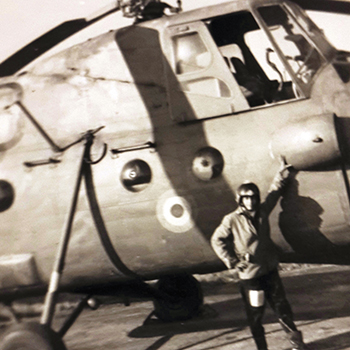
ACM Major with Russian MI-17 helicopter
The government appointed Major as an independent director on the boards of Air India Limited and Air India Express. Major, along with three other independent directors, had made it very clear to the management that they would not accept any sitting fees, nor any free tickets. Many sound proposals were put up during their tenure for the turning around and improvement of the airline. But theirs was an advisory role — approval and implementation was the prerogative of the management and Ministry of Civil Aviation.
The Government of India appointed Major as the ACM on March 31, 2007 heading the fourth largest air force in the world with a four-star rank. "By the grace of Ahura Mazda and the outstanding support I received from my air warriors, the other two sister services and all government agencies, my tenure as the ACM was very satisfying, fruitful and indeed very pleasant.”
About his choice of career, Major says: "On March 22, 1965, I reported for training as a flight cadet in the IAF. The flight and ground training was gruelling, but full of adventure and great times as I was striving to fly well, fly hard and fly safe, besides remaining an officer and a gentleman at all times!” On December 31, 1967 Major was commissioned into the force and the "wings” were pinned on his chest in a ceremonial passing out parade held in Air Force Station, Hakimpet, Hyderabad (his home town). The new Helicopter Training School building at the Station has been named the FH MAJOR BLOCK.
Born on May 29, 1947 in a humble Parsi family in Secunderabad, he was brought up, educated and groomed in true Parsi traditions — starting his education in a Parsi school initially and then finishing his schooling from the Wesley High School. He joined Nizam College thereafter, but left after about a year on being selected to undergo training as an IAF pilot.
Major has the distinction of raising and commanding the very first MI-17 squadron of the IAF in 1985, and deploying it for operations in the Siachen Glacier area — the world’s highest battlefield. He commanded yet another combat MI-17 squadron and led it into battle during the Indian Peace Enforcement Operations in Sri Lanka. For his leadership and valor displayed during these Operations, he was awarded the Vayu Sena Medal for gallantry. Later, as the commander of an important air force base in 1992, he led a daring heliborne operation to rescue 11 people from a cable car stranded and dangling at a height of 3,400 ft in the middle of a steep valley in Himachal Pradesh. He was awarded the Shaurya Chakra by the President of India for this act of exceptional bravery and devotion to duty. He was director, operations in Air Headquarters and Air Officer Commanding, Air Force Base Leh, the world’s highest operational flying base, in the aftermath of the Kargil conflict. He was awarded the Ati Vishisht Seva Medal by the President for his leadership and outstanding devotion to duty. During this tenure, the ACM also planned, co-ordinated and executed a tri-service search, rescue and rehabilitation operation in India and South East Asia when the devastating tsunami wreaked havoc.
On September 5, 2005, he was promoted and appointed as the Air Officer Commanding-in-Chief of the Eastern Air Command. His area of responsibility encompassed the borders with China, Myanmar, Bangladesh, Nepal and Bhutan — a daunting task to safeguard the air space and project air power in the entire north-east sector of operations. This tenure also saw the successful conduct and execution of combat air exercises with the air forces of United States, UK, France and Singapore. Major was awarded the Param Vishisht Seva Medal by the President for displaying outstanding leadership and exceptional devotion to duty during this tenure.
During his watch as ACM, the IAF was in the thick of its modernization process and Major was instrumental in the induction and operationalization of many aircraft and weapon systems — AWACS (Airborne Warning And Contol System), Hawk trainer aircraft, the Boeing 737-800s and Rohini Air Defence Radars.
Major has always had the strong support of his family. He had met Zareen in early 1967 when he was still a Flight Cadet in Bangalore. "We got married on September 18, 1969 when I was a young 22-year-old flying officer posted in Tezpur, Assam. We spent our early married life there, living in thatched huts called ‘bashas’— with snakes, panthers and wild boar for company! Notwithstanding the wild surroundings and equally wild air force guys, they were the most enjoyable and adventurous days of our life,” he recalls.
His children and grandchildren are all car and bike lovers. "Our son Zubin was born in 1970 and daughter Tooshna in 1972. They did their schooling and college all over the country. Zubin made up his mind very early to fly, and that’s what he eventually did. He is now a fairly senior commander in Jet Airways. He married his childhood sweetheart Ashima (since Std IV!) and they have two children — Hoshang and Jennifer.” Ashima runs her own interior design outfit. Zubin and Hoshang share Major’s love of adventure and have undertaken a biking trip to Leh, said to be the toughest road trip in the world. Major says, "Our daughter Tooshna is married to Homi Gandhi and they live in Dubai. Homi heads a banking and asset management consultancy and Tooshna works in the American Academy. They have two children — Kainaz and Bahram.”
"Zoroastrianism, as conceptualized and propagated by our prophet and his exhortation in the Gathas to find, investigate and come to the right conclusion, has indeed played a stellar role in my life. I have always believed that pursuit of truth, hard work, probity, honesty and integrity will stand you in good stead in all that you do,” states Major.
"Notwithstanding the fact that our community has given back to the country a lot more than was probably expected of them when they were given refuge in seventh/eighth century India, our contribution in nation-building, our cherished philanthropic pursuits and the very nature of our good Parsi way of life needs to be pursued, nurtured and carried forward by our younger generation. For this to happen, it is the bounden duty of the many Parsi trusts/learned elders/high priests to steer the present and future generations of our community by example — and not with rancor, legal battles, misplaced/unqualified/dated diktats and practices, which have no relevance in the present day context. In today’s information age, our youth will demand unambiguous clarifications supported by scriptural references. Enquiry, if honest, is to be encouraged and indeed, nurtured. Truth, faced at any stage of growth in a religion or community, can only be beneficial to all.”
◆ ◆ ◆
From the archive