
Cover Story
Brutal images...necessary truths
The social impact of a concerned artist has been driving painter Jeroo Roy
"I am not an activist or social worker but I am very involved in issues regarding violence against women in all its forms as well as exploitation of street children and working children,” says UK based painter Jeroo Roy whose exhibitions have not only impacted casual visitors but found support from New Scotland Yard (NSY) and the Home Office.
Variously titled What Honor, Whose Honor on honor based violence (HBV), When More is Less on female infanticide and feticide, Children Under Siege on violence against children, the theme unites the given set of paintings and sets the stage for the dramatic, often searing visuals. Presented as single or group exhibitions with other artists, Roy says she has "seen women brush away tears and people holding their stomach hard” at her exhibitions.
Describing the paintings on fetuses in "Prick the viewers’ nerves” in the BBC News, UK edition of September 8, 2004 reporter Elizabeth Blunt writes, "Rows of jars hold aborted fetuses of girl babies, beside them a list of what they might have become: midwife, housewife, actress, rich woman, poor woman, beggar woman, thief…Delicately hennaed hands of an Indian bride, consumed in flame, with a whole alphabet of injustice and hatred — abuse, barren, control. Burning, childless, dowry. Kerosene, lust, misery — behind the flames.”
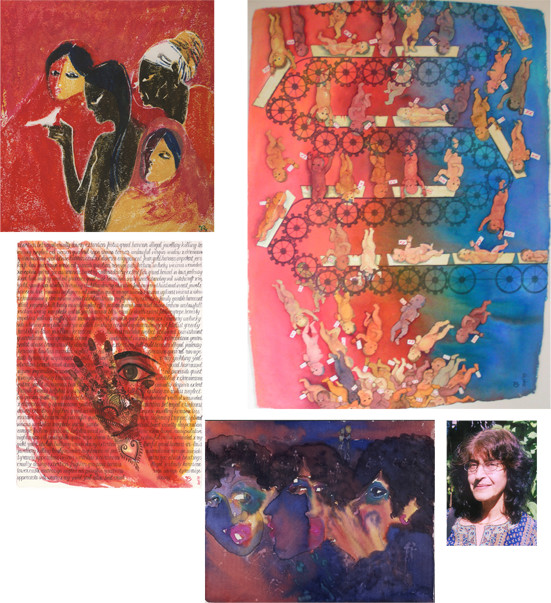
Roy (far right) with her exhibits (clockwise from top): 3 Generations and a Bird, The Production Line, Don’t Tell Anyone and When More is Less
Sometime in 2003 she had read a newspaper article about a girl in Delhi calling off her wedding at the last moment and summoning the police to deal with the prospective in-laws who were harassing her family for more dowry, Roy told Parsiana in the course of an interview on January 17, 2007. "Till then I was totally oblivious of how much trouble women get into.” A visit to Calcutta followed. There she says her nephew Gautam Ghosh introduced her to three women’s groups. "One showed me a file full of atrocities.” She heard stories of women trapped in abusive marriages, driven to suicide by incessant demands and pressures to produce sons, not daughters, dowry deaths — the cooking stoves that mysteriously blew up in the faces of brides whose dowries were not adequate. "The subject suddenly seemed to choose me, instead of me doing the choosing,” Roy had told the BBC. "I decided I’d try to put my feelings into my paintings, create awareness,” she conveyed to Parsiana.
The graphics were first created to mark India’s Year of the Girl Child. The solo exhibition, When More is Less went on display at the Light Gallery at London’s Marble Arch, in April 2004 and Zee TV was one of the media covering the event. "Some rich and influential Indian people were angry that I was exposing private family matters,” she recalled. But others were sympathetic. Someone from the Nehru Centre (the cultural wing of the Indian High Commission in London) produced a copy of Death by Fire by Mala Sen, representatives from Amnesty International and the Southall Black Sisters noted their appreciation. "And three women privately thanked me for the paintings because it gave them the courage to do something. It was this private statement of theirs which made me realize and gave me further confidence that I was doing the right thing in publicizing the paintings as much as possible...
"I will never know how many people were affected, but I am aware that they (the paintings) have a lot of power to do good,” notes a satisfied Roy. The exhibition What Honor, Whose Honor followed at the Nehru Centre in September 2004.
"She paints untiringly…thin and convivial but completely engrossed in her paintings which littered all around,” Divya Mathur of the Nehru Centre described the artist in "Jeroo Roy’s Children under Siege” in Pravasi Times, April 2006. "I first met Jeroo in 2002 when she came to the Nehru Centre to look at our gallery for a solo exhibition. Looking at her fine work,” continued Mathur, "it was a straight ‘yes.’ Again, in September 2004 she came forward to present What Honor, Whose Honor, coupled with a seminar in which she spoke of her intense feelings about the violence against women which she had come across, mostly through news and books. This exhibition was very successful from the awareness point of view.”
"I am an experienced detective used to seeing death. The Production Line reduced me to tears, comparing the waste of female human life to the beauty and joy that my daughter brings to me,” wrote Ian Peggigton of the NSY in the visitors’ book. "Your paintings touched my stomach, my heart and my brain and gave a remaining picture and feeling that will guide me in my future efforts. Thanks,” wrote Bam Bjorling of the Swedish agency Kvinnoforum. She was invited to display her work at the September 2004 Conference on HBV at the NSY, London, and at the October 2004 International HRV (honor related violence) conference by Kvinnoforum in Stockholm.
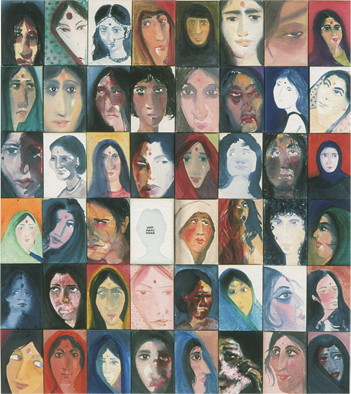
Acrylic on canvas: How Many More
A spate of testimony to the poignancy of her work can be found on Roy’s website. A small cross section: "Wonderful, brave work that faces up to a subject that many would prefer hidden. Oh that there were more women with the passion of Jeroo Roy,” notes Joy Hodder of Initiative Magazine. Kamalesh Sharma, Indian high commissioner, wrote it was "Very disturbing, as it should be. Art with a purpose.” Baroness Cox, member of the House of Lords, described the work as "powerful, challenging, unforgettable.” "Even brutal images, if they reveal a necessary truth, are inspirational,” noted author Mala Sen while Judge Simon Wilkinson found it "challenging and deeply disturbing.”
"The images that Roy has produced are disturbing, and are not the sort of art which buyers can comfortably hang on living room walls,” notes Blunt, adding, "The fact that the exhibition is unlikely to be a commercial success doesn’t faze Roy. She would rather it was kept together for a time as a touring exhibition, so that (the paintings) can be instrumental in stopping atrocities being repeated.”
Through 2005 and 2006 Roy’s work has been on display at various conferences — the International NSY conference on Forced Marriages at the Victoria Plaza Park Hotel, London, the NSY/Home Office conference on HBV, London, and part of a travelling group show on HBV in German cities. Running a theme "Imagine a world without violence” marked a group show "with big names,” as she notes, at Cork Street Gallery, London and again at the Oxo Tower on the South Bank. In Decem-ber 2006 Roy says she was invited by an Iranian and Kurdish women’s group meeting at the Amnesty Building in London where they showed her CD on violence against women and children and exhibited a couple of her paintings.
The Bombay born daughter of the late Homi Vajifdar and late Dinoo (née Deboo), Jeroo was brought up by her grandparents in Simla where her maternal grandfather Faramroze Deboo owned a hotel called Devicose. Later he moved to Panchgani where he established the Hotel Jerroze — a combination of his name and that of his favorite granddaughter. Roy says her son Manab has so many of her grandfather’s characteristics, "he may be reborn in my son!”
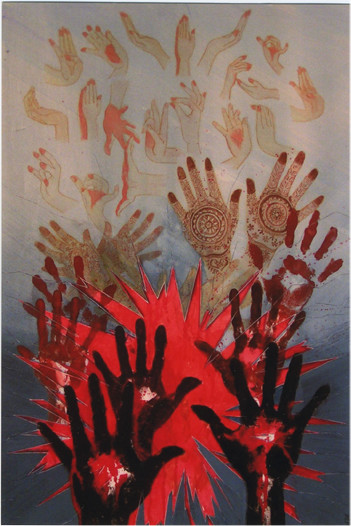
Acrylic on canvas: No More, Enough is Enough
An alumnus of the Sir J. J. School of Art, Roy trained further at the London College of Printing. Starting to work with an advertising agency in Bombay — where she met photographer and future husband Pabitra Roy — Jeroo began by illustrating children’s books, two of which she says she wrote herself: Anita Desai’s Peacock Garden and Story of Rama published by the Oxford University Press. The couple later moved to London where in 1982 Jeroo became involved in the building trade and for the next six years was a maintenance builder while continuing with her illustrations and painting. In 1988 she formed her own company and became a building contractor. As notes her bio data, "This meant that the painting aspect of her life was put on hold while she took on the demanding task of establishing herself as a female contractor in what was a tough world to break into.” Then, in December 2000, at the height of her building career, she decided to retire from the trade and get back to painting.
"I am first and foremost an artist. I felt the consciousness that I can contribute to (mitigating) the sufferings of others. But I am also interested in birds and animals…My favorite bird is the crow. I can spend hours watching their tricks, teasing kites” as she did, watching jungle crows on a recent trip to Ranthambhore with Manab. There was a time, not too long ago, when she studied ornithology, learned to ring birds with information about their species, age, wing span, etc. There was much more to the course but circumstances put a stop to the training. Pabitra fell ill. Zerbanoo Gifford, whom Roy describes as "generous, largehearted and sincere,” persuaded her to do portrait miniatures of the 208 subjects — 70 from India, the rest from all over the world — who feature in her book Influential Women. She undertook to be part of a group exhibition: Indian Painters in the UK and India in September 2001 in west London, followed by a solo exhibition at Nehru Centre in June 2002.
Pabitra passed away last year and Jeroo made a trip to India with her son to catch up with family and friends. Her sister Dr Lily Pastakia is a lumbar puncturist at the Bombay Hospital, brother Rusi is a ship engineer based in India while Behram, an electrical engineer, has migrated to Toronto. Her sister-in-law Aroti Ghosh, widowed at a young age, has founded a school for orphans and tribal children, at Jargram at Midnapore on the border of Bengal and Bihar, Jeroo tells us. Also on the agenda was to set up dates for her exhibitions as well as for the launch of Gifford’s book. After its initial launch at the National Portrait Gallery on London’s South Bank on September 17 this year, the book is expected to have two subsequent launches in India — probably with the International Women’s Conference in Delhi in early November followed by one in Bombay at Pheroza Godrej’s Cymroza Art Gallery. Rekha Modi, who owns a gallery in Calcutta, will organize the event there. The owner of the Forum Gallery in Madras was also said to be interested in displaying Jeroo’s work.
Continuing to paint the The Working Child and Children under Siege, designing a birthday book and diary for 2008, Jeroo maintains, "It is important for me to see the lighter side. Too much overdose of violence suddenly can affect my character.”
◆ ◆ ◆
From the archive