
Business
Taking a bow
He’s the new darling of the media. Television channels, newspapers and magazines eulogize him. Every activity and nuance of the man is reported.
For someone who has traditionally been media shy and almost reclusive, Ratan Tata and Tata Steel’s acquisition of the Anglo-Dutch steel behemoth Corus not only propelled India to the international business limelight but also made Tata an Indian icon.
The Tata and Mittal names are now synonymous with steel, with Laxmi Mittal’s combined might making him the largest manufacturer of the metal in the world. Tatas is now number five.
Even the Government of India got into the act offering Tatas assistance if they needed help in finalizing the deal. The general belief was what is good for corporate India, is good for India. "It’s an example of new found confidence of Indian industry,” said finance minister P. Chidambaram [The Economic Times (ET), February 1, 2007].
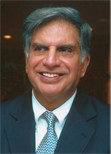
Ratan Tata: flying high
For a country that once had to send its gold reserves abroad as collateral, the US $ 12.11 billion (Rs 54,000 crore) purchase price demonstrated India’s new financial and industrial prowess. It’s hard to believe that only a few decades ago one had to apply to the Reserve Bank of India for permission to remit even five dollars to a US university for admission formalities.
The country’s socialistic politicians’ bias against business, and especially large corporations and multinational companies, has now been turned on its head as Indian firms in turn go global.
"The Corus acquisition has not only put Tata Steel on the global center stage but also made it a giant among giants in India Inc. The steel conglomerate is now the largest private company by sales in India (Rs 105,227 crores),” remarks the ET issue of February 1, 2007.
"In its 100th year Tata Steel has taken this step that will make it an international company,” stated Russi Mody, the former head of TISCO (Tata Iron and Steel Company) as it was then known (ET, February 4, 2007).
The newspapers have been carrying reports of Tata Power bidding for Globeleq, an operating power company with assets in Asia, Africa and the Americas. Spanning 13 countries Globeleq generates 5,000 megawatts from 13 different companies, states ET of February 5, 2007. Globeleq’s assets are valued at around two billion dollars.
The Tata Motors plan to start a small car factory in Singur, West Bengal, is also under way despite opposition from some political parties and an alleged business rival. The bhumi puja was conducted on January 21, 2007 "at the site to mark the beginning of its automobile unit that will produce the ‘Rs one lakh’ car,” stated ET, January 22, 2007. The construction work is being undertaken by the Shapoorji Pallonji group, notes the write-up quoting the West Bengal director of industries, M. V. Rao. "The people of Singur are happy over the development,” he reportedly added.
Opponents of the plant had claimed the locals who owned the land were forced to sell their property at less than market rates. Tata had noted his company had been caught in the "crossfire” between the West Bengal government and its political opponents.
If he wasn’t already flying high enough, Tata flew a Lockheed Martin F-16 multi role combat aircraft at the Aero India Show in Bangalore on February 8, 2007 and a Boeing F-18 Super Hornet the very next day. The 69-year-old Cornell architecture graduate is an avid pilot. "I don’t get much spare time, but the little I have is spent flying,” Tata was quoted as saying in an interview on the group’s website.
"Be bold in setting your goals and do not be afraid of taking risks,” he told ET (February 1, 2007) a few moments after the Corus takeover.
◆ ◆ ◆
From the archive