
Business
Tatas market cap leaders
By crossing the two lakh crore rupee mark, the Tata Group is number one in market capitalization
The Tata Group has overtaken public sector giant ONGC (Oil and Natural Gas Corporation) in market capitalization (cap). Tatas become the first Indian corporate house to cross the two lakh crore rupee mark ($ 46.1 billion). ONGC Group’s market cap currently stands at $ 39.4 billion, as per a report in the Business Times section of The Times of India of March 7, 2006.
With revenues in 2004-2005 of $ 17.8 billion (Rs 799,118 million), the equivalent of about 2.8 percent of India’s GDP, Tata companies together employ some 215,000 people, as per the information provided by the Group. Their 32 publicly listed enterprises have a shareholder base of over two million. The Tatas operate in more than 40 countries across six continents, exporting products and services to 140 nations, as per official sources.
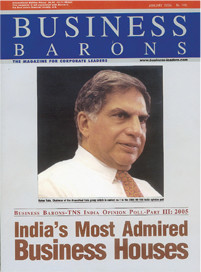
On the cover of the prestigious publication Business Barons (January 2006) is Ratan Tata, profiled as head of the Tata Group, ranked first among "India’s most admired business houses.” With an indexed score of 40, the "Tata Group has emerged as India’s top business house in the Business Barons — TNS India (which is the Indian affiliate of one of the world’s largest market research organizations) opinion poll for 2005… The Group topped both the management quality ranking and the overall ethical index…” the magazine noted.
The Tatas beat last year’s winner Reliance Industries which slipped to third place. Information technology (IT) heavyweight Wipro stood second. Featuring among the top 15 in the parameters of management quality, financial performance, returns to shareholders and ethics were Godrej at No 8 and The Bombay Dyeing and Manufacturing/Wadia Group at No 12.
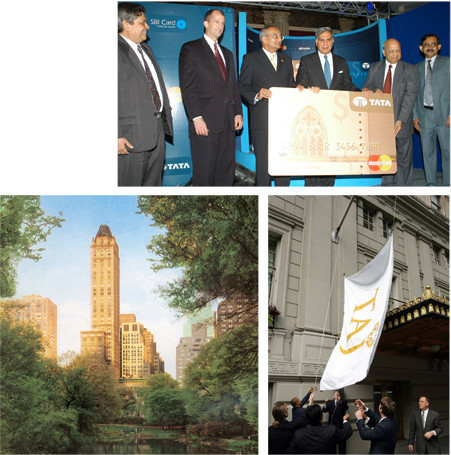
Tata Credit Card launch (from left): Kishor Chaukar, John Rice, Sunny Sannon, Ratan Tata, A. K. Purwar, Ashok Sinha; The Taj flag goes up at The Pierre (far left), New York
Ratan Tata shared cover space in Business Barons December 2005 issue too with IT legends Azim Premji and N. R. Narayana Murthy as "India’s Most Admired CEOs.” While Premji was ranked first, Tata ranked second jointly with Murthy. In the Business Barons – TNS India opinion poll in the previous year (2004), Tata had featured at fourth place. "Mr Tata has over the past decade transformed the Group by more than doubling revenue and profits… he has preserved the liberal image of the Tata Group… he avers that his group is not driven by an instinct to ‘grow over everybody’s dead body’. But he is not in a mood to lose control either. Instead he is turning one of India’s most diversified conglomerates into a global player. The Tata Group is now more focused than western multinationals and Asian peers and is expanding into markets like Africa and Korea,” the magazine writes.
Godrej Group chairman Adi Godrej is at 15th place in the publication’s opinion poll for "India’s most admired CEOs,” while Thermax’s Anu Aga ranks at No 19 in the top 21 mentioned.
In a further thrust towards venturing into new areas, Ratan Tata stated at the Indo-US Economic Cooperation conference in New Delhi during the visit of US president George Bush to India from March 1-3, 2006 that his Group would be interested in operating a nuclear power plant in the country if the government allows, as per the Mumbai Mirror, March 4, 2006. "‘If the government opens up the sector for private investment, Tata Power Company would certainly be interested…’ said Tata,” the paper reports. So far nuclear power plants are being operated by the state-run Nuclear Power Corporation of India Limited. Besides Tata Power, which is already into thermal and hydro power, Reliance and National Thermal Power Corporation would also eye the nuclear power market should it open for private players as well, subsequent to the much hyped Indo-US nuclear pact separating civilian and strategic (military) nuclear facilities.
Check it out
With the Tata Group being at the forefront of resurgent India’s corporate charge on to the world stage, their global acquisitions in 2005 totalled over one billion US dollars! "Tata Group chairman Ratan Tata’s dream of becoming a global player has taken a definitive shape in the year 2005. The Group, which had begun the process of internationalization by acquiring UK based Tetley in 2000, has stepped up its global presence in ’05 by acquiring eight global companies in deals totaling over one billion dollars,” HT Business Bureau had reported in the Hindustan Times of December 24, 2005.
Among the high profile, visible take-overs of businesses abroad was the management contract of The Pierre, New York bagged last July by Taj Hotels Resorts and Palaces of The Indian Hotels Company Limited (IHCL). On February 1, 2006, IHCL officially opened its newest acquisition — Blue, Wool-loomooloo Bay, Sydney, marking its maiden foray into the hospitality industry in Australia. The acquisition price for Blue was Australian $ 36 million, as per a press release from the Group.
"We are delighted to make our debut in Australia with this wonderful hotel, located in the upmarket business district of Sydney… The entry of Taj Hotels Resorts and Palaces into Australia is significant as it represents one of the fastest growing markets of international arrivals into India… The acquisition of this hotel is yet another step towards establishing a significant presence for the (Taj) brand across the globe,” Raymond Bickson, IHCL managing director and chief executive stated at the inauguration.
Strategically situated on The Finger Wharf, the hotel is within walking distance of Sydney’s central business and shopping districts, the Sydney Opera House and adjacent to the Royal Botanical Gardens. The 100-room, five-year-old hotel, formerly traded as the "W,” is now listed under its new ownership as a member of The Leading Small Hotels of the World, as per their press release.
The Pierre, New York, with its neoclassic spire and distinctive copper roof, rises multi-storeyed on Central Park at Fifth Avenue and 61st Street. "Speaking for the owners of The Pierre, I herald with great enthusiasm the arrival of Taj Hotels in its new role of manager and guardian of this unique edifice. Taj brings a wealth of experience in luxury service and maintenance and a sincere commitment to both. We anticipate a long productive partnership. Welcome to our home,” stated Phyllis Mailman, chairman, 795 5th Avenue Corporation, the cooperative owners of the property. Under the management contract, the Taj’s commitment includes upgradation and renovation of parts of the 76-year-old hotel and marks its return to the US and its debut into New York’s luxury hospitality market, notes the write-up.
Dipping into the holiday homes’ business is Tata Coffee, the coffee plantation company. Branded as "Plantation Trails,” the large, colonial style homes, occupied earlier by raj-era estate managers and planters, will be available for tourists at between Rs 2,500-Rs 3,000 per room with bed and breakfast for two persons with taxes. Lunch and dinner will be extra at Rs 250 per head per meal, as per www.tata.com/tata_coffee/media The venture is currently confined to eight estates in the Coorg area in south India and might be extended to other regions like Hassan and Chickmagalur by year end, the website adds.
With eco-tourism finding favor, "next on offer will be tea experience in its Annamalai Tea Estates, a two-hour drive from Coimbatore (in the Nilgiris area of south India),” states the Hindustan Times, February 23, 2006.
In another landmark deal last year, Tata Tea had acquired Good Earth, a US-based fruit and herbal tea brand for around US $ 100 million. Global consumption of speciality (value added) teas is growing at a faster sip compared to traditional black tea, according to industry analysts.
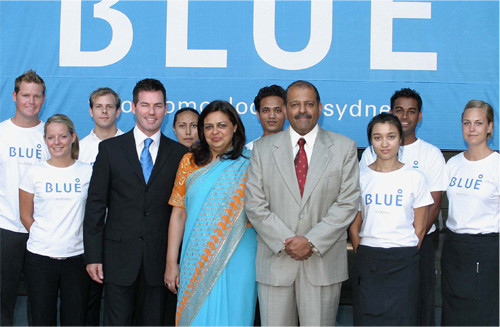
At the Blue, Sydney (from left, in front) general manager Michael Shannon, Taj’s Jyoti Narang, Indian Consul General Chinoy with hotel staff
Loyal credit
The Tata Group, covering 93 operating companies, announced on February 15, 2006 the launch of the Tata Credit Card. In association with SBI Card (which is a joint venture between State Bank of India, India’s biggest banking group, and GE Capital, one of the world’s leading finance companies) and MasterCard International, the Tata Credit Card is billed as India’s first credit-plus-coalition loyalty card, as per company sources.
While there have hitherto been a spate of co-branded credit cards with loyalty programs, they have been confined to single brands and single categories, for example an airline or petroleum company. Tata Credit Card customers, on the other hand, can avail of benefits not only from Tata Group companies such as Tata Motors, Voltas, Tata AIG, Westside, Taj Hotels, Titan, Tanishq, VSNL, Tata Indicom, Star India Bazaar, Landmark Bookstores and NDPL but also from heavyweight corporates Air India, Indian (formerly Indian Airlines) Jet Airways, BPCL (Bharat Petroleum Corporation Limited) and the India Today group. This multi brand coalition loyalty program is named The Tata Privilege Program and customers will be rewarded through Tata Reward Points, as per a press release from Vaishnavi Corporate Communications.
For every Rs 100 spent, a customer can earn up to six Tata Reward Points from the partner brands and one point when they shop anywhere else with the Tata Credit Card. Each point is worth one rupee. As an introductory offer, customers will be able to earn four Tata Reward Points for every Rs 100 spent on all purchases with the Tata Credit Card, effectively offering a four percent cash back to the customer on every spend he makes, the release adds.
The Tata Credit Card entitles clients to withdraw cash from over one million ATMs worldwide and 13,000 ATMs in India, including over 6,000 State Bank of India ATMs. The card will be accepted at 24 million outlets worldwide and 1,10,000 outlets in India. It also entitles the user to complimentary personal accident insurance up to Rs 30 lakhs from Tata AIG.
"In bringing together the powerful Tata brand, the expertise of SBI Cards and the innovation and global strength of MasterCard, this card will reward customers in virtually every area of relevance to them,” Nitin Gupta, country general manager, South Asia, MasterCard International, stated at the launch. Since Reward Points will be added across several partner brands the accumulation of points would be faster.
"Coming soon are more innovative offers – Instant Rewards that eliminate the need to call the Helpline for Reward Vouchers and allow the customers to redeem their Tata Reward Points directly at the cash counter in partner brand stores; a Tata Card for those who wish to become members of only the Tata Privilege Program without the credit card facility,” details the press release. "We are looking at increasing the tie-ups to other companies also,” Roopam Asthana, chief executive officer, SBI Card stated at the launch, reports The Economic Times, February 16, 2006.
The Tata Credit Card will initially be available in Bombay, Delhi, Bangalore, Calcutta, Hyderabad, Poona and Jamshedpur. By May 2006, it will be available in all major cities and towns in India, state company sources.
Trusting TCS
Prestigious Stanford University of the US and leading global IT company Tata Consultancy Services have entered into a five-year research and development collaboration in the critical area of data security and privacy. The project started on January 1, 2006 and "TCS is contributing one million dollars in terms of people costs,” states The Hindu of February 14, 2006 reporting on a press conference in Bombay addressed by TCS chief executive officer and managing director S. Ramadorai and Mathai Joseph, head, Tata Research Development and Design Centre, TCS’ software engineering research center in Poona.
Stanford University is part of TRUST – Team for Research in Ubiquitous Secure Technology – a multi-university initiative that includes the University of California at Berkeley, Cornell and Carnegie Mellon Universities as well as industry partners like Cisco Systems, Hewlett-Packard, IBM, Intel, Microsoft, Qualcomm, Sun and Symantec. "The collaboration with TCS is an exciting opportunity to engage India’s high technical and scientific skills to help accelerate progress in this important field of data privacy,” said James Plummer, dean of the School of Engineering at Stanford University, reports www.tata.com
In September 2005, TCS had clinched a $ 260 million deal, the largest by an Indian IT services company, for a five-year contract to provide applications support and enhancements to Dutch banking major ABN Amro, a landmark order prominently reported on leading Indian television channels and print media.
◆ ◆ ◆
From the archive