
Business
Viable vials
A premier manufacturer of ampoules and tubular vials in India, Kaisha’s health care products are also exported to 35 countries
Four million of them are dutifully checked, inspected and examined each day before they are permitted to leave for their destination. Knowing that they are on a health mission the screening has to be very stringent. Packaging health care is seen not only as a business opportunity but also as a responsibility by Kairus Dadachanji, managing director of Kaisha Manufacturers Private Limited, recognized as a premier manufacturer of ampoules and tubular vials in India. "We have to ensure that no substandard product reaches the patient in the market… more particularly in the case of injectibles which go directly into the bloodstream where there could be immediate and disastrous consequences,” stresses Dadachanji.
Started with an investment of Rs 25 lakhs by the two enterprising partners — Dadachanji and Shapoor Mistry (scion of Shapoorji Pallonji) — and a turnover of Rs 70 lakhs nearly 15 years ago, today their turnover is close to Rs 100 crores and expected to double in the next two years, reveals Dadachanji. The name of the company, Kaisha, was coined, putting together the first syllables of their first names. Beginning with ampoules their production line in Daman expanded to include vials and pre-fillable sterile syringes. Requiring high technology and high knowhow the delivery system offers sterile syringes under the brand name of Safepac. Growing at an annual pace of 35-40 percent, next year they hope to see a growth of 100 percent. With the setting up of their new company Sovereign Pharma Private Limited where Dadachanji, Mistry and Poonawallas of the Serum Institute are partners, they have forward integrated into pharmaceuticals. "Dealing with practically all major pharmaceutical companies — multinational or local — we have built up a mutual business relationship and a strong bond of trust, making it easier for the pharmaceuticals to move ahead with us,” says Dadachanji.
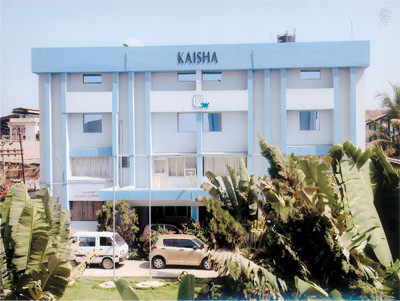
Kaisha plant in Daman
Presently 35 percent of their production is exported to 35 countries across the globe but by the year end it may rise to 50 percent. "The fact that they are asking for more and more material from us would endorse that our products are well accepted.” Taking pride in their GMP (good manufacturing practice), meeting the approval of different regulatory boards (with each country being governed by its own Food and Drug Authority) Dadachanji explains how "you have to prove that systems are in place from the first stage to the last with relevant documentation.” With their production and inspection machinery imported from Europe they take pride in announcing on their website (kaishamanufacturers.com) that they have "fully integrated, fully automated operations… computerized controls and in-built camera (that) ensure close monitoring of the production process and strict adherence to specifications… the world’s most advanced electronically led after forming line,” all conforming to international standards. Referring to the discipline and sterilization code adopted in the plants, Dadachanji elaborates, "I may own the plant but I can’t walk into the filling plant. Only authorized people in authorized clothes may pass through authorized areas.”
The prevalence of spurious drugs in the Indian market makes the manufacturer remark, "We are continuously pushing pharmaceuticals to better their packaging so that it becomes more difficult for people to copy.” The Drug Price Control Order regulates the industry by preventing pharmaceuticals from raising their prices beyond a certain level in the market. "The manufacturers are squeezed with many of them considering the option of withdrawing their product from the market when it is not viable beyond a point.” While appreciating "the government stand that medicine should be affordable to the common man,” Dadachanji maintains, "You have to give what the market desires…
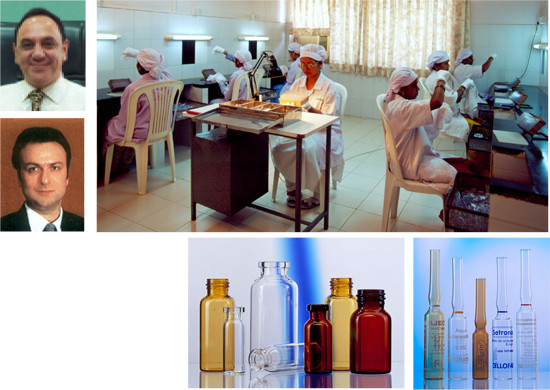
Kairus Dadachanji (top) and Shapoor Mistry; (right) in-house quality control and inspection for superior vials, ampoules and syringes
"India will be the pharmaceutical hub over the next 10 years,” predicts Dadachanji, pointing out how Indian companies are buying companies in the West. "The world has to stand up and take notice. They need to be in India if they want a share of the pie.”
He recalls the time when they entered the market and "completely changed the state of vial manufacture.” He was aghast when he learnt that some vials were being produced in open sheds with the manufacturers rationalizing, "We have been doing it for so many years. It’s working well.” Counters Dadachanji, "Just because you have not had a problem does not mean it is correct. It’s living on borrowed time. It is difficult for us to try and convince the local market to improve by investing in technology. There are some who understand (the import of this) immediately and yet others who understand but don’t want to understand.” He thinks it "very important to curb the menace of spurious drugs. The government should take strong action against those who are caught; make it difficult for them to operate. It would send a clear warning to others…”
In addition to maintaining exacting standards, timely delivery of consignments is equally important. With a workforce of over 1,000, Kaisha’s plants work 24 hours a day in three shifts, six days a week, and sometimes on the seventh too although ideally Dadachanji likes to keep it closed for a day for maintenance. While Dadachanji insists that he works six days a week, his wife Pervin, a homemaker, is of the opinion that he puts in eight days a week, he smiles. "We have a lot of professionals working for us. But launching new things, expanding, completing assignments on time,” require Dadachanji to spend four days a week in Daman. Referring to the involvement of his partner Mistry, he says, "We form policies together and then it is my job to take it further.”
His two children, daughter Faarah, 19, and son Rishad, 17, are presently studying at Bombay’s H. R. College of Commerce and Economics and their father hopes they will join the business after they have obtained "a solid educational background and gained experience overseas to understand international business. Today if you have no global experience, you don’t stand much chance.” The scenario was different when he started the business after schooling at St Mary’s and graduating from Bombay’s Sydenham College. Kairus’ father Shavak, then managing director of pharmaceutical major Merck Sharp and Dohme had been keen too that his son study abroad. But "not being interested in numbers and paper,” and after studying three or four business possibilities Kairus realized that his interest lay in manufacturing. With his father’s profound knowledge in pharmaceuticals it was logical that the son choose an allied industry. "It was a big learning curve. The more interest one takes, the more one learns…The children will walk into an established organization. They need to understand the values and efforts that have gone into building this up. They have to move up the ranks.”

Fully integrated, fully automated operations ensure quality health products
Presently his family includes mother Homai, brother Phiroze who runs a transport business in Poona and sister Persis Freddy Guard who is settled in USA. Unfortunately his father, whom Kairus considered his "friend, well-wisher and guide and the only person who could make me change my views with his power to influence,” did not live to see his son’s success. A prominent photo frame of the father adorned the wall of Kairus’ Bombay office at New India Centre alongside that of Zarathushtra.
Just as his father never stopped him or dissuaded him from finding his own career, he believes "Parsi parents should give children the freedom to take calculated risks and do what they want to. We tend to be over conservative which does not gel with the modern generation. They are quicker…If we suppress the zeal then we are killing the intensity with which they want to move. Parsi entrepreneurship is limited, it should be much more.”
A trained navar who views himself as "a very strong believer in my religion,” saying his kusti prayers at least twice a day and visiting the Udvada Iranshah regularly, his base in Daman being just 10 minutes away, he feels obligated "to do anything and everything we can for the community. I am not orthodox but that does not mean I am abusing anything the religion is offering. Times change, things change and one must learn to adapt. It’s in our nature to be more mild than necessary.” But the public uproar over trivialities Dadachanji sees as being "off focus…missing the core issues. In a community where we are already a handful, it’s only going to take us two steps backward.”
Dissatisfied that issues "burst into the public domain before being discussed at smaller forums,” Dadachanji notes that "people at the helm should command respect. It is not sufficient to raise funds from others and do charity. People who are really doing charity are not talking about it. Shapoor does immense charity but till today I have not heard a single word from his mouth but only from others. Instead of looking for publicity, it is the betterment of the community which should be the objective. It’s the cause and success of the cause that we have to put before the self. If wrong people are getting into positions of power, it is very critical for the community.”
Would he be willing to work as a Bombay Parsi Punchayet trustee? "It is not easy to get there,” he states, and if it were, he would be interested "provided we have the freedom to discuss and effect changes for the betterment of the community; not just to support those in power.”
◆ ◆ ◆
From the archive