
Cover Story
Socking it right!
Virat Industries in Navsari manufactures colorful varieties of socks for reputed brands abroad
"Currently our main markets are the United Kingdom, Switzerland and the United Arab Emirates. In this business the main ingredients of success are quality, trust and timely deliveries. Many an Indian company has failed due to no commitment in delivery,” says Adi Madan, managing director (MD) of Virat Industries Limited (VIL) in Navsari. We are standing on the shop floor at Virat and all around us computerized electronic knitting machines are churning out at high speed, socks of all shades and styles and for all seasons!
Laid out on long tables in the aisles between the clattering machines are children’s socks full of the happy hues of childhood, ladies socks, speckled or sprinkled with the lure of lurex, socks plain or patterned for men in staid suits or sturdy enough for footballers’ rough runs! They are made mainly in cotton/wool, as per the clients’ orders. "We make around six million pairs annually. About 95% of total revenue comes from export sales. Our customers are some of the biggest high-end reputed retailers abroad. We set up this company from scratch and none of us knew anything about socks. We have all learnt the socks trade with experience. In India there were no organized socks producers. Today socks produced in Navsari in Gujarat are sold in Oxford Street in London. When you walk into a shop there and see your product on the shelves and the ‘Made in India’ label, you feel an immense sense of pride,” asserts Madan.
Laid out on long tables in the aisles between the clattering machines are children’s socks full of the happy hues of childhood, ladies socks, speckled or sprinkled with the lure of lurex, socks plain or patterned for men in staid suits or sturdy enough for footballers’ rough runs! They are made mainly in cotton/wool, as per the clients’ orders. "We make around six million pairs annually. About 95% of total revenue comes from export sales. Our customers are some of the biggest high-end reputed retailers abroad. We set up this company from scratch and none of us knew anything about socks. We have all learnt the socks trade with experience. In India there were no organized socks producers. Today socks produced in Navsari in Gujarat are sold in Oxford Street in London. When you walk into a shop there and see your product on the shelves and the ‘Made in India’ label, you feel an immense sense of pride,” asserts Madan.
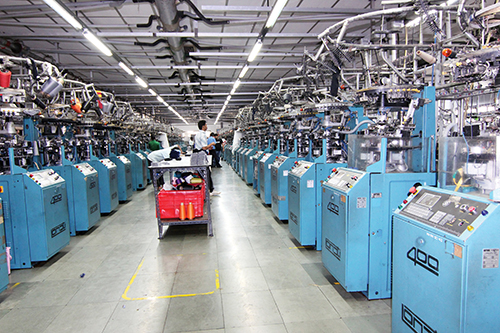
Spacious knitting hall with computerized machines
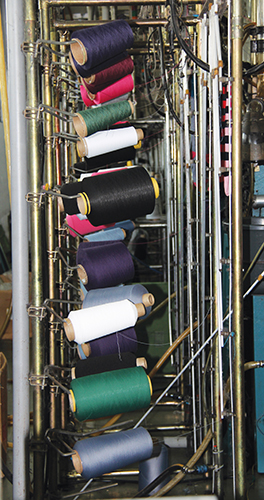
Colors of cotton
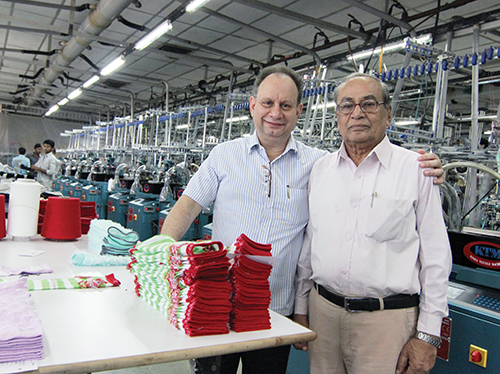
Adi Madan (left) with Nirmal Awtaney
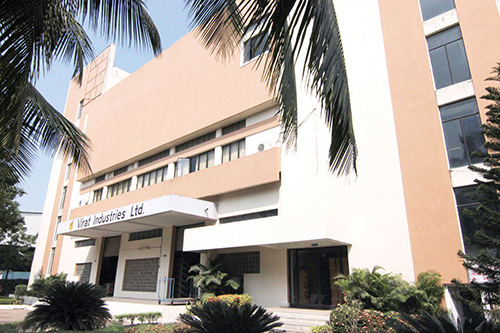

Factory exterior and logo
A public limited company, VIL is presently the largest manufacturer-exporter of dress socks among companies listed on the Bombay Stock Exchange, as per their fact file. Naozer J. Aga is chairman emeritus, Arun S. Sanghi the chairman of the board. (Sanghi is also chairman of the Sah and Sanghi Group of companies.) Naozer’s son Armand and daughter Ayesha K. DadyBurjor are directors along with Ajit Walwaikar and Harish H. Shah. Madan, based in Bombay, visits the factory frequently, oversees the operations and is responsible for the sales and marketing functions. Nirmal Awtaney is president-works at the plant which is situated in the GIDC (Gujarat Industrial Development Corporation) Industrial Estate in Navsari, adjacent to NH (National Highway) No. 8 which connects Bombay to Navsari and then Surat, which is less than 50 km away. A mid-sized industrial town, Navsari is approximately equidistant from Bombay and Ahmedabad on the main Western Railway line. VIL operates as an export unit under the Export Promotion Capital Goods scheme.
In Geneva last year, VIL was presented the Century International Quality ERA Award in the gold category by BID (Business Initiative Directions), with Madan receiving the award on March 10 at the hands of Jose Prieto, president and chief executive officer of BID. "The company has made huge strides recently as a leader for its sector and in India. The Award recognizes entrepreneurial achievements and also their dedication to continuous improvement and innovation — key concepts of the QC 100 Total Quality Management Model,” noted www.ideasb2b.com writing about the winners. Ninety two companies from over 50 countries attended the convention at the Intercontinental, a stone’s throw from the United Nations and the Red Cross headquarters. "This is a very prestigious award and we got it without applying for it. They have their own system of locating awardees through reference of earlier awardees. It is a secret ballot and they only let you know once you’re selected,” asserts Naozer. Interacting with other winners from countries like Ghana, Cuba, United Arab Emirates, Netherlands, Romania, etc was an eye opener, declares Madan. "There were people from so-called third world countries doing excellent work,” he adds.
In India we consider socks a mundane part of dressing but in the West socks are looked upon as an item of fashion (in terms of design, different knits and colors), observes Naozer as we speak to him and other directors in the office of Armayesh in south Bombay. The family is highly experienced in the fashion industry since the 1970s when Naozer and his wife Sheila promoted Armayesh, a leader in the manufacture and export of hand embroidered products to high fashion designers around the globe (See "Exquisite Embroidery Expertise,” Parsiana, October 1997). The Armayesh Group today comprises six private limited companies, one limited liability partnership called Armayesh Enterprise LLP with Armand’s wife Niloufer as chief executive officer, and one public limited company.
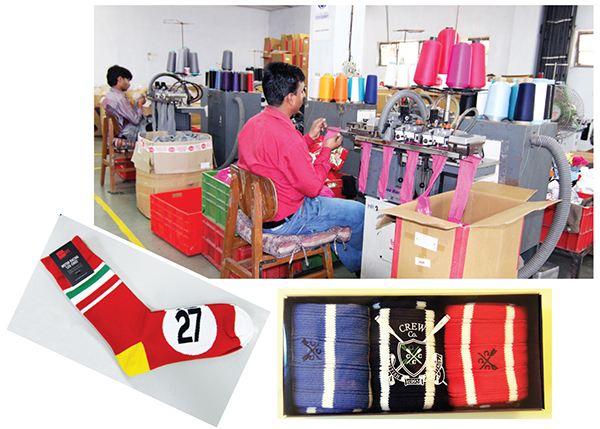
Work in progress and finished products for foreign markets
Naozer tells us about VIL’s nimble-footed growth. "The company’s performance for the half year ended September 30 has been excellent. We have achieved a profit in the first six months of this financial year what we did in the whole of last year.” A strong order book, including from new customers in the USA and Australia for niche varieties, ramped up production, better product mix and favorable foreign exchange rates have been contributory factors. Contract manufacturing is a complicated business and to be a credible competitor their product has to meet international norms in terms of comfort, stretch, sizing, skin care, etc, declares Madan. "Our main competitor is Turkey. There are two reasons for this. As a EUCU (European Union Customs Union) member Turkey can dispatch socks to the European customer with an exemption of customs duty. The transit time by road to Europe is around five to six days, so costs are less. Istanbul has around 12,000 socks factories! They are very strong in socks. In Europe the industry has become uncompetitive because of high labor costs. We realized this when we were studying the market in the UK. They wanted to shut production and buy offshore. We found that particular niche.”
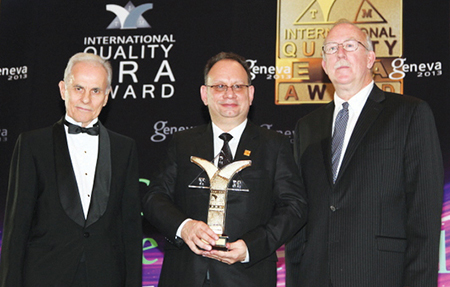
Madan (center) with International Quality ERA Award, flanked by Jose Prieto (left) and Norman Ingle
The factory itself is neat, clean and meticulously organized, including the warehouses for the storing of yarn and the finished goods. The rules for outsourcing are very strict, Madan mentions, and big retailers have become more so for countries like India, Sri Lanka, Bangladesh, Vietnam, etc following a fire in a garments factory in Bangladesh. The MD himself is thoroughly conversant with the production process and explains the details as we move around, starting with the knitting department on the second floor. "We have 100 machines, from Italy and Korea and more machines are coming. It takes five minutes to make one sock (men’s size). It all depends on the style and design. All the yarn we use is pre-dyed.” He shows us the united colors of yarn: "Two yarns are twisted to get this effect… Ribbed socks are more of a classic variety, mercerized socks are finer…”
As we walk along the aisles, Madan points to what is labeled Matching Mismatched Socks! "This is a new concept. A ‘pair’ consists of three socks – two are the same and one is of a different design or all three can be different! Wear what you want. Customer’s choice! Ninety percent of the customers send us the designs as they have whole teams of designers. Certain clients want you to do the designing which is done on the computer and fed into the machines with special software. Production is taken up after the samples receive the stamp of approval.” The large knitting hall is full of clatter and color! Intense-faced operators, overseeing seven to eight machines each, check each sock as it pops out after the first stage is done. Segregated into acceptable, mendable and seconds, they are clearly marked with tags and brought down by pallet truck to the finishing department on the floor below via the capacious, heavy-duty lift.
Automated processes at this stage include linking (stitching the seam), turning and boarding. "We do steam boarding (in which each sock is stretched over a foot-shaped board). Most socks people don’t have this machine. The sock is simply pressed (ironed) without the heat. Normally a one centimeter plus minus is allowed as per each size. But within the pair there can be no difference,” he explains as we watch workers putting each pair together. The menders dexterously repair very tiny holes they may detect on scrutiny. "The repairing is done by hand using the same needles that are used by the knitting machines, as finely as if the machine has done it. Abroad they don’t even do this because of the labor costs.” What is the rejection ratio, we query. "It’s about three percent overall,” he responds, adding that no consignment of theirs has ever been rejected. The packing is done as per the assortment required. "Some want a five day-pack,” he says, showing us the days Monday to Friday knitted into the socks! For others it may be a five-pair pack or a three pair gift box specially designed by VIL. The colorful labels, which they get printed in Bombay, display the brand name, the bar code and the price — in Swiss francs (if the consignment is going into stores in Switzerland) or GBP (Great Britain pound) or the relevant foreign currency. "The product is advertised in catalogs months in advance and has to be in the store on that day,” Madan emphasizes, so taking time out may mean being timed out! "The basic hallmark of this business is ‘always tell the truth.’ We do not accept an order if we do not have the necessary production slot available.” Many companies accept and then get socked off the shelf!
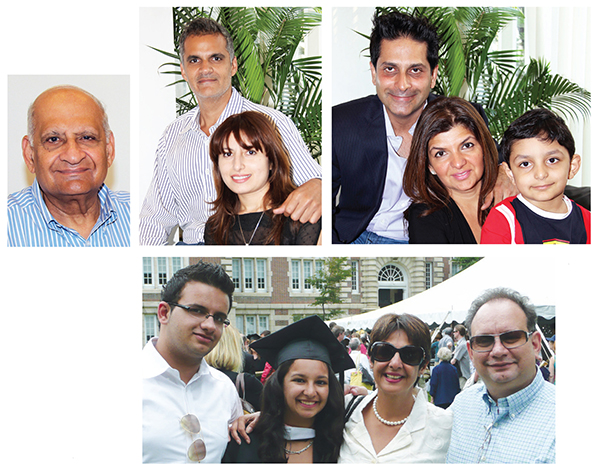
Naozer Aga; Armand and Niloufer Aga; Kaizad and Ayesha DadyBurjor with son Keanu;
Adi, Ayesha, Janeen and Jehan Madan at graduation in the US
The factory itself is designed and engineered by Gherzi Textil Organisation, Switzerland and their associates Gherzi Eastern Limited, Bombay. Virat commenced production in 1995 and the project cost was around Rs 85 million, states the company’s website www.viratindustries.com "The word Virat means ‘huge’ in Sanskrit,” Madan informs us. The building is presently compact in size but the management is looking at expansion, with the original plan incorporating room to grow. "During the first few years we experienced many problems. There was shortage of funds and few orders. But as the customers started liking our quality, services, communication, sampling, etc, they developed trust in us and orders came at an accelerated rate,” Awtaney tells us. On the technical side, the right enabling environment has to be created. Knitting machines, which run round the clock all days of the week, need compressed air so that the needles move easily and the risk of rusting is reduced. Humidity control ensures that yarns are lubricated and there are no breakages during production.
"It’s a Himalayan task to pass the social audits. Labor laws, fire safety, health and safety, norms of air and water pollution, etc have all to be complied with. The factory can’t run without Awtaney who has been with us for the last 17 years,” commends Madan. There is no unit of this size in the Industrial Estate and whenever a minister or other VIP comes to visit, he is shown VIL as a model factory in the Estate, he adds. "Awtaney will bear me out that in a small place like Navsari, young boys and girls aspire to work for Virat. The attrition rate is virtually zero as most of the staff and workers live in the vicinity. Most of them, including the ladies, have been with the company from inception.”
The Aga family’s association with VIL started around 2003-04. The company was originally promoted by Madan with other partners who wanted to opt out as the business was incurring losses, explains Naozer. Madan being related to the Agas by virtue of the fact that Naozer’s mother Shirin and Madan’s grandmother Tehmina were sisters (daughters of Sir Dhunjisha Cooper, founder of Cooper Engineering Limited of Satara and the first prime minister of Bombay, as the post was known at that time), Naozer narrates that they were ready to invest in the business on the condition that Madan continue as MD. "It was a risk but a calculated one and the company turned the corner very soon.” Shapoorjee Chandabhoy Finvest Private Limited, a 100% family-owned, registered non banking financial company, became the new promoter with Naozer as chairman. Armand, Ayesha and her husband Kaizad are the other directors of Shapoorjee Chandabhoy Finvest.
For VIL, a quality product means an expanding footprint and bonding with the best brands! "Our turnover has grown from four crore to Rs 22 crore in less than 10 years. Our sense of pride is that in 2003-04 the share value of Virat was around one rupee and now (as of February 6, 2014) it is around Rs 36 per share of Rs 10,” avers Madan. The company has been paying dividend for the last five years. "The maiden dividend was five percent and has gone up to 15 percent for the year ended March 31, 2013,” notes Awtaney. "A large part of the credit for successful performance goes to Madan who has as managing director so ably executed the policy and strategy of the company, with his exceptional hard work, dedication, focus and commitment, coupled with the utmost of integrity and honesty,” acknowledges Naozer. "He has been fortunate in having Awtaney as his colleague, as without the expertise and support provided by Awtaney Virat would not have achieved such good results.” In its special feature of January 21, 2014, analyzing the stock performance of 3,000 companies of varying sizes, Capital Market mentioned VIL as an outstanding stock performer in the small/micro market capitalization sector in the last eight years.
Naozer retired from the board in March 2012 and was designated chairman emeritus. "At the time of takeover I was looking for someone to assist us on the VIL board. I requested Sanghi, whom I have known since 1952, to consider coming in as director. His query was ‘do you want me for namesake?’ I told him I wanted him as a fully interested and involved director! His hands-on role, his vast local and international experience has been invaluable.” "At the board level, his (Sanghi’s) analysis, direction, policy and vision have been tremendous. He studies things meticulously. He has been a great contributor,” Armand remarks. "My father too is very forward thinking, very sharp and a great number cruncher. They push the team to execute, so an idea doesn’t remain an idea which lapses. They see it through. We (the management) are all on the same page and complement each other.” Walwaikar was earlier company secretary and was brought in subsequently as director. Shah joined the board in 2010 in place of the retiring M. G. Kulkarni, a renowned textile expert who had worked with top textile mills in the country and who had been with Virat Industries since inception. Armand and Ayesha have been significantly contributing to Virat as directors and will eventually shoulder increased responsibilities, their father asserts.
Madan has been associated with VIL from inception in 1990. Navsari was a sleepy town, he describes, and high rises have come only in the last 10 years or so. It is famous for its diamond cutting business and has a large number of non-resident Indians who come calling each winter! The Parsi population has been steadily depleting. "There was a Parsi club,” he recalls. VIL has no Zoroastrian from Navsari among its 130 plus workforce there. "My father Fredoon did his textile engineering from Manchester and was one of the oldest textile experts in India. I have memories of going to Bombay Central station on a Saturday or Sunday morning to pick him up when he returned from Navsari where he was looking after the Navsari Cotton and Silk Mills owned by Jal Mehta (whose wife Roda is also one of the Cooper sisters). Little did I know that I too would be travelling to Navsari by Flying Rani to look after a business there!” Madan’s maternal grandfather Dr Dara Variava was a surgeon in Rajkot and a member of the Rajya Sabha in the 1950s. "My mother Roshan (Ruby) was a cookery expert and her recipes are incorporated in the Time and Talents cookbook,” says Adi. His wife Ayesha has made a name in chocolates under the brand Choc O Bloc. Their daughter Janeen worked for two years with the World Food Programme in Dakar, Senegal. She is currently doing her Masters in the Friedman School of Nutrition Science and Policy at Tufts University in Boston. Son Jehan studied in H.R. College and works in a digital marketing company as a senior content strategist.
At the age of 72, VIL’s chairman emeritus remains achieving and adventurous! A connoisseur of bikes, Naozer still rides his racing Honda CBR1000RR Fireblade to Panchgani and back every month with an overnight halt in Poona. Hot on his horizon is the Kawasaki Ninja ZX 10R, 2014 model which he has bought. Being a first generation entrepreneur and having dared to go global, Naozer knows the realism of retailing. "India can develop into a manufacturing powerhouse competing with any country on quality, prices, delivery and any other parameter. The problem today is that rules, regulations, paperwork and procedures are so excessive that company directors and management are more anxious about not breaking any law than about increasing the business. The trends are favorable, but regrettably not translated into visible action by the government.” India’s image, he believes, is much better than it was and it will become more so with proper government policies. Entrepreneurship within the Zoroastrian community is on the decline, Madan believes, with young people preferring professional careers or secure jobs with banks and multinationals. "The spirit and appetite for entrepreneurship is low also due to the fact that it is considered very difficult to set up an industry due to various government factors/permissions/competition/high interest rates,” he observes. He mentions Mustang Socks and Spenta Industries Limited of Palghar as being among the Zoroastrian socks manufacturers.
For VIL, the direction is clear. "We are continuously expanding, increasing the capacity each year by 10-15%. We’ll extend the factory building also,” Madan asserts. "We will focus on marketing, local sales, a JV (joint venture) with a foreign socks manufacturer if possible and even mindful diversification if the opportunity arises,” notes Armand. And feet will remain firmly fixed on ground realities!
◆ ◆ ◆
From the archive