
Religion
The lure of Iranshah
Despite the journey, people still make their pilgrimage to the most ancient consecrated fire in India
The Iranshah Atash Behram presently enthroned at Udvada was the first ever holy fire consecrated in India.
After the downfall of the Sassanian dynasty, a group of Parsi Zoroastrians left Iran to protect and preserve the religion and the community and landed at Div, to the south of Saurashtra. They stayed there for 19 years. Thereafter, due to threat of Arab invasion, they left Div and landed in Gujarat, on the west coast of India.
The Hindu king known in the Parsi tradition as Jadi Rana, granted the Parsis permission to settle in his kingdom and allotted a vacant plot of land where Parsis settled and established their colony (in 716 AD). The Parsis named their new settlement ‘Sanjan.’ The High Priest of the Parsis then requested Jadi Rana to allot a separate piece of land where they could install their holy fire. He granted a secluded piece of land as well as necessary assistance so that the Parsis could ceremoniously install the holy fire. The necessary religious requisites (alat) were brought from Khorasan, a province in eastern Iran by land route. Under the leadership of the High Priest, Dastur Neryosang Dahval and with intricate religious ceremonies, the holy fire was consecrated and enthroned on Adar mah, Adar roz in the year 90 AY (721 AD) and was named ‘Iranshah.’ The Spiritual King of Iran thus kept the remembrance of Zoroastrian Iran for ever.
The Parsis gradually migrated from Sanjan and settled in various places particularly on the west coast of India viz. Navsari, Surat, Vankaner, Variav, Ankleshwar, Bharooch, Cambay and Thana. They required priestly services in their settlement and therefore the priestly cadre also began to migrate from Sanjan to the above mentioned places. They formed themselves into various groups. Around the end of the 13th century, they met together and defined and fixed their boundaries which formed the diocese (panthaks) of the five respective priestly groups, their rights and duties. Sanjana priests at Sanjan remained in the service of the Iranshah.
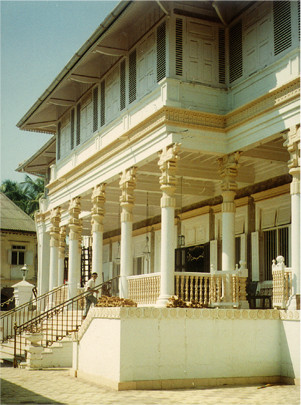
The Iranshah in Udvada: holiest of holies
After around 700 years of peaceful stay, Sanjan was invaded and destroyed by a Muslim invader and his commander. The Iranshah was removed from Sanjan and carried to the mountain of Bharot and kept in the caves at the top of Bharot for 12 years. Later it was taken to Bansda where the Iranshah remained for a further 14 years. Thereafter, at the instance of Behdin Changa Asha, a leader of the Parsis at Navsari, the Iranshah was shifted to Navsari under the leadership of three Sanjana dasturs in around 1419 AD.
In Navsari, the Sanjana priests were within the jurisdiction of the Bhagarsath priests and they remained in the service of the Iranshah. The holy fire remained in Navsari for about 320 years with the exception of about three years (1733-36) when it was carried to Surat due to political instability. Then it became necessary to shift the holy fire back to the jurisdiction of the Sanjana priests. In 1740, with the permission of the then Damajirao Gaekwar’s government, the holy fire was shifted to Valsad and in 1742 to Udvada where the Holy Fire Iranshah is enthroned and burning with radiance and glory till date.
Priests belonging to Udvada Nav Kutumbi (nine families) Athornan Anjuman of the Sanjana clan headed by the authors, the twin Vada Dasturs are in the service and tend to the holy Iranshah. The forefathers of the present day priests of Udvada Nav Kutumbi Athornan Anjuman have undergone tremendous hardships, sacrificed twice their settlements, properties, estates, etc to carry out their divine religious duties in the service of Iranshah.
In Udvada the holy fire had been enthroned in the temple buildings built by religious minded, charitable Parsis. For the past nearly 110 years, the Iranshah has been enthroned in the present building built by Lady Motlabai Manekji Wadia. The temple building is maintained by the Wadia Trust.
All the affairs of the Anjuman are carried out from the kind donations received from religious minded, charitable Parsis who contribute to the Kathi Fund, Iranshah Fund, Ravan Avalmanjal Fund, Dakhma Fund, etc.
The number of devotees over the past several years has increased though they may not stay in Udvada for a longer period. This is due to better traveling facilities available these days. On the night of December 31 every year when most people prefer to go for dance and parties, it is heartening to note that many Parsi devotees visit the Iranshah fire temple and offer prayers at midnight i.e. around 12.40 a.m. local time to celebrate the universal New Year.
May the blessings of the holy fire Iranshah be upon the Udvada Anjuman, Parsi community and humanity at large. Amen!
◆ ◆ ◆
From the archive