
Institutions
The Forum’s 50th
Founded on July 18, 1956, the Forum of Free Enterprise battled the socialistic mind-set of the country’s political leadership
From rigid socialism that curtailed all forms of economic development to the present day global ambitions of Indian industry, the Forum of Free Enterprise (FFE) has stood out as a beacon of liberal economic policies.
Celebrating the institution’s golden jubilee on July 19, 2006 at Bombay’s The Taj Mahal Palace and Tower hotel, Minoo Shroff, president of the Forum recalled how the body started out under the chairmanship of his late uncle, the noted economist, A. D. Shroff. The FFE published articles on the contribution of the private sector, delivered talks on free enterprise and networked with members of parliament.
"There was incredible apathy” from business houses and individuals but the Press was "surprisingly supportive,” reminisced Shroff who is also the chairman of the Bombay Parsi Punchayet. Though the Forum’s opponents predicted its "early demise, the Forum grew from strength to strength,” he noted. Reputed jurist, taxation authority and past president of the Forum Nani Palkhivala "relentlessly fought for human rights.”
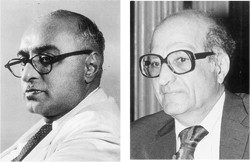
A. D. Shroff (left) and Nani Palkhivala: the Forum’s torch bearers
The contribution of M. R. Pai, the Forum’s former secretary and vice president for 47 years was recalled by Shroff. Around a lakh of people have participated in the Forum’s activities. FFE’s achievements "could not have been (possible) without Pai.” Shroff also lauded the late Pai for grooming well his successor, S. Divakara, the body’s director general.
S. S. Bhandare, adviser to the Tata Strategic Management Group, a member of the Forum’s management council and co-author with professor of political economy Ajit Karnik of the book Eventful years released that evening by noted industrialist Ratan Tata, recalled the crowds that gathered at the Brabourne Stadium to hear Palkhivala deliver his annual critique of the Government of India’s budgets. The book seeks "to capture (the) fascinating story of the Forum” from 1956 to the present, notes the preface.
Tarun Das, chief mentor of the Confederation of Indian Industry (CII) speaking on "Adapting Indian Industry to Globalization” noted how well the house of Tatas had "adapted to globalization.”
The basis for Indian industry to venture abroad is "competitiveness,” said Das. The second requirement is technology. This required a substantial investment in research and development. "You can’t depend on a single market” anymore, said Das. "There’s no choice for the big boys. They have to go out…their bed is often on an aircraft… they have to cope with change… they have to follow different policies in different parts of the world.”
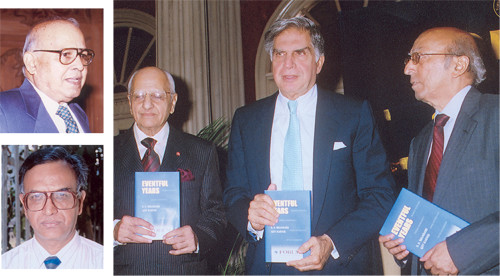
Above (from left): Minoo Shroff, Ratan Tata and Tarun Das launching the book, Eventful years. Far left: M. R. Pai (top) and S. Divakara
Protectionism, however, was increasing "especially in the West… (there are) non-tariff barriers as we call it. (They want to) keep India out of the market place.” Noting that India had "amazing talent” with 500 million people under the age of 30, Das said India would be the "global hub of the service sector” and that our "manufacturing and engineering skills will be on par with China.”
Socialist policies that "reserved” certain industrial sectors for the small and medium scale enterprises crippled the growth of India’s manufacturing base. Otherwise instead of cheap Chinese goods flooding the world market, it would have been Indian products, Das said.
India still had a long way to go to "clean up” policies that hampered industrial development. For example the chief executive officer of a software company lamented that it took "14 months to get environmental clearance” for constructing a building to house training facilities and classrooms on the company’s campus, Das remarked.
Shroff noted that if the liberalization process in India had started 15 years earlier, "we’d be talking of India and China instead of China and India.” Comparing life to an endless marathon Shroff noted, "if you want to run, run fast.”
◆ ◆ ◆
From the archive