
Institutions
Pondi's Parsis past and present
The Parsi graveyard is spruced up through the initiative of Vantage Advertising
It was while inspecting some Christian graves in Pondicherry over two years ago that Donald Joseph of Vantage Advertising (VA) of Madras observed the dilapidated condition of the Parsi graveyard in that South Indian town that was once a French colony. "The caretaker (of the graveyard) at that time was under the impression they were Muslim graves,” notes Zarin Mistry, honorary secretary of the Madras Parsi Association.
At the behest of Darius Bahadurji, managing director of VA the graveyard was cleaned in mid-2005 by the cemetery caretaker and gravedigger and the gravestones were spruced up. There are six tombstones all of which are built of granite and inscribed with brass inlay work.
The cemetery which is rectangular in shape and measures 15 feet x 60 feet is under the jurisdiction of the former French colony’s municipality, notes the write-up sent by Bahadurji.
"I understand the municipality has plans to rebuild the breached wall but I guess that will have to be followed up,” says Mistry. The wall is four feet in height and is broken at two places (at a length of 12 feet and eight feet). After 1928 there don’t seem to be any Parsi graves in Pondicherry. Possibly the bodies were then brought to Madras (for burial). The entrance gate is missing and there is no signboard declaring it a Parsi cemetery.”
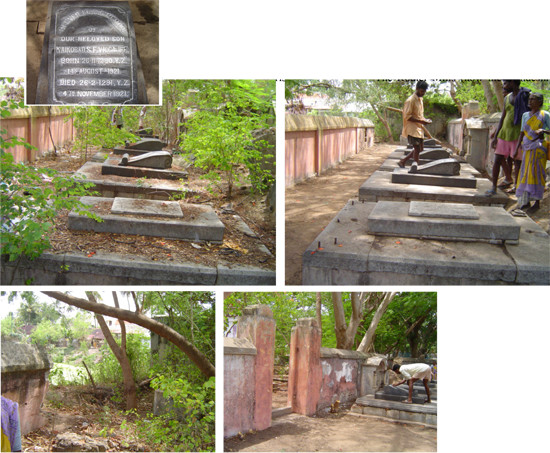
Clockwise from top left: A washed grave- stone; the graveyard before and after the clean-up; the missing entrance gate and
one of the two breaches in the wall
History
Madras resident Noshir Choksi gives a brief history of the Pondicherry Parsis and the cemetery. His maternal grandparents Tehmina and Dhunjisha Manekji Chhapkhanawalla were married in the year 1900 in Bombay. They shifted to Pondicherry immediately after their marriage and settled down in a house in the Savana Mills (now the Anglo-French Textile Mills) compound. His grandfather was appointed as chief dyeing master in Savana Mills. This still was under the control of French management. Since the French found it difficult to pronounce his grandfather’s surname, they changed it to "Printer” and the new surname "Printer” continued thereafter.
There was one more textile mill — The Rodier Mills (now the Swadeshi Mills) — under English management at that time. Between these two textiles mills in Pondicherry there were five Parsi families who lived as permanent residents there: Dhunjisha and Tehmina Printer (Savana Mills), Khurshedji and Manekbai Eduljee (Rodier Mills), Sorabji and Khorshedbanu Viccajee (Savana Mills), the Toorkeys and Bhagwagars.
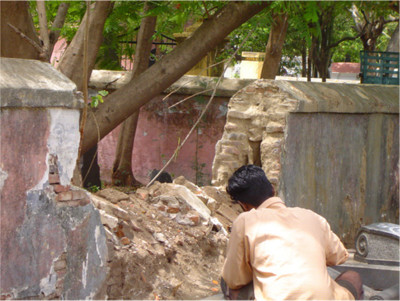
One of the two breaches in the cemetery compound wall
These families prospered and children were born unto them till sometime during 1910 or 1911 the Printers lost their two-year-old daughter Dhun. This was the first Parsi death in Pondicherry. A final resting place for the dead Parsis did not exist and the Printers had to seek the French governor’s help for providing a piece of land to be made into a Parsi aramgah. The French governor allotted the land within an existing Christian graveyard and thus was established the Parsi aramgah in Pondicherry in the year 1910 or 1911.
The Viccajee family, during their stay in Pondicherry lost three of their children: daughter Manijeh — born September 23, 1919, died February 26, 1920; son Kaikobad — born August 18, 1921, died November 4, 1921; daughter Freanny — born October 1914, died January 1923. The Bhagwagar family lost their daughter Dinbai Pallonji Mistry on March 20, 1924 in Pondicherry.
The last grave in the cemetery is of Dhunjisha Manekji Printer — born July 2, 1870 in Nagpur, died February 15, 1928 in Pondicherry.
The existing Parsi aramgah is located at Ambedkar Road, Netaji Nagar II, Pondicherry.
Parsis presently living in Pondicherry include Firoze Solina, Behram Minoo Solina, Dr Nergis Solina, Nergis Karaka, Coomi Banaji, Rookshaad Banaji, K. D. Sethna, Shehnaaz Lalit, Nergis Pesikaka, Firooza Aubry, Hufreesh Dumasia, Hufrish Sethna, Natasha Storey, Shiraz Panthaky, Ayesha Panthaky, Navroz Modi and Adil Writer.
◆ ◆ ◆
From the archive