
Books
Remembering Sorabjee
Down Memory Lane: A festschrift in honour of Soli J. Sorabjee. Published in 2020 by All India Reporter Pvt Ltd, Congress Nagar, Nagpur, 440012 website: wwwaironline.in; email: aironline@gmail.com/support@aironline.in. Pp: 576. Price: Rs 795 (hardback).
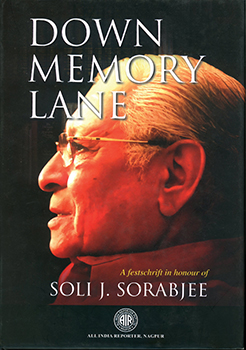 Soli Sorabjee’s demise on April 30, 2021 brought forth a torrent of tributes which was as well-deserved as it was anticipated. For more than half a century Sorabjee was a looming presence on India’s legal scene — a presence which was supplemented by his visibility in other ways as well, including as a newspaper columnist, public speaker, contributor to television programs, jazz aficionado, free speech activist, and briefly even as a special rapporteur under the United Nations’ human rights mechanisms. A gregarious and outgoing personality, he made many friends and acquaintances both within India and outside, and associated himself with a number of professional and other bodies around the world.
It must be a matter of some regret that, despite possessing a first class intellect and enviable powers of articulation, Sorabjee never channelled his energies to writing books during his long and distinguished career (with, it must be added, a couple of exceptions: there was a monograph entitled The Law of Press Censorship in India which appeared under his name in 1976, and another, a co-authored volume on Nani Palkhivala published in 2012). Truth be told, he lacked the self-discipline to devote himself to the task: many at the Bombay bar still chuckle at the recollection that he had committed himself to writing a new edition of a much-loved classic, Maxwell on the Interpretation of Statutes, some 40 years ago — a commitment that remained a mere promise at the time of his death (the commissioning executive for the book had, in the meantime, himself shuffled off his mortal coil and the publishing firm involved had ceased to exist!).
So, what we have now is the next best thing: a collection of Sorabjee’s writings put together between the covers of this book and published just a few weeks before his demise. Sub-titled a festschrift, the volume was released in Delhi in the presence of a physically frail, but mentally agile Sorabjee on the occasion of his 91st birthday (the constraints imposed by Covid meant that a larger function to celebrate that anniversary could not be organized).
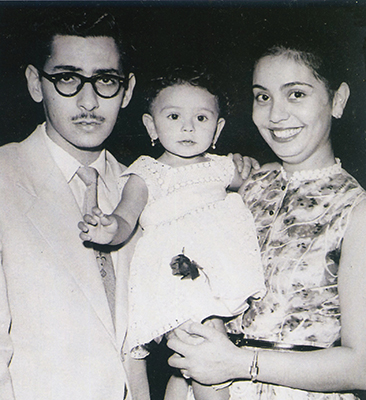
Soli and Zena Sorabjee with Zia
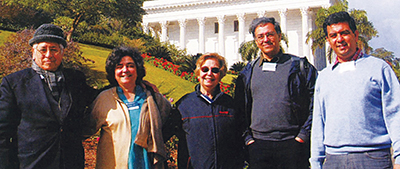
Soli, Zia, Zena, Jehangir and Hormazd Sorabjee
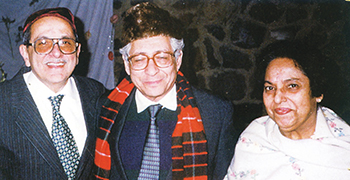
Soli Sorabjee (center) with Fali and Bapsi Nariman
The general editor of the festschrift is Pallavi Sharma, advocate, Supreme Court of India. The book, like many in the genre published in India in recent years, is a curious mix of Sorabjee’s own writings, on the one hand, and tributes paid to him by well-wishers, on the other. For good measure, a dozen photographs have been stuck on at the end, some from the Sorabjee family album and others contributed by friends and colleagues. This odd format appears to be quite a popular one, but it is likely to leave some readers slightly perplexed and bewildered.
The essays, 109 in all, span 10 subject areas: freedom of speech and expression; fundamental rights and duties; human rights; Constitution; rule of law; judiciary; democracy; Supreme Court and Bombay High Court; and remembrances. The second substantive section, tributes to Sorabjee from colleagues and friends, has 25 items, all arranged under the heading "Reminiscences.”
An inevitable criticism that the book will attract is that the classification of the articles is quixotic, even arbitrary: Why a separate section on freedom of speech when that freedom is very much a part of fundamental rights? How are "human rights” different from "fundamental rights”? Why have discrete sections on the Supreme Court and the Bombay High Court when both institutions come under the broad umbrella of "judiciary”? Many such questions can be asked, but it would be a mug’s game to pursue that line of enquiry because overlaps of that kind are inevitable (and, in the larger scheme of things, excusable).
There are, however, grounds for more serious criticism. For a start, the editing — if anything of that nature has even been attempted — is, to put it mildly, shoddy and careless in the extreme. There is overwhelming evidence that most of the items included in the collection have simply been scanned and reproduced without any serious attempt at proof-reading. Examples of glaring, inexcusable errors include: "Leseet Juris” (for Lex et Juris); "Memoty” for Memory (in the Table of Contents, no less); "Balanter” for Galanter; "Shivarao” for Shiva Rao; "Corner-stone” for Cornerstone; "she Supreme Court” for the Supreme Court; "Popular Jusist” for Popular Jurist… the list is quite long and depressing.
Editorial attention to the text appears to be conspicuous by its absence. No effort has been made, for example, to remove disfiguring underlining from the body of articles, or getting the spellings of contributors’ names right, or providing suitable headings for items appearing in the "Reminiscences” section (one has the cheesy title "A View from the Chambers of Padma Vibhushan Soli J. Sorabjee” — authored by a certain Nisha Bagchi whose frothy ebullience, incidentally, clearly outstrips her writing talents).
There is also huge inconsistency in referencing, and incomplete references abound. Case titles are occasionally italicized, but not uniformly — to compound the offence, sometimes only part of a case title is italicized. No effort is made to check the titles of books or other sources from which passages are extracted.
However, if these entirely avoidable blemishes are put to one side, there is much in the book that is illuminating, edifying and inspiring. The range of issues covered, despite overlaps, is impressive, and it testifies to Sorabjee’s eclectic interests. Many of the themes addressed in the articles are as relevant today as when they were first articulated over a period of four decades. In addition to matters of general concern — such as the rule of law, judicial independence, separation of powers, and democracy — Sorabjee has applied his mind to some complex questions, including: How far can freedom of expression be allowed to go without harming other interests? What should be the balance between rights and duties? Where should the line be drawn between acceptable and unacceptable judicial activism? How can the ideals of transparency, accountability and independence be accommodated in the system of choosing judges? Are equality and freedom reconcilable? There is a particular need for young people to be exposed to such debates, and the book therefore deserves the widest possible circulation. A practical way of maximizing the benefits of the book would be for a cheaper — and far lighter — paperback edition to be brought out, minus the "Reminiscences” and the photographs.
Those "Reminiscences” add very little to the value of the book or to the stature that Sorabjee had achieved during his long and rich career. To be fair, some of the tributes are sincere, touching, revealing, motivating and/or highly evocative. Many contain reminders of the uplifting values of a bygone era which is unlikely ever to return. But a lot of the tributes are pedestrian and formulaic. A couple of them are downright vapid, made worse by an embarrassing inarticulacy on the part of their authors. Sorabjee deserved better.
One of the noteworthy aspects of Sorabjee’s career was that he did not succumb to the temptation of undue self-enrichment through extortionate charging for his services. It is a sad reflection of our times that this fact even needs to be mentioned, but such are the levels to which avarice has taken hold of the senior echelons of the Indian bar that there is an unconscionable disconnect between effort, talent or application, on the one hand, and reward or remuneration, on the other. "Law,” observes Sorabjee pertinently in his Preface to the current volume, "is essentially a service oriented profession and does not operate on the laws of demand and supply. It is not a commercial undertaking.” Any hope of that message being heeded by today’s generation of lawyers is non-existent.
A final word that needs to be said about the book is that there seems to be, on the part of the publishers, something bordering on contempt for the reader. Pompously, they have inserted a disclaimer at the beginning of the volume as follows: "Although due care and caution have been taken to avoid any mistakes, errors or omissions while compiling, printing and publishing the names of parties, citations or any other matter published in this publication, readers should verify its correctness respectively from the concerned journal(s).” Leaving aside the questionable grammar of that sentence, many would argue that the disclaimer also suffers from the vice of inaccuracy because by no reasonable standard can it be said that the publishers have taken "due care and caution” to avoid mistakes etc, as has been pointed out above. But in the India of today, it is unlikely that many readers would complain — a reality which is more depressing than the appalling lack of professionalism on the part of the publishers.
Many of those who knew Sorabjee and his work will hope that his family will, in due course, collate and classify his papers, including what must be a significant corpus of correspondence, and, after careful selection and editing, bring out another volume — or volumes — which will do justice to this notable son of India. VENKAT IYER
Iyer is a UK-based barrister and legal academic.
◆ ◆ ◆
From the archive