
Cover Story
Cultural renaissance
Celebration of the 3,000th anniversary of Zoroastrian culture was spearheaded by UNESCO-PARZOR in Delhi, Bombay and Calcutta
It was an event planned with military precision. Never mind that Maharashtra governor Mohammed Fazal’s enthusiasm in viewing the exhibits in the foyer led to a delay in the start of the inaugural function. A thousand hearts swelled with pride as he spoke of "3,000 years of a great community of the world.” The sentiment was echoed by finance minister Jaswant Singh when he said, "You excelled in every sphere of national life.”
The speakers and the audience at Bombay’s Tata Theatre on October 2, 2003 were participating in the celebration of the 3,000th anniversary of Zoroastrian culture as declared by UNESCO. The pronouncement by the world’s premier cultural body had been made not at any prodding from India or Iran but at the request of the government of Tajikistan, a country that had once been a part of the great Zoroastrian empires of Iran.
The three millennia celebration had begun with the exhibition of "Pictures with a Purpose” mounted by PARZOR — the foundation for the preservation of vulnerable human heritage —under the aegis of the Indian National Commission for Cooperation with UNESCO (a wing of the Government of India’s Human Resource Development ministry) at Delhi’s Ashoka Hotel, July 8-10, 2003. Meant to coincide with the "Dialogue Among Civilizations” where 161 countries participated, the inauguration of the exhibition was UNESCO director general K. Matsuura’s first official engagement in Delhi. In the course of his inaugural address to the international conference Prime Minister Atal Behari Vajpayee had stated, "It is a fitting tribute to India’s longstanding tradition of tolerance that the Zoroastrians, a prominent minority community, are holding an exhibition to herald the celebrations of the 3,000th Year of Zoroastrianism, to coincide with this conference. They comprise less than 0.01 percent of our country’s population. Yet, they have made a major contribution to many walks of our national life.
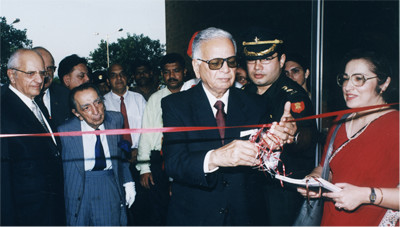
Governor Fazal inaugurating the exhibition. Looking on: Shroff, J. J. Bhabha and Cama
"The world needs to recognize the greatness of the Zoroastrian faith and culture, and help in its protection and resurgence. The Government of India (GOI) has lent full support in organizing this exhibition which will be taken to the other parts of the country.”
The Bombay event, October 2-4, 2003 began with the release of a five-rupee coin by Singh under the aegis of the Bombay Parsi Punchayet (BPP) bearing the visage of Dadabhai Naoroji 86 years after his death. The articulate Dadabhai had succeeded in getting himself elected to the British Parliament and had pleaded India’s case "seeking justice, not favors” as noted BPP chairman Minoo Shroff. Dadabhai had demonstrated the drain of India’s national wealth, describing the colonial economic policy as "UnBritish rule in India,” a charge that led to the establishment of a Royal Commission of Inquiry. He had spearheaded the education of women in India — an unpopular cause in the 19th century that resulted in threats to his person. A founder and three times president of the Indian National Congress, Dadabhai’s fight for swaraj led the young Mohandas Karamchand Gandhi, pursuing his own dogged path to becoming the "Father of the Nation,” to seek the advice of one he called his "dada” in a series of letters.
"Parsis are the most peace loving and patriotic of the people of India. It is fitting that the 3,000th anniversary is being celebrated and the Dadabhai Naoroji coin launched on the birth anniversary (October 2) of Mahatma Gandhi the greatest messenger of peace in the last century,” noted Fazal who released a revised edition of Dadabhai Naoroji: A Model for Indian Youth Today. A copy of the book by Dr Sarosh Wadia, first published in 1984, was presented by the governor to the late homeopath’s wife Daulatbanoo.
Singh recalled "the doyen of scientists, Homi Bhabha. What did he not contribute to Indian science?... princes of industry, soldiers, sailors, airmen... What is truly outstanding is that your community was never afflicted by any sense of minorityism, of lacking in confidence. It is truly remarkable how much you have contributed (to national life).” Singh emphasized that his words were "not part of a prepared text from my office... whatever I say, I do believe in from the bottom of my heart!” adding sotto voce, "(My) diligent officers work hard but not as hard as I work!”
The coin in a velvet box was formally handed to Shroff with the assurance that it will be legal tender and to the governor but before presenting a box to each of the BPP trustees and dignitaries on the stage Singh stepped off the dais to present the gift to Daulatbanoo Wadia, graciously bending low in the traditional Indian gesture of respect to the elderly.
It was Jamshed Guzder, then chairman of the BPP, who had urged the Government of India in 2000 to commemorate Dadabhai, Delhi Parsi Anjuman (DPA) president and PARZOR committee member Lt Gen (retd) Adi Sethna recounted the genesis of the coin in the souvenir produced for the celebrations. As member of the National Commission for Minorities Sethna was requested to liaise with government on possible ways to honor Dadabhai. Meeting with home minister L. K. Advani it was decided that a coin or currency note in Dadabhai’s memory would be a better remembrance than a posthumous Bharat Ratna. As the government had taken a policy decision that all notes would bear the imprint of Mahatma Gandhi only, BPP CEO, Behram Dastur’s concept of a five-rupee coin emerged as the most appropriate commemoration. The coin designed by Jamshed Irani was eventually minted in Bombay with BPP PRO Godrej Dotivala liaising with the general manager of the GOI Mint Arunesh Goorha.
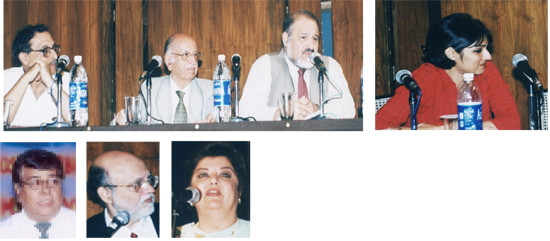
Clockwise from top left: Kapadia, Arceivala, Mistree and Moddie at Eco-ethics seminar; Gadihoke and Vyarawalla; Mody-Kotwal; Bharucha; Banthia
Chairman of the Expert Committee of the National Museum, Muthuswamy Varadarajan provided the keynote address on Zoroastrian Culture. The former member of the National Commission for Minorities and ex secretary to the GOI Ministry of Culture was a mine of interfaith parallels, quoting Avestan and Sanskrit phrases with equal felicity.
The evening ended with the screening of In War and Peace — The life of Field Marshal Sam Manekshaw MC filmed by Jessica Gupta under the UNESCO PARZOR banner which had been premiered in Delhi to a full house of India’s defense services last April.
Eco-ethics
Acknowledging the GOI’s help in spearheading these celebrations in India and abroad, PARZOR director Dr Shernaz Cama noted: "Whatever we (Parsis) do and whatever we have done will never be enough to repay our debt to this great land of India.” However, "anniversaries are the time for looking at deeper issues. We have to preserve the past but also look at the future,” she observed. Accordingly, the next morning a capacity audience at the NCPA’s Little Theatre watched a 12-minute UNESCO PARZOR film titled Asha: The Law of Harmony which set the pace for a seminar on "Zoroastrian Eco-Ethics and Environment.”
"Environmental matters come so naturally to Zoroastrians,”commented Soli Arceivala, president of the Indian Environmental Association who had been the UN’s chief environmental health officer in South Asia. Chairing the event Arceivala, who has helped many countries find solutions to their environmental problems, noted that "people of old were good observers of laws of nature.” But Zoroastrians were the first to internalize hygiene, personal cleanliness, "because it was a part of their code of ethics and concept of Asha, the natural law of the universe.”
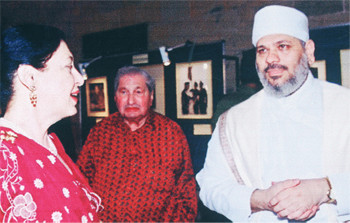
Modi with Jamshed Guzder and Udwada’s Dastur Khurshed Dastoor
Speaking on "Zoroastrian Theology” from the ecological point of view, Zoroastrian Studies founder Khojeste Mistree noted that the Gathas are not easy to understand and hence the translations vary. He spoke of cosmic dualism and the need to worship one force and reject the other. "It is wrong to say ‘Almighty God’” because according to Mistree God is not omnipotent. As there is only one life with resurrection promised at the "end of time,” Mistree said that a Zoroastrian should be aware of "the need to look after the physical world as against spending time in spiritualism... Asha is the matrix of order on the physical level which leads to the path of righteousness on the spiritual level.” For Zoroastrianism, which aims to promote immortality, pollution is a source of evil and death is not a part of Ahura Mazda’s plan. Hence "environmental issues are linked to Zoroastrian spiritual salvation,” he stated.
"Religion must have contemporary relevance,” declared Aspi Moddie, chairman of the Central Himalayan Eco-Development Group who addressed the subject "Bridging Zoroastrian Eco-Ethics, Modern Civilization and Science.” With the Darwinian theory of evolution now extended to social and spiritual development, the new science of genetics cracking the code of genealogy, Moddie noted that one can no longer be so sure of heaven and hell and the Chinvad Bridge. "The question now is, God or the Big Bang?... Man’s violence to nature and man’s violence to man” have created stress and disease at all levels of existence. "Ours is an earth destroying civilization. Kshthravairya (traditionally interpreted as good dominion) may now be called the quality of life.” The earth’s carrying capacity had been jeopardized by runaway population growth, mindless urbanization and destruction of major eco-systems, he noted adding that only four percent of the earth’s water is potable. India has only half the per capita supply of fresh water that it had it 1950, Moddie maintained. "The world’s first ecological religion with its central eco-ethics, symbolized in ritual, is the most acceptable part of past religions to modern civilization... In man’s mounting violence to man and nature, the best hope for man is as the Zoroastrian ‘Hamkar,’ or ‘God’s Co-Worker’ on Earth. And the Eco-Guru, Ian McHarg gives us the Zoroastrian ‘Vohumanic’ choice to be the Earth’s ‘protective steward or a planetary disease.’”
Prof Kavas Kapadia of the School of Planning and Architecture spoke about "The tanka system of potable water harvesting” where rain water from roof tops was appropriately sieved and stored in underground tanks for the family’s consumption. The system, which prevents water being drained into the sea, still exists in some of the old houses of Bharuch. Kapadia said, "The more hostile the region, the greater the care for storage of water,” and noted that Mohenjodaro, Iran and Afghanistan were some of the places where such elaborate arrangements existed. Centralized control on the distribution of water was introduced by the British. With increasing urbanization and the paving of streets, rain water is no longer absorbed by the ground and is wasted as it runs into the drains and thence into the sea instead of recharging the water levels underground.
In the discussion which followed former municipal commissioner of Bombay Jamsheed Kanga asked, "We claim that Zoroastrianism is the most ecologically conscious religion. Are there no such injunctions or awareness in other religions?” Mistree was unable to provide interfaith insights saying "this conference highlighted Zoroastrian perceptions,” but he noted that at the "intellectual level Zoroastrianism had better insight into ecology.” As an example he observed that the respect for nature demands that a priest knock on the well three times if he needs to draw water before sunrise as water is said to sleep at night. Moddie cited the Japanese "Wah,” the Chinese Fenghshui and the Rigvedic Hymn to Creation which he said could have been written by a modern physicist.
Kanga had also asked for details/plans for tankas to use in Mahableshwar where he said it has become the rule for every house to provide for water storage. However, this was not readily available. Kapadia noted however that in the Andaman Island and some states it is becoming necessary to catch and store water which is done at the community level. Also, waste treatment plants provide water for industrial and non-potable use. But storm water collection is likely to be the best source of water for consumption.
A lady in the audience wanted to know if the wood burnt in the fire-temples could be replaced by some other system of feeding the sacred fires. Mistree felt they must "continue the way they are” while Arceivala quipped, "Fortunately the Parsis will be gone before the sandalwood is gone!”
Providing an "outsider’s view” UNESCO’s regional advisor for culture (Asia and the Pacific) Dr Richard Engelhardt recalled the four points of advice from UNESCO to Cama when the PARZOR project began in 1999: that it must tap the energy of the Parsi community not of UNESCO; that the project requires lifetime commitment; that it must be institutionalized; that its approach should be proactive — not apologetic — and that it must provide necessary leadership to the community’s researchers.
"We see much of it happening... Oral traditions, practices, (constitute) tangible and intangible culture. It is necessary to document oral traditions to be able to share them within the community and with others... Across the world, the response could be very wide,” he noted.
History in pictures
A gutsy Homai Vyarawalla who at the age of 92 had personally mounted the exhibition of her black and white photographs in the foyer of the Tata Theatre, shared the stage with Sabeena Gadihoke whose book Through the Lens of Homai Vyarawalla is due to be published by Mapin under the UNESCO-PARZOR label. Vyarawalla’s career of over three decades as the only woman journalist in a male-dominated profession captured the essence of Indian history from the late 1930s to 1970.
Vyarawalla is one of the Three Women and a Camera that Gadihoke, who teaches video and television production at Delhi’s Jama University, had depicted in her prizewinning film that looks at "shifts in photography between two generations.” The Vyarawalla part was projected before the audience at the Little Theatre.
Answering questions, Vyarawalla noted that she had not trained anybody because she herself was not trained, didn’t know the theory: "It’s not for me to teach composition. It comes naturally.”
Living alone in Baroda after both her husband and her son had passed on, the sturdily independent Vyarawalla says, "Women can do anything and everything a man can do. Photography is a very nice profession. You get to see the best of things. Just be honest; don’t make up stories that don’t exist, respect privacy,” she advised.
Though her hearing is somewhat impaired, Vyarawalla’s clear recall of events, details and words depict a different economic picture of India. A film roll in those days cost 10 to 12 annas (60 to 75 paise). Her husband, also a professional photographer, paid a rent of Rs 30 and, "if he earned five rupees more, he’d put it in the bank!”
Just a fraction of an enormous body of work now remains, because Vyarawalla "never cared to collect anything... I never thought I’d live to see the 50th anniversary of the Independence, never thought of preserving negatives... some just survived...”
Demography and health
Noted plastic surgeon Dr Noshir Antia, chairing the session on "Demography and Health: Predicaments of Progress,” spoke of the need to understand human behavior — the attitudes of the individual, the group and of society at large — before fundamental research can provide the remedial tools. Heredity, the quality of nurturing, lifestyles, etc can be sources of strength and weakness that need to be addressed, he noted. The problems of an aging population — homelessness, destitution, lack of caring — confront the Parsi community, he pointed out.
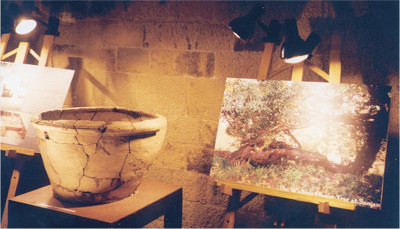
An exhibit from the Sanjan excavations
Studies on demographic and health research, a PARZORmodule facilitated by former chairman of the University Grants Commission Dr Armaity Desai has been funded by the Sir Dorabji Tata Trust on the medical side and the BPP on the social side, Sethna informed the audience.
GOI census commissioner and registrar general J. K. Banthia provided an "Analysis of recent census trends.” He noted that the 2001 census had, for the first time in India, permitted the respondent to check the entries made by the enumerator and correct them. But in intermarried families when the respondent is a non-Parsi, the whole family may be termed non-Parsi. He referred to the Parsis’ religious opposition to vaccinations in the 19th century on the ground that "by piercing the skin you are defiling Parsi blood.” In the event the smallpox epidemics of the time decimated this educated community as much as the rest of the country.
Addressing the present situation when increasing numbers of the community prefer to remain single, Banthia said he was amazed that men in the 32-40 age group want to live with their mothers! "In 1948 demographer C. Chandrasekar had projected the figure of 89,218 for the Parsi population of India in 2001. The actual figure is expected to be substantially lower, noted Banthia adding, "Whether the diminishing birth rate is due to despondency or selfishness, the future of the community can be told by its demographic trend.”
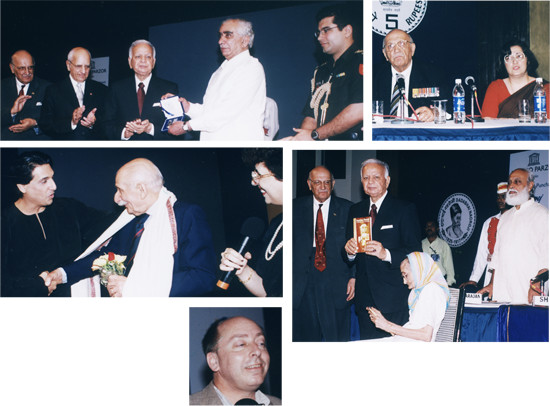
Clockwise from top left: Sethna, Shroff, Fazal with Singh releasing the commemorative coin and Governor’s ADC Capt V. Bhadwar; Sethna and Cama; Sethna, Fazal launching book, D. Wadia and Varadarajan; Englehardt; Davar felicitating Manekshaw with compère Zarin Commissariat
Speaking about "Neurological problems in the Parsi community” Dr Nadir Bharucha of the neuroepidemiology department of Bombay Hospital noted that 10 percent of the 14,010 Parsis from over 400 households of Bombay who participated in a pilot study in 1985 had been found to be suffering from neurological disease. Even at that time, 44 percent were over the age of 50 as compared to 12 percent of the general population. Stroke,epilepsy, essential tremors, Parkinson’s disease were evident with severe dementia among the elderly and the incidence of cerebral palsy and mental retardation in the process of birth. Hypertension, diabetes mellitus, heart disease, all of which afflict the community, enhance the neurological problems, added Bharucha.
Dr J. V. Undevia who has been working on Parsi genetics and the G6PD factor for 40 years noted that 12 to 14 percent of Parsis in India have this enzyme deficiency. He contrasted this data with that of Iran where the general population is infested with G6PD but the Zoroastrian Iranians are free of it. The G6PD factor is also strong among Negroes, though the African type is different from its Asian counterpart, Undevia said.
The high incidence of Rh negativity among Parsis often leads to neonatal jaundice, especially among male children. Parsis, have been found to be more susceptible to malaria with women showing greater proclivity (48.8 percent women 34.8 percent men) though those who are G6PD are less prone to malaria.
Some of these malaria figures date back to a research by Dr Bently who surveyed the population between 1901 and 1911. Susceptibility to malaria was then measured by enlargement of the spleen and more than 20 percent of Parsis were said to be affected. The initial conjecture was that wells in the house were the source of the trouble. However a comparative survey of Parsis who lived with and without a well in the house established that the incidence of malaria was unaffected. The Parsis set up their own panel comprising Drs Shroff, Daji and Kapadia who confirmed Bently’s results, noted Undevia.
"Cancer is considered a ‘stable’ disease because the risk increases with age. Therefore we must look at the age composition in an epidemiological study,” observed Dr Narendra Joshi of the Cancer Research Institute at the Tata Memorial Hospital who has been working on the immunological aspects of susceptibility to breast cancer with reference to the Parsis. While lymphomas and prostate cancer are predominant among Parsi men, one in 20 Parsi women is at risk from breast cancer, he noted. Parsi women are said to be 1.5 times more prone to it than the general population of Indian women.
Joshi sought volunteers from Bombay as well as other Indian cities — breast cancer patients as well as healthy women in the 50-70 age group — for their ongoing study analyzing the genes related to the functioning of white blood cells (Dr Joshi may be contacted on 022-25400398 /9819072938/narennjoshi@yahoo. com).
Under the heading "Genetic studies and the Parsi community,” Dr Pankaj Gadhia of South Gujarat University at Surat noted that his team has undertaken a pilot study with 50 Parsi families, each with at least two children. The objective of this laboratory study on blood samples is to obtain information on different genetic factors affecting the community with special emphasis on chromosomal disorders and other diseases. The study reveals a "fragile X chromosome,” he noted.
In the discussion that followed Undevia was asked for a reason for the high incidence of G6PD in the community. "It may have been the genetic response to malaria. But,” he conceded, "the interaction of genetics and the environment is a big question. Why have other communities not been equally affected? A hypothesis is that the G6PD affected suffer less from cancer.” Undevia also noted that inbreeding increases susceptibility to malaria. When brother-sister cells were mated in the laboratory, they became increasingly prone to various diseases including cancer and heart disease. "There is no such inbreeding in other communities,” he noted. "Americans feels that Parsis are Caucasians and therefore will have no G6PD,” added Banthia.
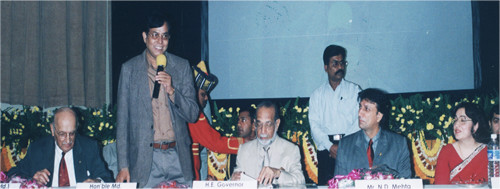
In Calcutta: Sethna, Minister for Minority Development Mohammed Salim, Governor Shah, Calcutta anjuman senior trustee Numi Mehta and Cama
Of weaving and embroidery
The session on Parsi crafts had two young textile designers from the National Institute of Design. Ashdeen Lilaowala, a member of the Zarathushti Field Student Programme launched by PARZOR, focused on kusti weaving — a part of his study of the textiles used by Zoroastrians as a part of their rituals and customs which is due to be published by Mapin under the title Threads of Continuity.
"While the community still follows some customs, others have fallen away and rituals have been reduced to suit urban constraints,” observed Lilaowala. Though the fear that the craft of kusti weaving, which takes years to master, is declining has been overshadowed by the monetary motive, it is largely elderly women who specialize in it and their numbers are falling.
The kusti represents the animal world in Zoroastrian ritual. In Iran the camel’s white hair was used in its making though in India only sheep’s wool is used. The BPP supplies 125 g of Puni wool, imported from Australia, to the weavers who first spin it into fine yarn. A kusti is normally begun on an auspicious day. The warp consisting of 72 yarns is stretched on the loom called the jantar. Bead torans are woven on the same contraption.
The new style of looms now in use, which permit the work to be removed and replaced midway, allows greater flexibility in restricted urban homes. The long hollow tube that is woven has to be turned inside out on completion. Known as "kusti uthlavanu,” it is the most difficult part of the job and needs substantial skill. When it is completed the kusti is bleached using sulphur. It is then washed and flattened, carefully rolled and tied and is ready for delivery.
Priya Mani provided insights on Parsi embroidery in her presentation "Painting with a needle.” Embroidery embellishes the base material with art and meaning though the receiver is often ignorant of the meaning imbued by the worker, she noted.
Silk and its embroidery were China’s gift to the world, initially introduced by Parthian traders to Europe, says Mani. When Parsi traders traveled to China, they brought back Chinese paintings, silk, porcelain and embroidered textiles. Later, these Chinese textiles were custom made to suit the requirement of the Parsis.
Chinese symbolism evolved round the concept of man’s need to live in harmony with nature. Thus the lotus symbolized prosperity, the chrysanthemums, joy, cranes and storks added dynamism, the human figures depicted Chinese society. The embroidery was done with very fine needles. While the satin stitch remained the basic stitch, French and forbidden knots, cross-stitch and broderie anglaise was used on garas, borders, jhablas and ijars. "Where the tuck-in part of the gara is not embroidered, it shows that it was made to order.” Entire landscapes with mountains and trees, often entire stories, were depicted on the garas. "Sometimes pieces were specially made with Zoroastrian motifs. A fine example is a border in a private collection that has the entire story of creation according to Zoroastrianism embroidered on it. The story of the embroidered portrait of Jerbanoo Kanga of Nagpur, tells of great love and tragedy for it was commissioned in her loving memory, after she died in childbirth, by her husband in China...
"Today Parsi embroidery is part of the traditional textiles of India. The embroidery of the gara is not merely a visual art but a standing testimony of a rich cultural and trade relation that existed between China and India... It is interesting to note that in India, this work is not known as Chinese embroidery but as Parsi embroidery and the gara and the kor ni (with separate border) sari is a Parsi sari to a lay Indian. The wide range of meanings and symbols, of motifs and colors, that were purposefully done by the Chinese, made no relevance to most Parsis but provide a fascinating study in the intermingling of cultures.”
Changing traditions
In the course of their field trips a "grandmother remembered things that her grandchildren said she had never told them,” recounted Sethna as he explained the genesis of the "Reet Rivaj survey.” The questionnaire printed in the Jam-e-Jamshed and Parsiana had two aims: to discover which traditions continued and which have been lost or changed and to involve the community in looking back at its traditions and culture.
Prof Rumy Mistry of Ahmedabad and Adil Marawala of Baroda analyzed the 1005 responses. In a tightly packed presentation at the final function at the Tata Theatre Mistry noted that the maximum responses came from the 60+ age group. The under 30 age group was poorly represented. The source of the responses confirmed the urbanization of the community: 338 in the metropoles, 525 in other cities, 99 from abroad including Tajikistan, 43 from rural areas.
Not all respondents indicated their marital status: 703 said they were married, 10 were divorced or separated, 64 were widows\widowers and 126 were single.
The majority (66.67 percent) reported a nuclear family structure with families of four of less. Most were graduates. There were 19 PhDs and 235 who had dropped out by standard XII. When the educational qualifications were correlated with age, it was found that the 45-60 year age group scored higher in professional education as well as entrepreneurship than those below 30.
While 14 persons said they had roots in Iran and 371 said they had roots in Gujarat, one individual had a family tree recording 27 generations going back to Sasanian times.
Among religious observances, 629 respondents said they light a daily divo, 13, including those abroad, do loban, 493 use agarbattis. There were 52 who followed the total menstrual taboo while 128 did no cooking. The dakhmas were favored by 987 respondents and 829 were committed to praying by the body before the funeral. While navjote and marriage rituals were largely observed, jashans, machi and to some extent ghambars were found to be decreasing, noted Mistry.
Ses, sagan, flower and bead torans, chalk patterns were carried out in most households. Traditional Parsi food had many votaries but the concern for animal friends enshrined in kutra-no-book (a morsel for the dog), gai-ni-rotli (a chappati for the cow) is fading. "Parsis still sing Chhaiyé Hamé Zarathosti but only a very few know the entire song,” notes Mistry. Hardly anybody knew monajats, garbas or khayaals. The making of sapats, phetas, pugrees is declining as the demand seems to have disappeared.
Almost all respondents said they were proud to be Parsis. While 85 percent believed their future lay in this country, only 55 percent considered themselves Indians first, Mistry observed. "Sixty-eight percent said they would prefer their children to marry a Parsi. Even though they were aware of the dwindling Parsi population 48.5 percent would like their children to have only two or less children.”
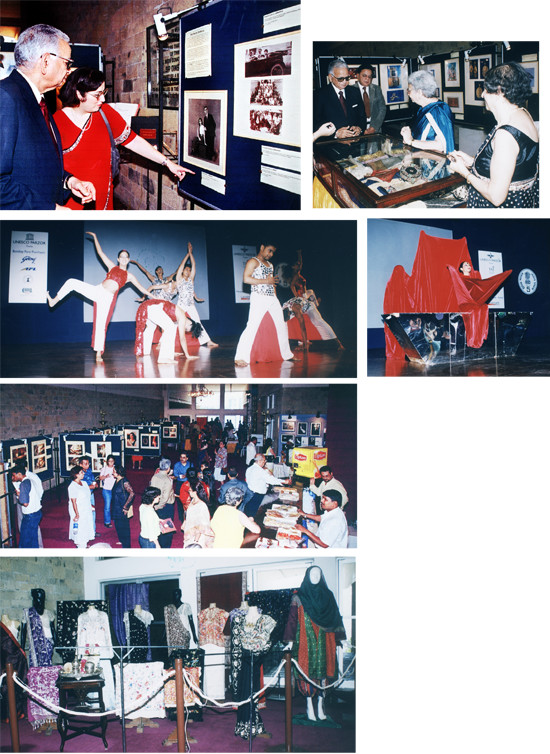
Top left and below: Fazal viewing exhibits; Below: Two glimpses of the Shiamak Davar troupe’s dance items. Alongside (top and below): "Pictures with a purpose” and Parsi/Irani textiles
Mistry clarified to Parsiana later that these percentages are based on the total sample (1005). Actually 666 Parsis out of 912 who responded to the question (73 percent) said they would prefer a Parsi spouse for their children. Two or less children were preferred by 573 out of 761 respondents (75 percent).
As a sequel to Mistry’s presentation Sethna told the audience, which included respondents who had all been specially invited, "You are an example to other communities — what you can achieve when you band together. Don’t think that thanks go to UNESCO. Thanks go to you to allow the rest of the world to share your culture...
"We also need to emphasize the issue of inclusion, of expanding our (embrace) to make a wider impress (on the world)...
"People have pointed out the absence of youths from (these) activities. Whatever traditions we are trying to preserve, (we must) make space for youths to participate (in them)...to be interpreters for the future, not only bystanders.”
Referring to the PARZOR movie Asha: The Law of Harmony, Sethna said that Delhi schools want to show it to their students. "It’s the first lesson I have learnt: make space for everyone in the community. The second one is to make a special effort at education. (Start with) information, documentation. I’ve been a student for the past three days, sharing oral and ritual traditions. The third is planned institution building. Not a hit or miss but a sustained effort; do archeological and medical research for which we need an infusion of scholars and (of ways) to finance it.” Emphasizing the tremendous results achieved by PARZOR with very limited resources — contrary to the community’s belief, UNESCO’s financial contribution in the PARZOR project is a one time infusion of seed money amounting to US $ 4,500 — Sethna made an impassioned appeal to support these efforts by contributing time, money and personal commitment.
The high intellectual quotient of the evening was leavened by a comic stand-up act by Mahbanoo Mody-Kotwal taking potshots at the prevailing ethos, both Indian and Parsi (eg "Rumy Mistry says we are sleeping over our problems: I say we are not sleeping enough!”) and a performance by Shiamak Davar’s dance troupe. And in a flood of emotion Field Marshal Sam Manekshaw, now a frail 90, ascended the stage escorted by his daughter Maja Daruvala and told the jam-packed auditorium, "I’ve been a very lucky man. I’ve got many awards... but what I appreciate the most is the one given to me by my own community... that my community thinks of me as ‘Apro Sam.’” The theater resounded with three cheers and a standing ovation.
The screening of In War and Peace ended the formal program after which the characteristic Bombay Parsi stampede for food —free Cobra Beer and sumptuous snacks provided by the Taj Mahal Palace Hotel — threatened the beautiful textiles and artifacts on display and had the organizers seriously worried about the safety of heirlooms generously provided by various individuals and families for the exhibition.
Endearing exhibits
Pictures of Zoroastrian rites, rituals and way of life as also of the historic participation of individuals in India’s national life, mannequin draped garas, kors and various clothing, the jantar, etc had been artfully displayed in the foyer over two days and engrossed many of the dignitaries who attended the events. The collection titled "Pictures with a Purpose” was later relayed to Calcutta where it was displayed at the Olpadvala Hall on January 24 and 25, 2004 and inaugurated by West Bengal governor Viren Shah who noted, "Zoroastrianism comprises a great human heritage which needs to be understood and actively utilized.” The films on Asha and Manekshaw together with one portraying the work being done by PARZOR were continuously shown over the two days.
An added attraction at the Bombay venue were pictures and artefacts excavated at the Bahrot Caves and Sanjan where the World Zarathushti Cultural Foundation is pursuing archeological excavations under the guidance of Dr S. P. Gupta, chairman of the Indian Archeological Society. In the course of two brief working seasons the finds of Sasanian and even Parthian pottery and six intact skeletons — all adults in their 30s, according to Rukshana Nanji of Belgam who is a member of the working team — seem to indicate that Sanjan was an important entrepot in Persian-Indian-South East Asian trade. Exhibits of Avestan calligraphy, and a session at the Little Theatre when films of these excavations were screened, provided a historical slant to the discussions that followed.
Though the community numbers are declining, the event proved that the Parsis remain an audaciously active and articulate community.
A scholarly perspective
"Humata — good thoughts, hukhata — good words and huvarsta - good deeds... the essence of Zoroastrian culture is these three pearls encased in the oyster shell of humanism; these are not prescriptions confined only to fellow religionists but comprehends all creation.” Remarking that Zoroastrian catholicism is the hallmark of its culture, Varadarajan noted, "Today more than ever, in the global context, I am sure the Zoroastrian considers himself an integral part of the Family of Man, transcending regions, soaring over geography.” The environmental factor was acknowledged in the "obeisance to Nature and grateful acknowledgement of its bounty (that) has always been a guiding spirit of the Parsis.”
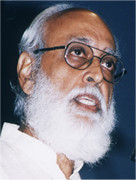
Varadarajan: "recognize the commonalities”
Homogeneity and deference to democratic values, secularism and charity for all, a dynamic work ethic, gender equality — each aspect was acknowledged with a bouquet. Then, midway through his address Varadarajan touched upon the problems nettling the community today — the declining population, the plunging birthrate. "Is it because of outmoded rules of marriage? Is it because of the differential rights of a male Parsi vs female Parsi arising out of marriages out of the community, out of the faith? Is it genetic handicaps?
"The second issue is that of conversion. Decades ago, Justice Dinshaw Davar had held in what remains undoubtedly a landmark ruling, that the Zoroastrian religion not only permitted but enjoined conversion from another religion... Alas, he could not find a single instance in 1,200 years of such an event!”
Varadarajan dared to list all the community’s bugbears: "Parsi paternity being the sole determinant in the event of an inter-faith marriage; adoption; disposal of the dead; the last rites and rituals; and yes, the Zoroastrian calendar itself!”
Aware that these are "contentious issues towards the resolution of which I am not qualified to contribute,” Varadarajan quoted Prof Mary Boyce’s words, "The best proof of any religion is that it exists, that it is part of the same evolution,” in support of his belief that "at no point of time there can and will be obliteration of this splendid testament of faith that goes by the name of Zoroastrianism.” He also noted that "there can be no orthodoxy or modernism, the root maxim of good thought-good word-good deed retaining the same value for the modern man as for the ancient.”
Referring to the growing alienation between generations, between liberal and orthodox ideas, between races and religions that is altering the mindscape of the world we live in, the former IAS officer urged the Parsis to usher in what Rabindranath Tagore had termed "a new spirit of collective mankind,” recognize the commonalities, "crown their achievements of the last two centuries, be the ones to usher an inter-faith dialog that would bring about greater comprehension, if not a fusion of religions.”
Dadabhai Naoroji Awards
"Dadabhai Naoroji combined in himself the best of India. He exemplified the teachings of Zarathushtra,” noted Maharashtra governor Mohammed Fazal who was the chief guest when the Dadabhai Naoroji International Society with its dual base in London and New Delhi, announced its annual awards in Bombay honoring outstanding citizens in the name of the Grand Old Man of India. The society had been initially constituted in 1991 to celebrate the centenary of Naroji’s election to the British Parliament - the first Asian ever to have earned the sobriquet of MP.
The awardees on June 30, 2003 had included three Parsis. International management expert R. P. Billimoria recalled his childhood interactions with Naoroji’s granddaughters Nergis and Goshi Captain. The others were noted plastic surgeon Dr Noshir Antia and Bombay’s well-known social worker Homai Modi who was also the day’s emcee.
Renowned historian Dr Rafiq Zakaria, Dev Anand, Nasiruddin Shah and Prem Chopra, songstress Lata Mangeskar and the chairman of the Punjab and Sindh Bank N. S. Gujral were also nominated for the award, several of them receiving it in absentia.
The Society’s secretary general Dr S. S. Mohapatra recalled the life and times of Naoroji and the institution of the Society at the prodding of then British prime minister John Major.
"We need an institution to take Naoroji’s ideas forward,” said guest of honor Y. P. Trivedi. "The 20th century was the century of politics, dividing the world into small segments after the breakup of the Ottoman Empire and World War I. The 21st century is the century of economics, of a globalizing world” he said and made a strong pitch for "economists who can run this country, shape its (growth).” Zakaria made an equally passionate plea for communal harmony which "Naoroji symbolized,” adding, "Our leadership’s greatest blunder was to accede to (the) Partition (of India).”
◆ ◆ ◆
From the archive