
Religion
Adopt a stand
After performing the navjote of their adopted daughter Zenea, the Rustumjis are planning to build a universal fire temple in Bangalore
"I want to use this as a start of a crusade to prevent people from sundering the community which they are unfortunately succeeding in doing (as also) to redress the wrongs perpetrated by the priests…” unabashedly announces Noshir H. Rustumji who spurred by his interpretation of the Zoroastrian religion chose to have his adopted daughter Zenea initiated into the Zoroastrian faith in Bangalore on March 22, 2007. The navjote was performed in the presence of close friends and family followed by a grand reception the next evening at the Jaiyamahal Palace Hotel.
In a community where interfaith unions are frowned upon and their children given official admission to the faith only if the father is a Parsi Zoroastrian, Rustumji dared to confer his and wife Phirooza’s Zoroastrian lineage to Zenea, not knowing her original antecedents. Rearing her since the age of two in their Zoroastrian household in Bangalore, "do they expect me to take her into the Hindu or Muslim faith?” he asks rhetorically. The Rustumjis were only informed by St Catherine’s Home from where they adopted the baby that the biological mother was keen that her daughter be raised by a Parsi. Referring to the instant rapport between the Rustumjis and Zenea, Noshir observes, "There must be greater bonding between Phirooza and Zenea” than a child and her natural parent. Today, nine-year-old Zenea studies in the third standard at the Indus International School but until the age of four Phirooza was the only one who could understand her mumbling of words, mentions Noshir who has an elder daughter Rocshana, 19, (in her final year at the Indus International School) from his first marriage to Karbaan. Six years after Karbaan’s demise he married Phirooza who being unable to conceive they decided to adopt a child.
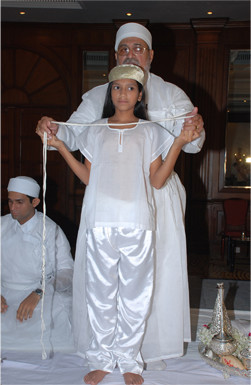
Zenea Rustumji being initiated into the Zoroastrian faith
"What he’s done is the right thing,” confirms Vispy Wadia of the Association for Revival of Zoroastrianism (ARZ). "More childless couples should adopt and then raise the children as Zoroastrians,” believes Wadia, having heard of a Parsi couple who died issueless leaving behind their prestigious property at Walkeshwar for their non-Parsi electrician or plumber.
"By initiating her they are not saying she is a Parsi. They are only saying she is a Zoroastrian,” notes Wadia insisting that this is "not conversion” for the child was not following any other religion before she professed her allegiance to Zoroastrianism. With the support of 18 priests the ARZ has been able to perform 83 navjotes in the last one-and-a-half years, of non-Parsi spouses married to Zoroastrians and of children of outmarried Zoroastrians, he reports. "ARZ has gained momentum… spurring people at different places. They are exercising their option. If they wear their sudreh-kusti or pray from the Khordeh Avesta they are not infringing on any other Zoroastrian’s rights.They are not entering your agiary or Doongerwadi… They don’t want to do anything chhoopa-chhoopu (stealthily).” They are willing to wait for the universal fire temple being planned on land donated in Goregaon or a similar one Noshir is keen to start in Bangalore where the entire family can pray together. Although it requires "a lot more money than I have at present,” Noshir, a builder who owns the firm Rustumji Developments, says this dream has been "very close to my heart for the last seven-eight years. Hopefully by next year it should take off.”
Families like Noshir’s have stopped frequenting agiaries which permit entry only to Parsi Zoroastrians. His rationale is simple: "As long as any member of my family is not welcome there, I do not want to go.” He cites the instance of his brother who after his marriage to an Englishwoman did not feel like going to the fire temple if she had to wait outside on the bench while he and the children prayed inside. "What explanation can a father give to his children as to why the mother is not allowed inside? What am I supposed to tell Zenea when she asks ‘Can I go to an agiary?’ That our religion is so narrow-minded and bigoted? That we still have false notions of Aryan purity — goro Parsi né karo Parsi (fair and dark-skinned Parsi)? That our priests who should be disseminating religious beliefs are ensuring that we die out? That people are being swayed by the cockeyed views of people like Khojeste Mistree who being articulate are able to mislead others? That a promise given to Jadi Rana (under totally different circumstances) is being cited as a reason for not opening our agiary doors even to Zoroastrians? (No such promise was given to Jadi Rana, assuming such a Rana ever existed — editors). It is not that a million people are queueing up outside to enter the agiary. But if they are ordained Zoroastrians and have learnt the basic precepts what is the harm in accepting?” he questions. Due to the prevailing unwelcoming attitude there are presently many Zoroastrians who Noshir describes as being "in limbo.” He fears they may "get disillusioned… become indifferent to religion…be drawn to other religions. We are constantly losing people. Can Zoroastrianism afford to?”
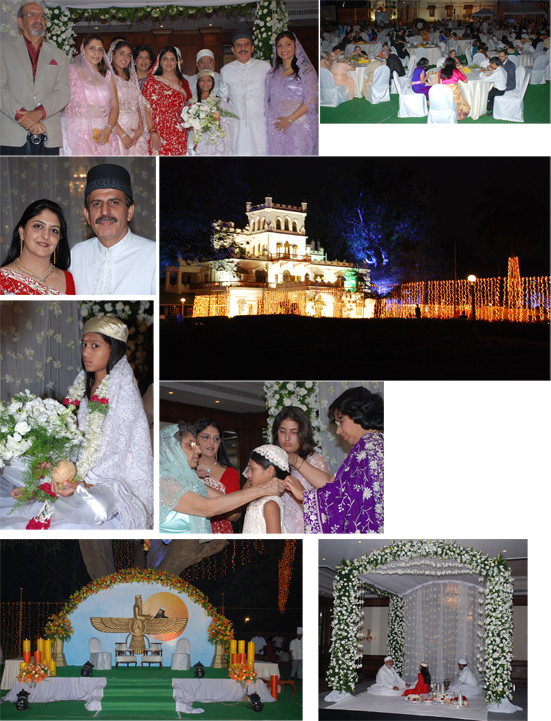
Family and friends join in the festivities hosted by Phirooza and Noshir Rustumji (second row, left) to celebrate Zenea’s navjote in Bangalore
Noshir is equally scathing of the "double standards of the presiding deity,” as he sarcastically refers to Bangalore High Priest Nadirshah Unvalla. He is particularly piqued with the octogenarian priest who allegedly stated that Noshir "Musalman ni chhokri lai aayo (has brought in a Muslim girl).” He is considering initiating legal action against him. Unvalla had reportedly forbidden some of his close associates, trustees and even Noshir’s relative Kurush Dastur who is presently serving as a priest for the Bangalore Anjuman from attending Zenea’s navjote. Noshir had to bring in priests Merwan Dastur and Kayomarz Charna from Bombay to perform the navjote. Countering a report in the Mumbai Mirror of April 4, 2007 which stated, "Many Parsis reportedly did not attend the function after being prohibited by the local priests,” Noshir states, "Ninety percent of my Zoroastrian invitees attended. Of the balance 10 percent, five percent must have had genuine reasons for not attending and there were five percent (about 15 families) who stayed away because of Nadirshah’s fatwa.” Regardless of Unvalla’s injunction, trustee Soli Pochkhanawala did honor the invitation, reports Noshir, referring to "clear dissension within the Anjuman although it has not surfaced openly.”
The Mumbai Mirror report quoting World Alliance of Parsi Irani Zarthoshtis founder member Homi Ranina as saying, "People adopted by Parsi parents will start demanding rights over houses in our colonies in Mumbai” makes Wadia comment, "The orthodox don’t talk from the religious issue but the social and economic issue. Where do the scriptures state the Prophet’s message is meant only for the Parsis? We are not asking for any flats in Parsi baugs. And even if anyone were to apply to the BPP (Bombay Parsi Punchayet), reject his application.”
Determined to "expose the shallowness and fraud of the orthodox,” Noshir is ready to wage a legal battle to fight against this "so-called ethnic purity, discrimination in the name of religion.” With the promised honorary service of C. V. Nagesh, one of the eminent criminal lawyers, Noshir is prepared to take this issue all the way to the Supreme Court although he realizes that he "may win some, lose some.” He presumes that over 50 percent of the community in Bangalore must be subscribing to his views, not more than 10 percent could be the "rabid lot” and between 30-40 percent would be the fence-sitters. For too long have well-meaning members of the community stood "as bystanders, ké wachmaa kah pariyé (why get involved unnecessarily),” he observes before explaining his reasons, "I am not fighting for the Parsis. I am fighting so that Zoroastrianism does not die out.”
◆ ◆ ◆
From the archive