
Cover Story
The ARZ agenda
The start of a prayer hall that welcomes outmarried Zoroastrians with their families is a major victory for the liberals
"If a person is good enough to be your spouse, the father or mother of your child, he /she is good enough to be a part of the Zarathushti religion,” believes Association for Revival of Zoroastrianism (ARZ) trustee Kerssie Wadia.
It was in pursuit of that ideal that the ARZ held its inaugural jashan this Shahenshahi Khordad Sal, the Prophet’s birthday (August 25, 2005), in a private flat loaned for the purpose and was rewarded with the respectful attendance of over 100 individuals — intermarried Zoroastrians with their spouses and children as also Parsis with their Parsi spouses supportive of the idea. Avers cotrustee and brother Vispy Wadia, "We are trying to reverse the mindset of 1,400 years.”
What has propelled the ARZ founders, mostly middle class professionals happily married within the community – the six founder trustees besides the Wadias are heart specialist and founder of the Ruby Hall Clinic of Poona, Dr Keki Grant, Farhad Bottlewalla, a builder in Poona, Capt Behram Surty, a master in the merchant navy, and Bombay businessman Aspi Billimoria – to undertake this uphill task? The Association was formed, says K. Wadia, because they realized that the decline in the Parsi community’s numbers is irreversible: "You can’t increase the birth rate. You can’t reduce the death rate. You can’t stop intermarriage…We were worried at the thought that Parsi ethnicity will surely come to an end…We are here to ensure that the religion does not become extinct in India.”
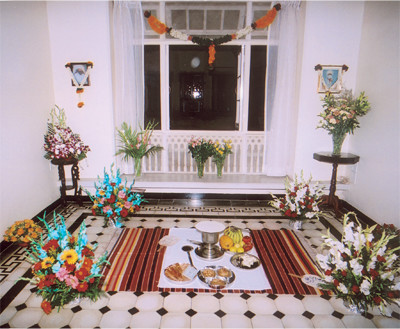
All ready for the jashan
So, though they "would ideally like all Parsis to marry within the community,” as note the Wadias, they braced themselves to face the reality of 40 percent intermarriages annually within the community. "When we throw out a single person for marrying out, we throw out his or her future generations.” What has also been a source of distress is the double standards in the community and its high priests condoning and accepting the wealthy upper crust into the faith as also those at the bottom of the ladder because without the nassessalars and chasniwallas the dakhmas and the agiaries would grind to a halt. But "the middle class is caught in the bind of priestly fatwas,” says K. Wadia.
"Our first long-term agenda is to set up an agiary for all Zoroastrians, a place where an intermarried family can worship as a group…People have been advocating that we take over an existing agairy where there are no more than three or four worshippers. But we don’t want to touch existing agiaries. We believe that rules like forbidding intermarried families to enter are wrong but we won’t violate them…To change these definitions (Entry for Parsi Zoroastrians only) would lead to 25 years in the courts. Therefore we want to set up a separate place. The idea of setting up a separate institution has been advocated by the orthodox for years. Setting up a place of worship is my constitutional right. The intermarrieds also have a constitutional right to pursue their own religion including Zoroastrianism!”
The Wadias, who belong to a behdin family, say they have been acting as catalysts for the navjotes of the children of intermarried families, where either spouse is a Zoroastrian, for the past four to five years. "So far we have been conducting such navjotes in our own flats. People from Surat and Navsari have been contacting us,” he says, adding that there are 15 mobeds who were known to them even before the ARZ was formed, who have been conducting such ceremonies, supplementing their income from other professions.
The idea of institutionalizing the practice was born when the son of a Maharashtrian father and a Parsi mother joined the Wadias’ office. Though keen to be a Zoroastrian, the man told them he would become one only if he could enter a fire temple legally, with dignity. "He needed a religious base to support him. It set us thinking,” says K. Wadia. "If we can give them a place of worship where they can rightfully come with spouse and family… It led us to form the ARZ as a platform.”
Accordingly, the ARZ trust deed came into being in June 2004 and was registered under the Bombay Public Trusts Act 1950 on September 9, 2004. Enjoying 80G exemption under the Income Tax Act, there are to date 250 members of the Association many of whom have sought out the organizers in response to their advertisement in Jam-e-Jamshed Weekly. Their advertisements in Parsiana, started recently, have yet to evoke a similar response, says K. Wadia. So far ARZ activities have been financed by the trustees and their family members, sponsoring events directly from their personal income. However, the project to set up a ‘universal’ agiary needs wider support from likeminded community members and they hope that the traditional principles of charity will induce Zarathushti corporates and individuals to loosen their purse strings.
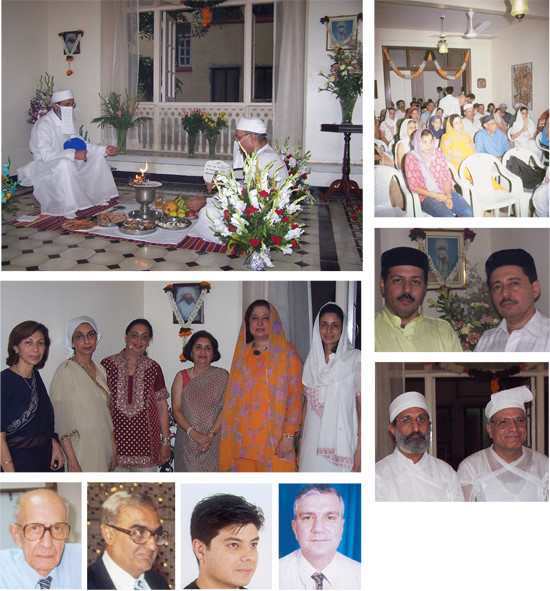
Clockwise from top left: The ceremony; the devotees; Vispy (L) and Kerssie Wadia; Mirza (L) and Madan; Surty; Bottlewalla; Billimoria; Grant and AIMZ ladies (L to R) Smita Crishna, Narang, Vera Mahajan, Ave Mehta, Amersey and Meher Rafaat
The second community flashpoint which the ARZ is addressing is the question of the first four-day prayers for those Zarathushtis who opt for cremation. "We do believe that dakhmenashini is the best system of disposal of the dead if it works. But the solar concentrators are not working properly. One solar panel concentrates on a single body for four days. In the meantime there is a pile up of bodies. When people opt for cremation under the circumstances, they have the right to funerary prayers. The priests and the agiaries pursue a double standard: they refuse to provide prayers for the first four days and are eager to take over from the fifth day as they can make money over the months and years!”
Why then did the DDD-AG (Disposal of the Dead with Dignity — Action Group) fail? "It was bound to fail,” say the Wadias, "because they were targeting an existing institution — Doongerwadi. If the DDD-AG had gone forward to set up a separate establishment for the purpose, they would have succeeded…Our hall or agiary, even the residential flat that has been loaned to us temporarily, will provide that facility. It will be a place where navjotes and lagans can be done. We can arrange for priests to perform ceremonies for those opting cremation, not only for the first four days but thereafter, including muktads. The number of intermarriages is on the rise. The number of cremations is on the rise. Once we institutionalize the facilities, more people can avail of the benefits.”
With so many mobeds in intellectual agreement and physically ready to provide the services that the community needs, the ARZ’s aim is to set up a Mobed Council of India. "We can also say we are working under them,” notes K. Wadia. Thus the ticklish situation, which arose when the DDD-AG "compromised because of a backlash from the community” leaving 22 mobeds who had supported their move high and dry, would not be repeated. With their livelihood at stake, 20 of these priests had felt compelled to apologize to the high priests for their so called rebellion in order to once again get their quota of work in the agiaries and atash behrams.
Of the two of the four sons of Bakhtawar and the late Noshir Wadia, Kerssie is a chartered accountant and vice chairman of the Zoroastrian Cooperative Bank and is married to Pearl. They have two sons Merzan, 16, and Rohaan,12. An alumnus of Rajkot’s St Mary’s School and Chinai College in Andheri, he enjoys reading and writing poems and shairies in Hindi and Gujarati and sings Hindi songs. Vispy is a commerce graduate from Raheja College at Santa Cruz after schooling at St Francis. Married to Firuzi, they have two sons, Hoshaan, 10, and Kevin, seven. A businessman who provides total office facilities like secretarial, administration, payroll, etc to companies who outsource such functions, Vispy says he enjoys traveling and cricket. They consider themselves and their families to be orthodox, regularly visiting atash behrams and agiaries, wearing their sudreh-kusti at all times and scrupulously maintaining a vegetarian diet throughout Bahman mahino. "We don’t believe in anything except Prophet Zarathushtra. We never go to dargas, churches or shrines. There is no photo or icon of any other faith in our house or office. And we do believe that when Zarathushtis go into an agiary, they should be properly dressed,” says Kerssie as Vispy nods his assent.
When Ervad Framroze Mirza, one of the two full-time mobeds who conducted the ARZ jashan — the other being Ervad Khushroo Madan — who is also a member of AIMZ (Association of InterMarried Zoroastrians) told AIMZ president Meher Amersey of the navjotes of the children of intermarried Parsi mothers arranged by the Wadias, she rang them up saying, "You are doing our work!” Thereafter Kerssie says he was introduced to her by journalist Bappu Malcolm and his wife Divya and became an associate member of AIMZ in 2003.
The two priests didn’t charge for their services for the jashan nor did they accept any ashodad. In addition Madan provided the implements and food for the ceremony at his expense, says K. Wadia.
Amersey is jubilant: "For years eminent people have been telling us to go to court to fight for our rights. Now for the first time support has come from the community. That’s far more important than any court verdict. Practically every family has an intermarried member. The first step is that the children must be accepted. Later the spouse can be made conversant with Zoroastrianism. It’s time that the spirit of Zarathushtra is promoted. That’s what the projected place of worship is all about. AIMZ is very grateful to ARZ.”
"The essence of religion is simple living and high thinking. Unfortunately charity has taken a back seat in the community of late. We are not living the life we should,” adds AIMZ honorary treasurer Khursheed Narang. "This place, though temporary until a hall or temple can be acquired, will be used by ARZ as and when required to enable intermarried families to come together, pray together.”
The Wadias say they have never been involved in community politics and have no intention of starting. That is why they "don’t even want to contact Bombay Parsi Punchayet (BPP) trustees because then their internal politics will come on to (us)!” Kerssie draws the line. But they do have an opinion to add to the world body debate: "We need to focus our attention on the problems of Zoroastrians in India rather than waste time on discussing whether to join the world body or not. Though we do believe that the world body wouldn’t harm the Zoroastrians of India. For international recognition we need a world body. The number of Zoroastrians (in the world) is small. The number of Parsi Zoroastrians is even smaller. We need a mouthpiece for us world wide.”
What then is their stand on those Tajiks and South Americans who choose to follow Zarathushtra’s faith, we wonder. "Our Prophet Zarathushtra was not a racist. But what you are referring to is missionary activity. We are not talking of missionary activity. We just want to establish the legitimate rights of intermarried families,” says Kerssie.
As for WAPIZ (World Alliance of Parsi Irani Zarthoshtis), the Wadias say, "We are not against the formation of WAPIZ because WAPIZ has been formed to look after the race. We are here to ensure that the religion does not become extinct. We definitely consider Parsis as Zarathushtis. There is no conflict of interest. The work WAPIZ is doing is like that of the government of Maharashtra. We are like the central government…”
◆ ◆ ◆
From the archive