
In Memoriam
Hail the harmonicist
Died: Phiroze Maneckshaw Damri, 90, founder director of the Hohner Harmonica Club, on June 16, 2005 in Bombay following lung failure.
Died: Phiroze Maneckshaw Damri, 90, founder director of the Hohner Harmonica Club, on June 16, 2005 in Bombay following lung failure.
His passion for music and the humble harmonica was such that until the last year of his life Damri continued to teach this instrument to three generations of students. Known to be a "meticulous teacher, fiendishly punctual,” he sought to inspire the same devotion in his students. He taught the harmonica in 14 institutions, in Bombay as also Panch-gani, mentions a close associate, the popular venues being his alma mater, St Xavier’s High School, Queen Mary, Princess School, St Mary’s, Campion, St Stanislaus and the Young Men’s Christian Association.
As the official Indian representative of Matth Hohner (the renowned German harmonica manufacturer) he was paid a monthly stipend of Rs 80 on the understanding that he would promote the instrument and teach the mouth organ free of cost to interested pupils. The outbreak of World War II brought an end to his German connection so to support himself he started charging a nominal fee of eight annas from his pupils. A self taught harmonica player he mastered the instrument by studying from the book, How to play the harmonica the easy way. Within six months he was invited to give his first broadcast over the All India Radio (AIR), and by the end of the year had already formed his band followed by an all ladies’ band a year later. There was a phase when every Friday he and his students would be invited to play for the AIR, recalls his wife Pilloo who had started learning the harmonica from him in 1945 and later used to help him conduct harmonica lessons. His zeal and determination ensured that under the auspices of his Club an annual harmonica contest was a regular feature.
He was able to make his mark on the music scene in India, Russia, USA, Japan and the Caribbean, his life’s details were gleaned from different Press clippings. Among his most memorable performances was the one at the First World Harmonica Festival in 1953 in Duisberg, West Germany. Dressed in a Parsi dagli he played an Indian tune, the music score for which was written by the late Cecil Mendonza, the then music director of AIR.
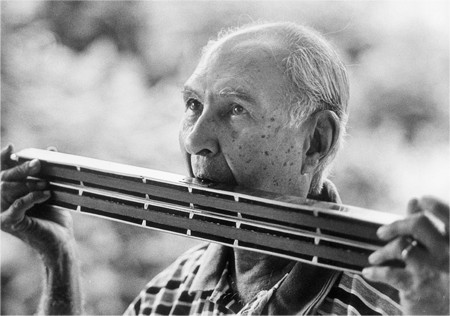
Damri: taught music with a passion
The devoted harmonica player never forgot his own humble origins. Having lost his father when he was barely four years old he understood the travails faced by his mother Banubai to bring up his two younger siblings and him. On learning that his mother had to sell her gold bangle to finance his first year of studies at Wilson College he preferred to forsake his studies and sought to earn a living through his music. Banubai was a harmonium player and not surprisingly music came easily to Phiroze and her younger son Minoo (Bob) who had made a name for himself as a drummer. Before Phiroze took a fascination to the harmonica in 1938 he had learnt the violin and the mandolin from Mehli Kasinath and used to play in the latter’s band earning Rs 2 per evening plus the dinner. Over the years Phiroze’s monthly fees had increased to Rs 50, but when he realized that certain students could not afford even that amount, he would willingly teach them free of cost, notes Pilloo.
Hohner had also presented Damri with a piano accordion and a few harmonicas. His prized array of mouth organs included a super chromonica as also a baby harmonica, barely one-and-a-half-inch in size. Their son Kersi plays the accordion, but the harmonicas were not being put to optimum use by Phiroze and Pilloo so the couple were considering gifting their cherished collection to the Prince of Wales Museum. They subsequently felt the set of harmonicas would be valued more by one of their students and thus sold it to him only last year. The proceeds from this sale, Rs 51,000, were used to support the cause of music, with Rs 26,000 being gifted to the Mehli Mehta Music Foundation, and Rs 25,000 to the National Centre for the Performing Arts. Pilloo is content that the donations were given during Phi-roze’s lifetime.
Disappointed that few of today’s children make time for hobbies and the rest give exclusive importance to studies he was happy though that he had taught three generations of students some of whom had come together at the Diamond Jubilee Concert of the Hohner Harmonica Club on November 30, 1997. This was to be his last public performance when the Hohner Harmonica Band played under his baton. As noted The Times of India of July 4, 2005, Bombay "has lost one of its oldest contributors to the culture that helped make life in the city a little less brutish.”
The humble harmonicist is survived by his wife Pilloo, son Kersi and brother Minoo (Bob) Damri.
P. M. G.
◆ ◆ ◆
From the archive