
Politics and Policy
Fascism at the Federation<BR>World body stymied by Arnavaz Mama
An unruly mob disrupts the all India body's deliberations at Ahmedabad for almost half an hour
A well orchestrated attack by the smaller, more orthodox anjumans under the baton of Khojeste Mistree of Zoroastrian Studies greeted the leadership at the executive council meeting of the Federation of Parsi Zoroastrian Anjumans of India (FPZAI) in Ahmedabad on December 18 and 19, 2004. Their misgivings about the proposed membership of the FPZAI in the formation of the world body of Zoroastrians lies in their belief that thereby the Parsi Zoroastrians of India, hitherto considered the leaders of the Zoroastrian world, will be marginalized by the more numerous converts who are reverting to the faith in the Eurasian countries of Tajikistan, Uzbekistan, etc, those who choose the Zoroastrian faith in Europe and the Americas, the progeny of Parsi women married to men of other faiths, as well as the Iranians who have migrated to the West.
The topic was sought to be raised even before the minutes of the last meet were approved and signed, setting the stage for a cantankerous meeting. Though the world body discussion was not on the agenda, the orthodox lobby made a strong bid to lay to rest the question of India joining the proposed International Zoroastrian Organization (IZO) with its two wings — the WZO-F comprising the federations of the Zoroastrian world and the WZO-I as the extant World Zoroastrian Organisation has been renamed — by demanding an immediate vote. Though the program as per the agenda was disrupted, the discussion was allowed but not a vote.
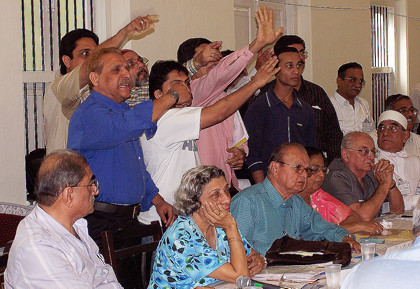
(Sitting): BPP, Surat and other delegates (Standing): Orthodox cabal in action
Tempers ran high throughout the two days. Even as Madras president Nariman Mogrelia recounted the perception of his anjuman towards the acceptance of the children of outmarried Parsi women, pandemonium broke out leading to an exchange of harsh words between him and Areez Khambatta, president of the Ahmedabad Parsi Panchayat. The all-India body’s proceedings were disrupted for close to half an hour as a group of rowdies from Surat and elsewhere raised slogans and verbally abused delegates and threatened bodily harm.
The other major bugbear, demographic decline, was equally vehemently contested by the orthodox. Paradoxically, the very anjumans loud on both fronts because of the proxies acquired by spokespersons of Mistree’s camp like Tannaz Parakh, Yazdi and Anahita Desai, and others have but a handful of Parsi families surviving in their areas. (Yazdi Desai acknowledged that he had "only one mandate: to launch an attack against the world body.”) Dr Homi Dhalla who presented a paper on the subject as a guest speaker had to bear with interruptions and heckling.
The Fourth World Zoroastrian Youth Congress will be held in Melbourne, Australia, between December 27, 2007 and January 3, 2008 at the Mount Helena Campus of the University of Ballarat. The site has been booked and they have acquired their own website: www.4wzyc. com as noted its secretary Shirin Mistry.
The World Zarathushti Chamber of Commerce (WZCC) is trying to open its fifth chapter at Bangalore or Hyderabad, declared Federation president and Bombay Parsi Punchayet chairman Minoo Shroff. Cama Hotel’s managing director Jehangir Cama who is the WZCC director in charge of Gujarat, noted that chapters in Surat, Baroda and Bharuch are on the anvil.
Eminent property developer Pallon Mistry has given the BPP a cheque of 50 lakh rupees towards the seed capital of their venture capital project and four or five new entrepreneurial projects are on the anvil for funding, stated Shroff. Though the BPP has successfully launched a mediclaim policy for its staff, its search for one to cover the community at large has not yet fructified, noted BPP CEO Behram Dastur.
The Foundation for the Development of Udvada (FDU) will incorporate one or two members of the Udvada anjuman as trustees, noted FDU managing trustee and BPP trustee Dinshaw Tamboly. The Gujarat Government, whose representatives are also on the board of the trust, has informed them that road development in Udvada will be taken up on a priority basis, he noted but was challenged by Parakh who stated that the government has declared it will not take up any project unless specifically requested by the anjuman. The FDU is another source of friction with the conservatives who are challenging in devious ways Tamboly’s credentials to be on the trust board.
The proposed amendments to the Bombay Public Trusts Act (BPTA) which had so exercised the delegates at the previous meet has been relegated to the back burner by the Government of Maharashtra, noted Shroff, citing an assurance given by the chief minister. The BPP and the Tata Trusts have drawn up a memorandum vetted by legal luminary Fali Nariman in which the Punch-ayet had stressed its rationale for protecting the towers of silence and its other charitable institutions. The amendments would give the government superceding powers and control of trusts. Noted chartered accountant and Nargol anjuman president Hoshang Wania, who had initially brought the matter to the notice of the Punchayet, added that since Shroff’s meeting with the government, the law ministry had split the BPTA into two sections, one being the Mohammedan trusts and waqf properties and the other dealing with the rest of the public trusts.
The Valsad anjuman has just joined the Federation as its 70th member. The next meeting of the Federation will be held in Bombay on June 4 and 5, 2005 to avoid clashing with the Eighth World Zoroastrian Congress due in London, June 24 to July 1, 2005. Registration forms for the Congress are available with the BPP’s senior executive Sheroo Master. With Omin Debara of Hyderabad offering to hold a winter Federation meet and Baroda and Poona already in line, the December meets for the following three years have been committed. Every alternate meeting is traditionally held in Bombay.
The long serving senior executive of the BPP and executive secretary of the Federation Sheroo Master who will be retiring from the trust in March 2005 for health reasons was praised by Federation Honorary Secretary Keki Gandhi for her services to the all India body. "Not a day passes when we do not talk to each other on the phone regarding the Federation,” Gandhi said. He noted Master was very prompt in giving information and ensured close coordination between the BPP and the Federation.
Just before the start of the proceedings, a heated exchange between Khambatta and the president of the Parsi Youth League of Ahmedabad (PYLA) Khushnum Avari led to the withdrawal of PYLA members from the Federation meeting which they had helped to organize, including receiving the delegates at the railway station and the airport and organizing their smooth transportation between their hotels and the venue of the events. The delegates were informed of PYLA’s withdrawal from the proceedings via a general letter with copies to all those attending the meeting.
World body
Though the constitution of the world body is still in the drafting stage as per Shroff — the drafts are believed to be flying back and forth between Shroff, Tamboly and Gandhi representing the FPZAI, Firdosh Mehta, Rohinton Rivetna and Behram Pastakia of FEZ-ANA (Federation of Zoroastrian Associations of North America), Dorab Mistry and Malcom Deboo of the London based ZTFE (Zoroastrian Trust Funds of Europe) and Rumi Sethna and Rustom Dubash of the WZO (World Zoroastrian Organisation) — it is believed that the vote sharing as agreed so far gives India 35, FEZANA 24, Europe 16 and Iran 25 percent weightage.
In the discussion that followed, both Shroff and Parakh read extracts from letters by Dastur Kaikhusroo Jamasp Asa stating support for their point of view. Rustom Cursetji , president of the Thana Anjuman, Baman Cama of Baroda, Nariman Mogrelia of Madras and others tried to assuage the alarm of the orthodox by recounting the long history of negotiation and confrontation between the FPZAI and the WZO. However, the myriad tiny anjumans of rural Gujarat and elsewhere were too much under the sway of Mistree and others who are known to have gone to anjumans, especially where the populations generally comprise but a handful of families innocent of what is really happening at the international level, and persuaded them into believing what they had to say. It may be noted that very few of these anjumans have attended Federation meetings on a regular (or even sporadic) basis. Tempers ran so high that at the end of the day Yazdi Desai shouted at this reporter, "You are chors (thieves), not Press!” We had challenged his punctilious comment "Please report correctly. We have a consensus,” by asking "What consensus?” interpreting the term in its original sense of ‘general agreement, harmony.’
After an unscheduled morning tea break on the first day occasioned by constant interruptions in favor of a discussion on the world body (though according to Parakh "We have not come here for discussions. We have come here for decisions”) Gandhi suggested that the eloquent Mistree, who was the prime mover, have first say, others only adding points to his statement, not repeating them. Bardoli president Jamshed Mohta who had been supportive of the Federation leadership hitherto was now speaking for the opposition: "The issue is whether to join the world body or not. Put it to the vote. If the majority says no, the discussion ends.”
Admitting that the council meeting was the right forum for a logical discussion of this emotive matter, Cursetji was not in favor of "rushing to vote. We might fall prey to the herd instinct,” he reasoned. Cama asked if the delegates were "categorically clear” that their respective anjumans had given them the mandate to vote. "I am not,” he said, noting that the response to a referendum in Baroda was yet to come in. "Do you all have the authority to vote?” he asked and was met with affirmative sounds in the background. Challenged Parakh: "If several anjumans say they haven’t taken a vote, on what basis have Minoo Shroff and Keki Gandhi signed the commu-niqué?”
Mani Clubwala, a veteran of innumerable skirmishes with the Federation on behalf of the WZO, tried to reason that several anjumans were WZO members originally (The WZO permitted individuals and anjumans as members, though they had only one vote, same as the individuals. Among the anjuman members from India were Delhi, Madras, Calcutta, Jamshedpur and others — Editors) but was shouted down. "We are at a meet of the FPZAI” admonished Yazdi Desai who was attending a Federation meet for the first time. Piqued, Clubwala countered, "When you need money you ask the foreign Zoroastrians!”
"For money you can’t sell the religion,” maintained Bhikhaji Davierwalla of Mahuva.
"The question of money does not arise,” claimed Khambatta drawing an analogy with Indian companies that had sold out to foreigners. "The BPP is a power house. Compared to what the BPP has spent, WZO money is peanuts,” he cried. The orthodox responded with appreciative clapping.
Responded Cursetji, "I thought we were here to discuss issues, not peanuts or crores of rupees. Several decades ago there was a similar opposition to all the anjumans joining the Federation... Discuss concerns seriously... There is no one here against the religion...If Khojeste’s concerns can be adequately addressed... Permit a voice to be heard in moderation and in the right spirit...”
When Gandhi again suggested, "Let two or three principal people speak calmly, reasonably,” Hushang Vakil of Dahanu complained, "So far the discussion has been of structure, not of the nature of the world body.”
Yazdi Desai began by harping on the double barreled qualification of ‘Parsi Zoroastrian’ which not only features in the name of the Indian federation but in its objects clause which includes: "To promote and safeguard the interests of Parsi Zoroastrians and anjumans of India.” He accused the leadership and specifically Gandhi of obtaining the mandate for the world body from the Federation’s members in 2003 by "gross misrepresentation.” A focus of his attack was on the November issue of the Fed Newsletter in which Gandhi had defended the decision to join the world body. "It talks about everything except informing the delegates that it’s not a world body of Parsi Zoroastrians.” According to him by joining a body of non-Parsi Zoroastrians we may be endangering future generations of Parsi Zoroastrians. He said that the genesis of the problem lay in the world body’s membership clause which accepted only ‘Zoroastrians’ instead of ‘Parsi Zoroastrians.’ He said he requested Shroff "with folded hands, please do not join the world body...The majority says we don’t want to join the world body. When the resolution was taken, the same anjumans gave the vote. Now that they are questioning you, you question their right to do so.”
Even as Desai spoke, his wife Anahita who had the proxy vote for Solapur, distributed bound copies of letters from 30 anjumans addressed to the Federation secretariat questioning the aim of joining the world body. A product of Mistree’s organization Zoroastrian Studies, the folio was a testimony to his genius for marshaling opinions along his line of thinking.
Iranian Zoroastrian Anjuman’s Mehrwan Irani took umbrage at this emphasis on the term Parsi. Noting that 90 percent of IZA donations go to the Parsis, Mehrwan said, "If you consider yourself Parsi only, then I am Irani only.” He was mollified by Desai stating that the definition of Parsi Zoroastrian in the FPZAI includes Iranis. Accordingly Mistree, Desai and others suggested that the body being formed be a world body of Parsi/Irani Zoroastrians.
Mistree took over where Desai left off, noting, "If the world body recognizes that ethnicity is linked to the religion, it’s a different ball game.” He demanded open debate, "not in little cabals,” and accused the leadership of "sweeping things under the carpet.” In response to those who had held that dialog on the world body had been documented even by the Press, Mistree castigated what he called "the media’s specific agenda.” Claiming to have gone through the constitutions of the IZO, the WZO-I and the WZO-F he averred that the world body is "a mechanism to facilitate conversion...If a team of top lawyers got together, it does not promise (to protect) our Parsi Zoroastrian interests. Until the end of the day, all finances are held by India. Why bow down to 2.5 million Zoroastrians? Eventually we will be marginalized...Do we not have the foresight to involve our learned clergy?...If you accept South Americans, Africans, all sorts at the world body level, how can we in India say we can’t accept you? You can put 101 clauses in the constitution but if the constitution is flawed as I believe it is... any legal document can change with the mindset...”
Mistree castigated Gandhi for his statement "I am ashamed to be a Parsi” (made in the context of not sharing the religion with an adopted non-Parsi orphan but now being quoted out of context): "It is your privilege as an individual but as an office bearer you must heed the views of the community,” he said, citing the example of Shiavax Vakil’s resignation from the BPP in 1975 when his entrance into a dakhma and opinion on the system of dakhmenashini was criticized by the community. (Vakil left the BPP as he was hounded by the orthodox elements and physically threatened. As his health deteriorated and he realised his presence on the board of trustees was causing divisiveness he resigned and nominated noted businessmen Jamshed N. Guzder for the seat — Editors)
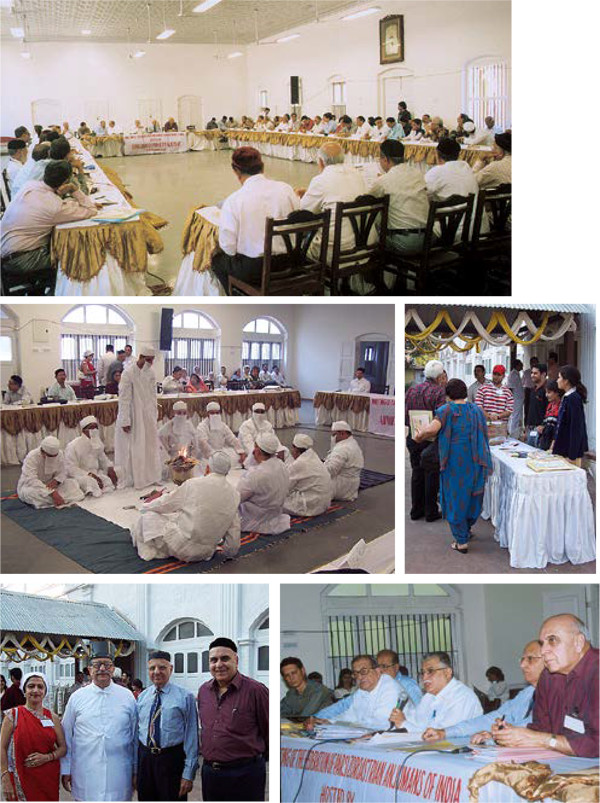
Top: Executive council in session; Centre: Jashan preceding the meet and registration desk at venue ;
Bottom Left: (L to R): Daruwala, Khambatta, Shroff and Tamboly. Right: The main table with Gandhi (holding mike)
The doongerwadi debate of 2000-01 (regarding the request from a section of the community to allow the use of the bunglis for those opting for cremation) was dragged into the present controversy as was the confrontation between the BPP and the Delhi Parsi Anjuman at the Federation level in 1978-79. (Immediately after the Third World Zoroastrian Congress in Bombay in 1978, the BPP withdrew from the Federation citing DPA president Shivax Nargolwala’s criticism of the BPP’s electoral system as impinging on its constitutional independence. During efforts to heal the rift BPP chairman B. K. Boman-behram sited DPA’s amended rules of March 1978, admitting non-Parsis spouses as members with limited rights—they couldn’t be trustees, go into agiaries or be buried in the aramgah — as a hindrance to the BPP’s reentry. In accordance with Boman-behram’s own suggestion the DPA vacated its seat on the Federation in favour of its religious body, the DPA Trust, but the BPP did not rejoin until 1981 by which time Boman-behram had retired and been replaced by Dr Aspi Golwalla as chairman — Editors)
He questioned the Federation’s dispensation with the opinion of the high priests who have signed a letter to the BPP chairman advising against membership of the world body. Mistree defended the dasturs’ right to change their opinion "on a case by case basis,” alleging that BPP trustees at election time have declared themselves to be orthodox, then changed their stance once they are in office.
Much of Mistree’s long comments were varying paraphrases of these statements but one thing that emerged was his ire at being ignored: "Have the scholars been consulted? Have you asked any of us? (Our advice is available) free of charge in an honorary capacity. Have you ever shown the courtesy of writing to me, of inviting me?” When he spoke of the need to "learn to respect our clergy,” Mistree cited the high respect accorded to the Roman Catholic Pope and the Sayedna of the Bohra Muslim sect (both belonging to what Mistree on other occasions has called the "later, non-ethnic, ‘romantic’ religions”), but made no reference to a Jewish rabi or a Hindu pundit of what he calls the "classical religions based on ethnicity,” the category to which Zoroastrianism belongs according to Mistree.
Many anjuman representatives asked to know the benefits expected to accrue from FPZAI’s membership of the world body. They did not receive an answer. Shroff had maintained that he had the support of his counterparts abroad that the managing committees of all the three bodies will comprise only Parsi Zoroastrians for at least 10 years but the opponents were adamant that the membership clause of all bodies be reframed to restrict it to Parsi/Irani Zoroastrians only.
The dissenters were asked to provide their comments in writing so that the Federation leadership could negotiate further with their counterparts abroad. So on the second day (December 19) Shroff was presented a memorandum signed by individual delegates from Bardoli, Nargol, Valsad, Saronda, Ahmedabad, Baroda, Panchgani, Suvali, Olpad, Solapur, Jabalpur, Poona, Khergam, Kudiana, Nagpur, Dahanu, Surat Nanpura, Borivli, Surat Parsi Punchayet, Belgaum, Davier, Vyara Songhad, Mahuva and Deolali (see "Memorandum of disagreement,” ) enumerating their demands. (Parsiana learns that Suvali, Olpad, Kudiana and Surat Nanpura are not members of the Federation — Editors)
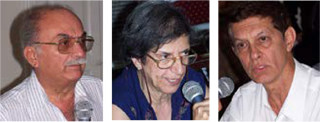
From left: Jehangir Cama; Khullar: heckled by the rowdies, "what’s her name?”; Dhalla: cut short his presentation looking to the mood of the crowd
When Mistree told Shroff, "Send our concerns and letter from the high priests to the foreign federations. You will go down (in history) as an upright leader, ready to listen to the voice of the community,” Shroff retorted, "Nobody wants to go down accepting obloquy. Many people ask, ‘what is the world body without India?’...When negotiating nuances you cannot pressurize. There are all sorts of canards, that I want to be the first president of the world body, etc. Dastur JamaspAsa says (in his letter) that he agrees with me. Have some faith. We are not fools... I make a last plea to you: don’t abandon them (the Zoroastrians based overseas), don’t keep thumping the table. People become scared to speak out...Look at our other activities...Rightly or wrongly you are stuck with us... ”
On his part Gandhi noted, "Today’s scenario was created over the past few months, to pressurize the Federation to take a decision. Those not taking any interest for years have been brought here to pressurize us. You’ve been talking of converts, getting signatures, etc...We’ll give what you put down on paper to the other countries. But if you say we’ll throw away the effort since 1960, we won’t do it. It’s not nice to close the door on someone’s face. If you do, they don’t come back.”
Demography
Describing himself as the "lone voice against experts,” Mistree quoted the Government of India (GOI) census figures for Parsis in 1981 (71,630) and 2001 (69,601) and asked, "If the death rate is three times the birth rate, how is it that the difference in 20 years amounts to only 2000? If we accept the GOI census figure for 1991 (76,382) then the birth rate figure has to be wrong, it has to be higher.” (Both the census commissioner J. K. Banthia and population expert Dr Asish Bose had stated publicly that the 1981 census figure of 71,630 may be erroneous. Mistree was present at both talks by the demographers — Editors) He estimated the global figure for Parsi/Irani Zarathushtis at 1,20,000 on the basis of 27,500 in Iran, 16,534 in North America, 2,200 in Karachi, etc. Mistree’s pet theory is that the GOI census does not take migration figures into account. "For too long we’ve gone on saying, ‘We are dying’...If you are quoting from magazines that have vested interests (read Parsiana) it’s very dangerous. The BPP Review figures are highly questionable ...If we assume the annual figure of 300 births is correct, and Anahita (Dr Pundole, who is spearheading the BPP’s Fertility Clinic) says 25-30 babies (are in the offing), it could increase the number of births by 10 percent straightway. Then where is the question of community extinction?” He claimed that this negative belief was "making the community lose confidence, damaging the psyche of young people.” He charged that it is the "hidden agenda” of some people that the "community is depleting at such an alarming rate, we need to take converts on board.”
Master: ensures close coordination
Making no claim to be a demographer or a mathematician, Zoroastrian member of the National Minorities Commission and president of the DPA Lt Gen (retired) Adi Sethna suggested, "Look at the figures for a period. The figures for the UK/US are not for the last 10 years. There are 4,500 in UK (in the course of the years) since Independence.” Age groups, the number of children per couple, were other relevant data to be examined, he added. He also noted that they had found that there were eight couples in Delhi who had need of Anahita’s expertise. "Even if you bring every child of intermarriage into the community, it will change the figures,” he stated, pointing to the exponential nature of demography. He suggested conscripting the marketing skills of adman Sam Balsara to motivate young people into early marriage and larger families.
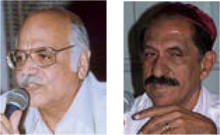
Cursetji (left) and Bhesania: Let "the voice of reason be heard”
Pointing to the scale of the GOI census which covered over a billion people in the space of a month, demographer Ava Khullar cautioned against being skeptical of their figures even though there were a lot of Parsi families who claimed they had not been visited. "From 1,14,890 (in 1941) we have reduced in 60 years by 35 percent...In the 1970s and 80s we had taken 100 percent surveys in Nagpur, Delhi, Vishakhapatnam, Bhavnagar, etc. The population trends were clear.” While the Indian population is a model of a growing one depicted by a normal triangle, with a large number of children at the bottom and a few old people at the top, the Parsis present an inverted triangle with very few children and too many aged, she said. "Our studies corroborate the census age groups. It is typical of what happens to any community that is urbanized, westernized, highly educated. Women’s professionalization reduces their fertility span. To ensure the maintenance of the high standard of living, one is prone to delay marriage. There is also the dearth of accommodation, especially in Bombay.” She noted that a similar situation exists in Scandinavia "but the original figure is large enough to take the shock.” She requested Mistree not to tell the community that "nothing is wrong with us.” The lack of parental pressure in our community to marry, the lack of social censure of the unmarried are among other reasons for the phenomenon, she said, explaining that as population increases in geometric progression, each non-marriage leads to a fall in the community’s childbearing capacity.
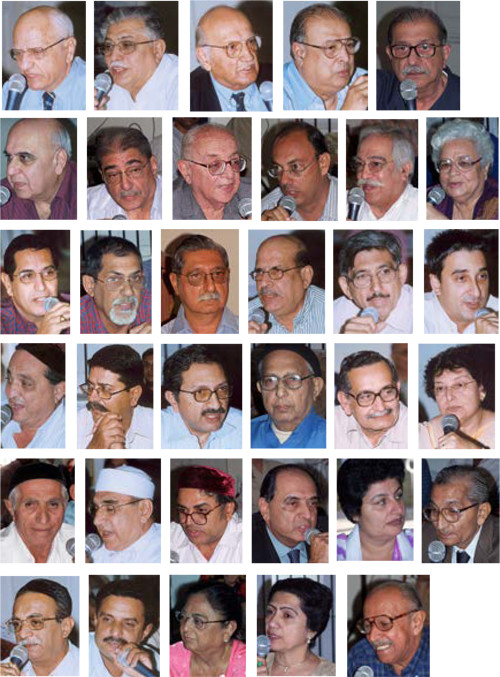
Top row (L to R) : Shroff, K. Gandhi, Sethna, Mogrelia, Khambatta;
Second row : Tamboly, Dastur, Dotiwala, Karanjawalla, Dadi Mistry, Clubwalla;
Third row : Paghdiwalla, O. Debara, A. Debara, E. Bhagwagar, B. Cama, Nargolwala;
Fourth row : M. Irani, P. Irani, Rustomji, Dandiwala, R. Gandhi, Tehmi Patel;
Fith row : Govadia, Panthaky, Aspy Sanjana, Bhada, Avi Sabawala, Dinshaw Mistry;
Bottom row :Unidentified participant, Kerman Batliwala, Shethna, Daruwala, Firoz Daver
An undercurrent of noise and comments caused Khullar to remark, "I’m afraid there is no freedom of speech. When sensible data is put forward, people clap and harangue.” (When a member of the Press requested members of the Surat contingent sitting behind Khullar to shush so one would hear the speaker Bhicaji Davierwalla responded in turn with a "shut up.”) When there was a demand for solutions, for reasons why the community was marrying out, Khullar referred to what Dastur had stated earlier in the day about the declining quality of Parsi youths. "We need to hear each other, understand each other. It’s the first requirement of a Zoroastrian. Make boys and girls more eligible for each other... The days of parental pressure are gone...”
Dhalla had been billed as guest speaker on the subject but constraints of time plus his own throat problem ensured an abridged version of a paper by him that had been published in the Jam-e-Jamshed Weekly of November 28, 2004 and Parsiana (November 2004). He prefaced his remarks with a reference to what noted physician Dr Farokh Udwadia had stated at a meet hosted by the National Commission for Minorities in Bombay on December 5, 2004. Udwadia had mentioned the depleting number of patients in the B. D. Petit Parsee General Hospital coupled with an enormous number of geriatric patients as compared to other age groups. Quoting Sorab Katpitia of Surat who has worked for many years on the problem of the defunct anjumans on behalf of the Federation, Dhalla noted that 29 anjumans were defunct or nearly so. "Sanatoria, dakhma lands have been encroached or lost. Archeological excavations in Sanjan prove that there had once been a very large population in Sanjan. Oral tradition says there were nine dakhmas there, though only one has been excavated so far. But the number of bones found there has been mind boggling. In Tena where there were seven dakhmas, there is no Zoroastrian left; in Khambat there were seven or eight dakhmas. In large areas of Gujarat the community has died out. I was in Iran in 1978-79 at the time of the Islamic revolution. Then thousands of Iranian Zoroastrians and Parsis left for North America. The migration is not only from India; all those in North America are not from Bombay or India.” Citing Parsiana statistics (which according to some people are fudged) he noted there were 27 births and 76 deaths in Poona in 2002, six births and 29 deaths in Hyderabad in 2002-03; the Allahabad anjuman has 22 aged members and three trustees, all over the age of 70.
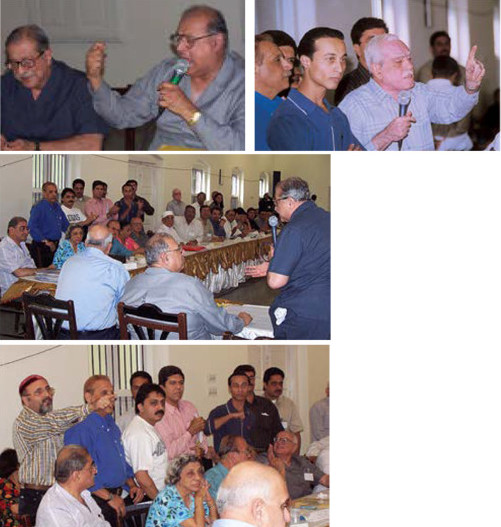
Hotting up (L to R): Khambatta, Mogrelia; Patvi and Noshir Dordee; Khambatta responding to Mogrelia; Vakil (extreme left with cap) Davierwalla (center in white shirt) and others: part of the shouting brigade
"What can we do to change the mindset? We must involve parents, teachers, international specialists, the WZCC. We must impress on our youth that it is not enough to live in the shadow of the past. We must be proud of our heritage but go for higher education, shoulder greater responsibility, be more interactive among those not living in the baugs.” He urged the BPP to persuade old people and lone occupants to move into smaller flats so that the younger people could avail of them to raise families. He suggested the shifting of fires from languishing agiaries on the lines of the Lonavla agiary which houses two fires, and the land sold where there is not enough Parsi population.
Gandhi responded by stating that the responsibility for increasing the population rests on the youth, hence they should be addressed at youth conferences and at the 4WZYC. Mohta suggested multiple wives and Tehmasp K. Bharucha of Poona stated there had been seven births and no deaths and only one divorce there in the past seven months. Porusasp Mehta from Poona demanded to know "where does Parsiana get its figures (for Poona births) from? They’re not from us.” They had been quoted by PPP president Dara Irani at a previous meet, stated the Parsiana editor Jehangir Patel.
At Shroff’s instance Patel told the audience that death figures for Bombay come from the BPP; the marriage figures from the Bombay High Court; the intermarriage figures from the Old Customs House and Bandra and out of town data from newsletters and punchayets. Birth figures for Bombay are (partly) gleaned from forms distributed at the PGH...He was barely allowed to finish.
FPZAI honorary treasurer Farokh Rustomji who is the CEO of the Sir J. J. Trusts took the opportunity to direct the discussion onto more constructive lines. "Demography is not just numbers...it charts progress. What is the corrective action? Every child creates wealth for the community.” He pointed out the dilemmas the community faces: "Do we educate children who go abroad and are a loss to India? Do we build schools of which our children take no advantage? Conversion is not the point. How do we use our assets to our benefit right now?”
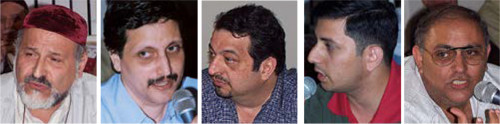
L to R : Mistree: Parsiana’s population statistics have "a vested interest”;
Desai: "You (Parsiana) are chors. You're not Press”;
Mehta: Where does Parsiana obtain the Poona birth statistics?;
Nanavatti: Where does Parsiana obtain all its statistics from?;
Sarondewala: "Does the Press have the right to speak at a Federation meeting?”
While Shroff conceded that the convening of a think tank was imperative, Mistree found Parsiana’s explanation of birth figures "unsatisfactory.” He said he was "questioning the wrong figures.” As for bones in the dakhma, he found nothing unusual: "There have to be bones in the bhandar. It throws no light on the population.” As for Sethna’s recommendation to think about the children of intermarried women, Mistree maintained, "Till we are able to come to the bottom of this, it is not for you or Dr Bose to go into it...Our job is to question the figures, analyse them...” He accused his opponents of trying to "fudge the figures,” adding, "Just because Dhalla has given a paper it does not (make him an authority). In the kingdom of the blind the one eyed man is king.”
Dhalla was not daunted: "The issue of the children of Parsi women was brought up by the BPP last October. In November/December when my paper was ready, I sent it to Dastur JamaspAsa. Till today I have not received an answer. I sent a revised paper again. I said please let me know if my theological interpretation is correct. He agreed that there was gender equity in Zoroastrianism. Eleven months back Khojeste was at the meet (when it was first presented). Why has he not critiqued it for 11 months? Why has Dastur JamaspAsa, for whom I have great respect, not replied? I am prepared to learn. This issue, this controversy, is dealt with from the point of view of the Daver-Beaman judgment. Today there is no more a patriarchal society. Zarathushtra himself had challenged it. Three of the six Ameshaspentas are female. It is a unique contribution in the history of world religions. There is no element of the female in Muslim, Jew or Christian theology. The equality of human rights (is a Zarathushtrian concept). The Rig Veda, the Bhagvad Gita were full of the caste system which Mahatma Gandhi (gave his life to change).”
"I take my husband’s name. Your wife takes your name,” shouted Parakh. But Dhalla maintained that the "patriarchal system is being challenged all over the world.”
4WZY Congress
At the University of Ballarat’s Mt Helena Campus, a 75-minute drive away from the airport, Mistry of Melbourne promised a true Australian experience to the delegates attending the Fourth World Zoroastrian Youth Congress. Allowing for substantial sports activities on the university grounds, she spoke of "fun in the sun, learning and interaction.” Noting that the location has been booked and arrangements for an inaugural jashan have been made when the smoke alarm will be turned off for 40-50 minutes, Mistry said the cost of the event will work out to about Australian $ 100 per day per delegate and sought donations from India. Accommodation is said to be in units of 10 and on the cards is a cookery contest for men. The Ballarat Wildlife Park where people can touch the animals and the sound and light spectacle at Sovereign Hill are additional tourist attractions on offer.
Estimating the total cost of participation in the Congress of Rs 28,000 as too high, Federation of Zoroastrian Youth Associations (FOZYA) president Sarosh Palkhiwala noted that even Rs 3,500 charged by the organizers of the Third World Zoroastrian Youth Congress in Poona in 2003 was considered too much for Indian delegates. "Your amount will only result in the elite or those fully sponsored attending the event,” he noted.
"You’ve got four years. Start saving money,” returned Mistry, adding, "We can bring prices down if we are spon-sored...Everybody in Poona was wasting breakfast.”
Youth
Palkhiwala announced that the 17th All India Youth Conference was slated for January 24-26, 2005 in Calcutta with delegate fees set at Rs 400 if the registration is effected before December 31, 2004. However, there is not much participation, said Palkhiwala, adding that the meet may be cancelled if sufficient numbers were not forthcoming.
Providing a breakdown of the earnings from the 3WZYC in Poona, Palkhiwala said that the five lakh rupee seed capital advanced by the BPP will be returned, 10 percent of the balance will go into FOZYA coffers, 10 percent will go to the Poona youth association and the remaining amount will be used to sponsor delegates to the 4WZYC.
Though their finances are low, the Poona youth association is able to organize events thanks to sponsorship from local organizations. It is now focusing on a Parsi play with an all Parsi cast. They were happy to announce three Parsi marriages among the youth. Though they have table-tennis, chess and a football team there is no coaching available. Zenia Motiwala of Borivli reported five meets and a day’s picnic to Gorai beach.
Reporting on the BPP’s Holiday Programme for Youth 2004 Azmin Mistry noted that each year marks a change. This year it included a very successful alumni weekend. Another innovation was the food stalls organized by HPY-ites. As usual there were competitions for all performing events and media presentation, slides and a film on the HPY. Twelve couples had emerged from the month-long programs, three of whom were to be married next year. Work on HPY 2005 has already begun.
Shiraz Doongaji of Nagpur sought sponsorship for Yazneen Rana to go to the Olympics. She is said to be studying at St Xavier’s College in Bombay but her coach is in Jamshedpur. "Get the total cost. People will certainly contribute for the first Parsi at the Olympics,” responded Gandhi. He noted that the Federation had received a donation of two lakh rupees for sports from BPP trustee and noted solicitor Burjor Antia, and hoped to concentrate on helping those who sought a professional career in sports.
WZCC
The Ahmedabad chapter of the WZCC has already enlisted 40 of its 60 existing entrepreneurs, said Jehangir Cama. They are working with the Government of Gujarat as well as the Confederation of Indian Industries (CII) to assimilate the changes in commerce and industry and give advice on capitalization, imports and exports, among other matters, he added. Referring to "Ahmedabad’s unique Entrepreneurship Development Institute” Cama noted that he had invited its director as well as other CII members for a series of talks so that local Parsi youths could be made aware of the different types of assistance available even from the government.
Shroff urged the delegates to undertake to set up similar chapters in Bangalore and Madras. "It’s a constructive activity which needs wholehearted participation,” he commented. Shroff said he had been saddened to learn that there were but 2000 Parsis left in Karachi and the flame of entrepreneurship had almost died out among the young. His contention was that if the WZCC provided a "beacon light” with studies of successful ventures, it might help swing the tide.
Rustomji, who is secretary of the all India chamber, alluded to the successful WZCC delegation to Dubai and reaffirmed the body’s intention to send a similar delegation to Iran next year.
While Poona already has over 50 active individuals and establishments as members, as per its representative Tehmasp Bharucha, Surat is yet to set up a chapter and was urged to do so by Gandhi and Rustomji. Noting that "South Gujarat boys are not so educated,” Surat Parsi Panchayat president Darayas Master said he was considering the idea of developing auto garages as cooperative enterprises on SPP land. He suggested the establishment of a "workshop where children can acquire the knowledge,” to which Gandhi countered, "Our experience is that we provide services but there are no takers. Find people interested in a scheme, then implement it.”
Essar Petrochemicals attended a recent meet of the Bombay chapter. They had said that they were interested in setting up gas stations along with small stores, as is the current trend, in different parts of the country, Dastur informed the gathering. They are seeking about half an acre of land in various places on reliable business terms, he added for the benefit of small anjumans with vacant plots. "The spark of entrepreneurship is not lacking. What is lacking is the knowledge. They don’t know how to go about the paper work, how to approach the various agencies available for finance, etc,” noted senior manager of the Zoroastrian Co-operative Bank Noshir Paghdiwalla. He suggested that an advisory service in this sphere be included on the WZCC website.
In answer to Cmdr Bhada’s complaint about the lack of marketing of the WZCC (He said he was not aware of the existence of such a body — though it has been substantially covered by the community Press, as Shroff remonstrated) it was suggested that further publicity be sought in cosmopolitan newspapers as also via the notice boards of residential baugs and agiaries.
Welcoming the inception of new chapters, Rustomji urged the smaller areas to appoint a point person with whom the WZCC could liaise to the benefit of local entrepreneurial talent.
Mohta, who is one of the few Parsis to have returned to agriculture, said that he urged the youths to take his seasonal fruits and flowers and sell them elsewhere but they will not do so. "Every youngster has ambition but it must be inculcated in them that there is nothing wrong in doing any job. A pushing nature, hard work and motivation are required.”
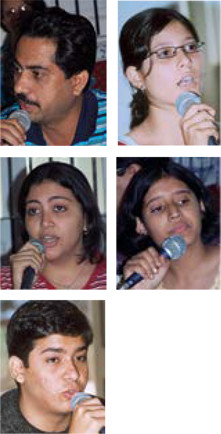
Clockwise from top left: Palkhi-wala, Azmin Mistry, Zenia Motiwala, Mehrab Modi and Raika Gazder
Anjumans
Madras
The normally placid recounting of the events and problems that affect the different anjumans was almost at an end when Nariman Mogrelia stood up to add to what Mani Clubwala had already related about the activities in Madras. He noted that the Mary Clubwala Jadhav Trust had provided financial support of 40 lakh rupees for the beautification of their agiary which will be celebrating its 95th anniversary in 2005. The work had been planned and executed under the supervision of the late Jangoo Clubwala, Mani’s husband, he added. He complimented their priest as a "very good, open-minded and pragmatic person ... These are the type of people we (as a community) require.” He also mentioned the Madras anjuman’s anxiety about their burial ground where 90 percent of the space had been used up and their apprehension that the rest of the space would not last beyond five years. One solution was to dig up the oldest graves but no decision had been taken.
He then went on to mention that of the 14 recent marriages in their area, the majority of boys and girls had married outside the community. "To find the pulse of the community we had (earlier) sent out a simple questionnaire — not one for scholars. Eighty-five percent favored the idea that Parsi girls’ children should be treated equally. They should not be denied religious benefits. We felt this kind of change needs 100 percent acceptance. So last year we sent the questionnaire again.” Though some people indulged in a "lot of propaganda” against the concept, the response percentage remained unchanged at 85 percent, said Mogrelia, adding that they were holding out for a 95 percent concurrence at least before effecting any change. Several people had questioned Mogrelia on the subject. "There was no reply to anyone individually except for Parsiana...I have a great regard for Parsiana... and that is why I gave them the reply.”
The Madras president went on to say that the Anjuman had taken up a project for a new hall next year which will have air-conditioning and an acoustic system. They intend to hire out the hall to increase income. "Besides you can also have Federation meetings there Inshallah (an Arabic phrase meaning God willing, used by Muslims and others, including Zoroastrians — Editors)
"Madras sends questionnaires to people who are affected... You know very well, they do not know about religion. If such questions are going to be asked to the affected parties and our dasturjis are not taken care of I am sorry...” said Khambatta, implying that Mogrelia was providing a benefit meant to woo the "common man.” He maintained that all the high priests have condemned the idea. "The decision to send the questionnaire was not mine. It was taken by all three bodies of our anjuman,” responded Mogrelia, adding, "I’m proud to say that Parsis in (Madras) are much better off than in Ahmedabad or Bombay or anywhere else... They are not going to be controlled by giving them any benefit...”
"‘Inshallah’ nahi bolai. Why did you say ‘Inshallah?’” chorused the rowdies from Surat and elsewhere. "Éné bahar kari deo... Éno sadro kusti check karo pahlé (You can’t say ‘Inshallah’... Throw him out... check whether he is wearing a sudreh kushti).” Mogrelia’s remark unleashed pandemonium and abusive language. "I want my dasturjis to be respected... My great grandfather was a dasturji...” Khambatta blurted into the mike. "É loko ni anjuman karta amaari milkat bahu vadharé hasé (Our anjuman is wealthier than theirs). If you want,our chartered accountant Mr Wania can ascertain... see whose bank balance is more...” "He (Mogrelia) does not have the right to discuss this on the platform of the Federation,” shouted Parakh. Dadi Mistry, vice president of the DPA, who tried to intervene, was shouted down by members of the unruly Surat contingent: "Tun Surat aav, tuné naago karsu...Tuné baari nakhsu...Nariman Mogrelia Musssalman chè. Sadro kusti péréch ké?...We are capable of fanaticism... "Aapra dharam ni saathé khel karsau... tau hamé tau salgi jaisu pun tamoné bi salgavi daisu. I challenge you to say what you said in Surat... Tamaraman taakaat hoi tau Suratma aavo. Ék ék né naagaa kari daisu. [Nobody has the right to play with our religion... We will burn but we will set you afire... Come to Surat if you have the guts. We’ll strip each one of you naked. (In the direction of Pervez Bhesania of Thana) Saalo dubro chè...kahri muko... he is an adivasi...throw him out...]”
Gen. Sethna: "Shut up.”
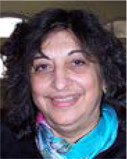
Shirin Mistry: organizing 4WZYC
Somebody shouted back:
"Pehlé énné shut up énné kaho tamé...
Pehlé eni passé maafi mango bas. Eh Inshallah saané vaasté bolyo. Aai Parsi oni conference chhè. (You tell him to ‘shut up’ first. Demand an apology. Why did he say ‘Inshallah?’ This is a Parsi conference.)
Khambatta: "Hoon maafi magooch ké tamé lok bèsi jaao. (I am tendering an apology so you can sit down).”
Homai J. Shethna of Surat pleaded: "Please pehlé shaanti rakho né decorum jaalvo évi maari tamné sauné vinanti chhé! Daayas parna ne daayas ni nichéna badhané tum né... Ane Inshallah jo bolia hoi né tamé jyaan rehta hau tan té word vapraato hoi né manas té boli padé téman é non-Parsi nathi thai jato. Tamé aai badha khota kaam nahin karo. (Please maintain order. I urge all of you. Those on the dais and those below, everybody. If he said ‘Inshallah’ and if the term is common parlance where he lives, it does not make him a non-Parsi. Please do not take wrong action).”
For close to 30 minutes this kind of uproar continued until Khojeste Mistree, à la Shiv Sena supremo Bal Thackeray, instructed the shouting brigade to cease: "Settle down, there are important points to be discussed... I recognize your emotions... What you are seeing today is symptomatic of a frustration that is growing in the community where the media is not supportive of the other point of view... Where the leadership is not in consonance with what is happening...”
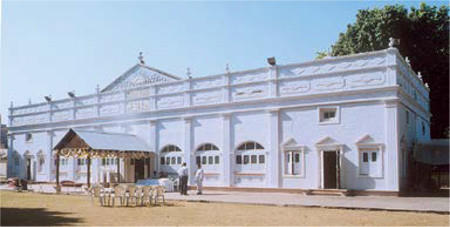
Zoroastrian Hall, Kankaria, venue of the proceedings
Ahmedabad
Work has begun on the construction of 60 shops/offices on the Ahmedabad Parsi Panchayat’s Doogerwadi land, Porus Karanjawalla informed the gathering. The construction will not only provide additional revenue but stave off encroachments which are the bane of Zarathushti anjumans in the mofussil.
The Panchayat, under its committee member Kety Daruwala has initiated the creation of a data bank of eligible Parsis from all over India with a view to matrimony. The exercise is a positive contribution towards the problem of the community’s depleting population due to late marriages and an involuntary bachelor state due to the inability to find a mate of one’s liking. Though the forms sent to the anjumans have not yet been returned with the details required, 125 forms from individual readers of the Jam-e-Jamshed Weekly had returned, the overwhelming majority being men, she noted.
Acknowledging the increasingly aging community, Karanjawalla spoke of the APP’s scheme of visiting the aged to help draft wills, pay bills, escort them on outings and gahambars. Its assistance to the indigent by way of food grains, medical aid, education, etc continues.
Allahabad
In his seventh consecutive term as president of the Allahabad Parsi Zoroastrian Anjuman Capt Homi Dandiwalla acknowledged the help of sister communities at the time of a death in the small, aging community.
Bardoli
Bardoli anjuman’s Mohta noted that representatives of the Tata Institute of Social Sciences had toured the neighboring villages and were "upset at what they saw.” The Parsis in the area are very poor and live in decrepit homes. Mohta volunteered to spend the time liaising with them if the Federation/BPP were prepared to help.
Baroda
The Baroda Punchayet is constructing a building in their agiary grounds to house poor Parsis, noted its trustee Baman Cama. However the land where the construction is proposed is threatened with bifurcation by a new road planned by the municipality, he said, asking for Sethna’s help to prevent it from happening.
Their annual awards function when proficient school and college students are acknowledged, had former chair of the University Grants Commission Dr Armaity Desai as chief guest, he noted. Cama also acknowledged a grant of two lakh rupees from the BPP towards the purchase of an imported bicycle for national level cyclist Nozer Patwa.
Belgaum
There are 20 Parsi and 50 Irani Zoroastrians in Belgaum and there had been three deaths and two births in the preceding six months, said Bhada. They are trying to generate funds to repair their agiary and the mobed’s residence, he noted, urging the audience to visit their "beautifully located, well appointed dharamshala.”
Borivli
There are about 1,500 Zoroastrians in and around Borivli, 542 of them being members of the Borivli and Suburban Zoroastrian Association, declared its president Noshir Paghdiwalla. Despite having no fixed assets the association looks after the social, cultural and religious needs of its members, and Zoroastrians from Jogeshwari to Dahisar attend its functions. A visit to the Parukh Dharamshalla to entertain its old inmates was undertaken by the association with the live orchestra of Marazban Mehta whose rendition of perennial favorites had some of them trying to dance, though they could barely walk, noted Paghdiwalla.
Davier
Marazban Wadia of Davier reminded the delegates of the 150th anniversary celebration of the Goiporia Agiary in Davier next year. They have a dharamshala with 10 rooms located behind the agiary but need funds to maintain a mobed to tend the agiary. Wadia’s spiel netted an immediate donation of one lakh rupees from Khambatta.
Delhi
DPA secretary Adil Nargolwala estimated the strength of the community in the national capital at between 750 and 800 individuals. About five months ago the DPA renovated and airconditioned five rooms of their dharamshala, fitting the bathrooms with geysers. The rooms are open for non-Zoroastrian usage when available. A couple from Scandinavia who is researching the life of Dadabhai Naoroji will shortly be hosted by the DPA at the dharamshala. Delhi had recently conducted a demographic survey and copies of the form were distributed to the delegates at the meet for them to be able to conduct similar surveys. The DPA now accepts ashes for dispersal in their aramgah. Books published by Piloo Jungalwala aimed at young readers are available with them for the benefit of other anjumans/individuals.
In response to their caterer’s appeal for immediate funds for medical treatment for his wife who had sustained a bad accident, the DPA members collected over five lakh rupees for an emergency fund. Administered by three community members — a trustee, the DPA treasurer and a lay member — the refundable fund is meant to be a loan for immediate use until the party concerned is able to make arrangements for its own money and to return the loan. "We hope we don’t have recurring medical emergencies,” noted Nargolwala. Sethna added that though people now generally have medical insurance, medicare is so expensive, that bills of a couple of lakh rupees can be run up in a few days.
Secunderabad - Hyderabad
Reporting four births, four navjotes, two marriages and 21 deaths, Secunderabad and Hyderabad Anjuman’s Omin Debara noted that the hearings in the case of the anjuman against the revenue board of Andhra Pradesh had been concluded and the judgment of the court was awaited. The anjuman had gone in appeal against the government’s decision to supercede the trustees with an administrator. The 85th anniversary celebrations of the Chenoy Fire Temple (since designated a heritage structure) over three days in August had been attended by various people including 35 youths from Bombay. A Gujarati natak performed by Dinyar Tirandaz and his troupe from Bombay was one of the highlights of the festivities. On the day of the Ardibehest roj parab 14 mobeds led by Bombay’s Ervad Aspan-diar Dadachanji had participated in the jashan, followed by an explanatory lecture by Dadachanji. Another plus point for the anjuman was the award of best principal to Shernavaz Baria. This is the second time she has been so honored, noted Debara. Cyrus Siganporia and his team from Bombay had cleaned their dakhma at the request of the anjuman. The Secunderabad representative heard of a birth in the community — here included — after he had presented this report.
Thana
Cursetji of the Thana anjuman placed the local Zoroastrian population at 3,000 with 14 births, eight navjotes, four weddings and 14 deaths in the past six months. A medical emergency similar to the one experienced in Delhi drew a response of Rs 55,000 on the basis of a letter circulated by the anjuman secretary Pervez Bhesania, he noted.
This is the 225th year of the Thana agiary and the anjuman is inviting applications for two one room-kitchen flats and one two room-kitchen flat on leave and licence basis. Their experience of providing flats on ownership basis has been an unhappy one with the recipients who got them at highly concessional rates now wanting to sell them at the market rate to other communities under the standard cooperative scheme. The Thana trustees had fought long legal battles to preserve the right of the community over Parsi properties sold off to cosmopolitan developers. Efforts are on by some individuals, including a few alumni to revive the Byramji Jeejeebhoy School whose structure had become dilapidated and was razed to the ground. The area is now being used as a parking lot, noted Cursetji.
Vyara
A hundred Zarathushtis live in and around Vyara, stated Percy Buhariwala. A community hall, a dharamshala and a dakhma belong to the community with a measly corpus of Rs 15,000 with which to maintain them. Sixty percent of the residents are dependent on agriculture. They need help from the SPP or the National Minorities Commission, he added. However a large atomic energy project is coming up in the vicinity, he noted. Reflecting on the status of community members among other communities, Dr Jokhi added that one Parsi was conducting a family court and settling disputes among the local adivasis.
Valsad
Aspy Sanjana, trustee of the Valsad Parsi Anjuman which has just affiliated with the Federation spoke of 500 Parsis in his hometown which witnessed four births, four navjotes and 15 deaths in the past year. Their community hall is called Bejan Baug and the famed Tithal beach is a place for recreation. They have four flats of one room each available for Parsis at a monthly rent of Rs 250, he noted. The anjuman, he said, provides financial aid for education and medical requirements totaling five lakh rupees which is also available to people living outside the area.
IZA
The newly elected president of the IZA Mehrwan Irani spoke of their annual disbursement of Rs 35 lakhs to Parsi and Irani charities. He was lauded by Gandhi for his single-handed battle for the preservation of the vast property (13 acres) of the Tithal Sanatorium for the community. After a grim battle of 18 years, the land which had been leased to a non-Parsi developer was restored to the community (for details see "The Tithal triumph,” Parsiana, November 2004). The Iranian Anjuman has undertaken to set up housing and a sanatorium on the land, some of which is said to be encroached.
Jabalpur
The Jabalpur anjuman has erected a shopping complex on the eastern side of their dharamshala, the shops going for 14 lakh rupees each, as per their representative Kerman Batliwalla.
Madras
The 291 Parsis in Madras including children are a cohesive group, maintained Mani Clubwala, the coopted member from the south zone. The three community institutions there set up monthly programs and the mothers are encouraging their children to take classes in voice training and mimicry so there is no shyness. The anjuman is in the process of renovating old buildings which have now become dilapidated.
Nagpur
With three births, 10 deaths, four navjotes and one wedding in Nagpur, its president Edul Bhagwagar stated that the population was declining — 1,200 Parsis in 1964 have dwindled to 603 in 2004 — and the anjuman lacked sufficient liquidity to look after the aged of whom 59 percent live in the Parsi colony and nine percent in other rented accommodation.
Nargol
The Nargol anjuman looks after three sacred fires including a dadgah which is nearly 1,000 years old, according to Farroak Govadia. They have three mobed quarters with three rooms each including one for menstruating women. The doongerwadi has a prayer hall, a ravan bungli, quarters for the manager and servants. The area around their agiary is up for sale and the anjuman wants to buy it off to preclude non-Parsis in the immediate vicinity. Blessed with 23 acres of land where they are trying to create their own source of bawal for the kathi required in the agiary, they want to replace the ordinary fence with barbed wire for further security.
Deolali
Deolali’s first lady trustee Tehmi Patel spoke of their agiary built in 1916 and the dakhma in 1917. Their Neterwalla Dharamshalla has all recreational facilities. The anjuman is strapped for funds due to the fall in interest rates so that they have to approach donors to meet the agiary’s maintenance requirements. There are about 350 Parsis in Deolali, mostly retired folk.
Poona
According to Tehmas Bharucha the population of Poona is second only to Bombay’s and increasing thanks to births as well as migration from Bombay. There have already been a couple of marriages in the newly constructed flats which number over 200, he said, and a home for senior citizens is under consideration. The construction of a hostel building to accommodate the substantial student population in this university town is expected to be completed in seven or eight months with ladies and gents being accommodated on separate floors. One solar concentrator has already been set up at their doongerwadi and a second one is in the process of installation.
Saronda
While there is faith in the fire of the 100-year-old Saronda agiary which had been renovated at a cost of three lakh rupees and nearly 300 persons had attended the gahambar on the occasion of its centenary, the corpus is insufficient to maintain it, noted Ervad Yezdi Panthaki. Some new homes have been built in the area but the area houses a largely transit population, he added.
Surat
After enumerating the many activities of the Parsis of Surat as well as the many organizations that are active in that city, after putting across the apprehension of the Surat Parsis about the formation of a world body, SPP trustee Yazdi Karanjia tried to ease the tension with a few laughs and philosophical quotes: "The shortest distance between two people is a smile. So why worry and get wrinkles, smile and get dimples!...In my humble opinion, insaanyat hi subsé pahéla dharma hai insaan ka/uské baad hi panna kholo Gatha, Gita aur Quran ka (Humanity is the first religion of mankind. Only thereafter can you read the Gathas, Gita or Quran).”
Those attending the Federation meeting were: Areez Khambatta, Farokh Kavina, Jehangir Cama, Rashid Medora, Porus Karanjawalla, Darius Doctor, Kety Daruwala, Kersy Daruwala, Pervez Wadia, Firoz Daver, Nina Sepai and Firdose Kapadia from Ahmedabad; Homi and Shireen Dandiwalla, and Rustom and Shehernaz Gandhi from Allahabad; Jamshed Mohta, Pervez Mehta, Homi Pithawalla, Ms Mehta, Viraf Munshi and Jaloo Mehta from Bardoli; Mehrab Modi, Baman Cama, Dara and Roda Hakim, Avi Sabavala and Farhad Wadia from Baroda; Khojeste Mistree and Cmdr Madioma Bhada from Belgaum; Sarosh and Pilloo Ginwalla from Bharuch; Minoo Shroff, Dinshaw Tamboly, Behram Dastur, Sheroo Master, Cawas Panthaki, Godrej Dotivala, Gool Kias, Azmin Mistry and Raika Gazder from Bombay; Noshir Paghdiwalla, Khurshed Pastakia, Y. B. Motiwala, Marazban Mehta and Zenia Motiwala from Borivli; Hushang Vakil, Firoz Jamshedji and Dhanji Jashumani from Dahanu; Marazban Wadia from Davier; Lt Gen Adi Sethna, Dadi Mistry, Keki Gandhi, Ava Khullar and Adil Nargolwala from Delhi; Tehmi Patel and Sherzad Patel from Deolali-Nasik; Farrokh Rustomji from FPZAI; Mehrwan Irani and Pervez Irani from the Iranian Zoroastrian Anjuman; Kerman Batliwalla from Jabalpur; Tannaz Parakh, Yazad Engineer from Khergam; Noshir Dordee from Kudiana; Nariman Mogrelia and Mani Clubwala from Madras; Bhicaji Davierwalla and Farrokh Kharas from Mahuva; Edul Bhagwagar, Yezdi Bhag-wagar, Shiraz Doongaji and Dinshaw Mistry from Nagpur; Hoshang Wania and Farroak Govadia from Nargol; Yazdi Engineer from Olpad; Yazdi Desai from Panchgani; Porusasp Mehta, Adil Saron-dewala, Tehmasp Bharucha and Mabrin Nanavatti from Poona; Yezdi Panthaki, Sarosh Poonawalla and Jehangir Mandiwala from Saronda; Zarvan Patvi, Eric Bhattena and Anahita Desai from Solapur; Darayas Master, Yazdi Karanjia, Homai Shethna, Hormuzdiar Patel, Kerman Sethna, Dinyar Besania, Noshir Dordi, Bhicaji Davierwalla, Kersi Nalla-daru, from Surat; Dinyar Besania from Suvali; Rustom Cursetji, Pervez Bhesania and Kaizad Bilimoria from Thana; Aspi Sanjana and Noshir Zaroliwala from Valsad; Dr Bahadur Jokhi, Cawasi Jokhi, Percy Buhariwala and Sarosh Buhariwala from Vyara. Shirin Mistry from Australia and Dr Homi Dhalla were special invitees. The Press was represented by Parsiana.
◆ ◆ ◆
From the archive