
Religion
“Fighting an enemy that does not exist”
Zarathushtra’s goal of Frashokereti implies “acceptance in Zoroastrianism,” stated Dr Kersey Antia in his lecture in Bombay
It was an epochal evening: a gathering of Parsis unseen for many decades as the upper crust joined the hoi polloi to listen to Dr Kersey Antia, billed as Vada Dastur — High Priest — of USA, a man who has single-handedly churned the Indian community’s orthodox establishment for over 25 years by performing the first public initiation of a non-Zoroastrian.
While the organizers — Association for Revival of Zoroastrianism (ARZ) and Association of Inter-Married Zoroastrians (AIMZ) — had taken a tip from the way the orthodox lobby normally beefs up its audience by providing to and fro transport from the baugs and colonies with some snacks thrown in for good measure, others drove to the crowded Y. B. Chavan Auditorium at Bombay’s Nariman Point on February 2, 2008 on their own and cheerfully settled in the aisles, steps and floor. There were doctors and company directors among them and many seemed to be in their seventies. There was no standing space left and eventually the public address system was activated so that those who could not enter the auditorium could hear the speaker. As quipped chief guest Gerson DaCunha, eminent theater and advertising personality and convenor of AGNI (Action for Good Governance and Networking in India), "Who says Parsis are dwindling in number? This is like an Adi Marzban hit at the Bharatiya Vidya Bhavan!”
The huge turnout must have been particularly galling to members of WAPIZ (World Alliance of Parsi Irani Zarthoshtis) whose founders Khojeste Mistree and Yazdi Desai had allegedly tried to prevent the function being held by appealing to the auditorium authorities to cancel the booking on the plea that there might be conversion activities which would lead to public disturbances. As it happened, the organizers and the Chavan management ended up by ensuring proper police bandobast (arrangement) and an announcement at the start of the proceedings urging those not in mental harmony with the speaker to leave the auditorium. The hecklers were also made to leave after a short spell of time.
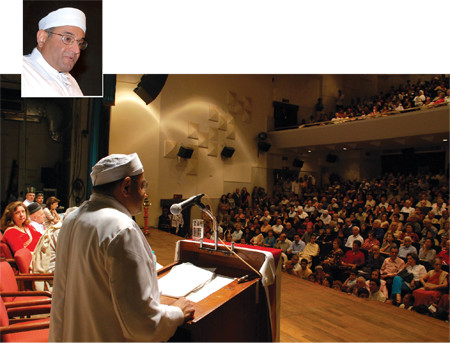
Antia (inset) speaking at the jam-packed auditorium
"I didn’t think I’d ever see in my lifetime recognition for the truth I’ve been fighting for for half a century,” said a visibly impressed Antia. Unlike the dragon-slayer image of him in the public mind, the words of the stocky, bespectacled psychologist from Chicago were mild, his tone gentle, his message one that has been heard oft times before. He was far from being a riveting speaker. His charisma lay in the fact that he practiced what he preached with courage uncommon in the community today. As others had done before him, he cited profusely from the Gathas and other common Avestan prayers to show that Zarathushtra intended his message for all mankind. He did not lose his cool even when heckled by a section of the audience, clapping, shouting as he spoke, insisting he answer a flood of questions which as Antia noted, seemed to ask, "Who is Rama, at the end of the Ramayana!”
Despite the fact that "more and more people have been encouraged to look into the scriptures and see what they say, red flags go up among Parsis whenever I speak, never among Iranian Zoroastrians!” declared Antia. "The Iranians went out of their way to welcome (American engineer) Joseph Peterson.” Founder of several darbe mehrs in North America, philanthropist Rustam Guiv himself had been in favor of acceptance and the Rustam Guiv Trust of California had supported the navjote (see "The Navjote of Joseph Peterson,” Parsiana, April 1983).
Antia’s speech did not only concentrate on those aspects of the scriptures which advocate the spread of the religion. He also addressed other aspects of scholarly interpretation that have become an article of faith with sections of the community: "Our religion is not dualistic. It is pregnant with philosophical ideas. All good things come from God.” In an allusion to the controversies and the declining numbers of the community he noted, "A race dies by suicide or by self-inflicted wounds.”
He quoted from other authorities like Rabindranath Tagore ("Go alone, study”) and Galileo Galilee ("Our own education stands between us and the past – and the future”) and cited a recent study on the Parsi community by Tanya Luhrmann: "No resolution is possible (between those who accept and those who reject the children of out-married Zoroastrian mothers )…The community rushes to fight an enemy that does not even exist.”
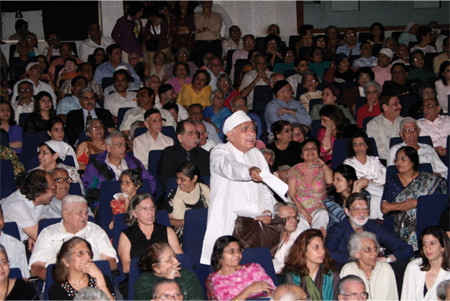
K. N. Dastur heckling the speaker
"These are dangers of our own making, not of our religion. We have utterly failed to follow our scriptures. In the upshot we are forcing people to go elsewhere for physical solace. They become bitter…” noted Antia, adding, "In North America we have resolved the problem; we accept the child whether the mother or the father is a Zoroastrian. And the little seed that the ARZ and AIMZ have planted here will grow. The great thing in Zoroastrianism is to fight for the truth. We have to take some action, perform some duty, to reach the goal.” He quoted UK based Iranian academic Shahin Bekhradnia that many Iranian Zoroastrians are shocked to learn that Parsis have different rules for men and women and reminded the audience that there was a time when Zoroastrianism had women priests. "All the texts support acceptance very clearly. The denial is for political, social, psychological reasons. People are terrified that their way of life and their special privileges are slipping away,” Antia noted.
"Zarathushtra says in the Gathas that you have freedom to choose and advises us to make the right choice. But to make the right choice every moment is so difficult…(That is why) everyone wants to be told what to do. Zarathushtra says the righteous made the right choice. He makes no reference to race or people. He speaks of the world, of mankind.” Antia rubbished the contention that there were no religions before Zarathushtra, noting that the Assyrians and Babylonians had their own. "The Iranian kings were tolerant but Darius regrets that the Elamites did not accept the word of Ahura Mazda. According to Prof Richard Frye, 50 percent of the population in Darius’ time were Elamites.”
Referring to Zarathushtra’s command to bring progress and renovation to the world which had been crying out in agony, Antia asked, "How can you bring renovation (to a world teeming with billions) with one lakh people, with limitations on women? He invites everybody to follow the path…This truth is equally true for men and women…In prehistoric times he had said, without men and women working together we cannot get Frashokereti…He ardently seeks the help of men and women so he can himself cross the Chinvat bridge…Zarathushtra doesn’t want praise; he wants action.” Even the later, Pahlavi literature has maintained the idea, said Antia.
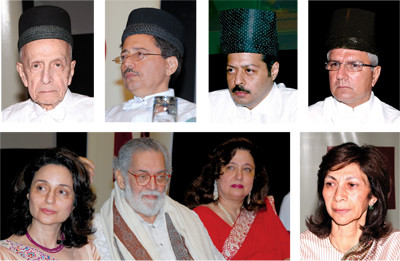
L to R (top row): ARZ’s Dr Keki Grant, Kerssie and Vispy Wadia and Darayas Malegam. (2nd row) AIMZ’s Meher Rafaat, Meher Amersey and Smita Crishna with Gerson DaCunha
"God has given free will to mankind so they can make their own action. He gave us free will even before he gave us religion,” noted Antia adding that evil is largely manmade. He cited the instance of Katrina, the tidal wave over the east coast of the US and noted, "The first act was Nature’s; the second was the neglect of the government. The same thing happened with the tsunami in southeast Asia. Very often it is man’s fault that leads to evil. Without free will there can be no responsibility. God depends on us (as hamkars) to help Him. In the Bundehishn there is a passage which speaks of khratu – intelligence – which can also lead to temptation. God can only give such a choice to all mankind.” Quoting from the Upanishads, Antia explained that the same idea surfaced therein – the concept of knowledge used with wisdom. "The Dinkard says that men born of one father should esteem each other. That the whole of mankind will be linked in mutual love on Frashokereti.” Challenging the oft repeated contention that Zoroastrians did not convert, Antia noted, "The priest Kardir boasts of converting Iranian subjects to Zoroastrianism… Noshirwan urged the Turks to be Zoroastrian. In 1903 Parsi dasturs and scholars said there is conversion/acceptance in the community, that even after the Arab conquest, during the reign of the Caliphs, acceptance was known.
"In the Afringan we pray, ‘Let obedience prevail over disobedience, peace over anarchy, generosity over miserly spirit that makes you clap when someone speaks…”
Antia was honored with a shawl and memento by AIMZ president Meher Amersey. Others on the dais so honored were Dr Keki Grant, founder of the famed Ruby Hall Clinic in Poona, now considered an ace cancer treatment provider in Asia; barrister Meher Master-Moos better known in Zoroastrian circles for her Zoroastrian College in Sanjan and for her staunch commitment to the Zoroastrian yearnings of the Central Asian peoples of Tajikistan and Uzbekistan; and Byram Nanabhoy Jeejeebhoy who has donated land in Malad for the building of a Zoroastrian fire temple.
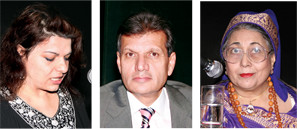
L to R: Tenaz Dubash, Byram Jeejeebhoy and Meher Master-Moos
"We Parsis are a great race, really. We are the people who built Bombay and still have a lot of fire to go around!” the nonagenarian Grant, who chairs the ARZ, was positive in his response to "the honor the Parsis of Bombay have given me today…We have overcome difficulties in the past. The present difficulties of a declining population will also be overcome. I request all of you to do it in a nice, moderate way without antagonism…sit together to overcome this little problem.” Noting that he had started his hospital, now worth Rs 800 crore, with nothing in his pocket 50 years ago, Grant recalled how he had gone from bank to bank for a loan but couldn’t get it because he was poor. Then he approached a bank manager whose mother was a patient and got the money without any collateral. Years later he asked the man what prompted him to take that decision and was told, "‘I liked your face. Also because you are a Parsi and Parsis never cheat.’ Even the Income Tax people accept our papers without question,” maintained Grant, urging the audience to cherish three principles: sincerity, honesty/truthfulness and charity without expecting anything in return, adding, "The more you give, the more you receive.”
DaCunha offered two reasons why his presence at this totally Parsi function needed no apology: "I am a Goan. I come from a land that has been the salvation of the Parsi community,” he jested, referring to the generations of Goan domestics in Parsi households. "I am another Goan at your service!” After the guffaws from the audience DaCunha continued, "As a non-Parsi I can speak without restraint or embarrassment of our deep attachment to this community. In advertising whenever we need to present goodness in 30 seconds, often and often and surprisingly often, a Parsi is chosen. All the millions watching (the advertisement) identify the message immediately. The way Parsis are, the way they live, their culture, is synonymous for faith, religion. It opens doors. That Zoroastrianism is spreading fast and furious and widely the world over is not surprising.” He contrasted the message of the most common Zoroastrian prayers – Ashem Vohu and Yatha Ahu Vairyo – with equivalent Christian prayers and noted, "You pray for righteousness, for the grace of caring. Your prayers do not begin with your own wellbeing as our prayers do. It is an important difference.”
Referring to Antia’s message of acceptance in Zoroastrianism DaCunha noted, "Fighting an enemy that does not exist is not easy.” He suggested the presentation of Zarathushtra’s message in an easy to comprehend format ("Transfer the theology of Zarathushtra to the Reader’s Digest”) adding, "I can’t say this to other communities. But Parsis are so rich in communicative skills.” He also suggested that the message be targeted to the youth. "We grew up reading about Bible characters. The religion should be simplified for the young.”
The speech was meant to be followed by the screening of the film Crisis in Faith: Zoroastrians Today, an hour long docudrama presented by US based director Tenaz Dubash. The proceedings were rudely interrupted with demands for a question-answer session interjected with catcalls and heckling. Antia gamely fielded some of the questions, but from the quantum of papers handed over it was obvious that the planned strategy was to disrupt the function. However, thanks to the security arrangements in force, the hecklers had to leave the auditorium. Furious, vituperative and totally irrational statements could be heard bandied around in the foyer. For example, Parsiana heard one man tell another in overwrought tones, "I don’t care! I want to go to the dakhma and be eaten by vultures!”
The orthodox response to Antia is on the anvil on February 15. Will they ask him, belatedly, to be their Valentine?
◆ ◆ ◆
From the archive