
Comment
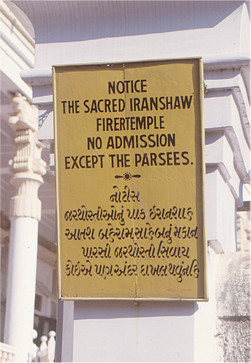
Entry barred
The author argues there are substantial legal safeguards to bar non-Parsi entry into fire temples
A new controversy debated in our community is that non-Parsis should be allowed to enter agiaries, atash behrams, bunglis at Doongerwadi and such places of worship. My answer would be an emphatic "No.” Non-Parsis should not be permitted to enter our places of worship. Some people of other sects allege that Parsis are orthodox and should change with the passage of time. In India there are a number of other temples and religious places too which permit only particular sects and do not allow others to worship there.
India is a secular state and the Constitution of India guarantees freedom of conscience and religion. Article 26 of the Constitution guarantees to every religious denomination or a section of it, a right to manage its own affairs in matters of religion and the right to establish and maintain institutions for religious purpose.
Further, article 26 of the Constitution guarantees to each religious denomination the right to manage its domestic affairs in matters which are concerned with religion and the State cannot interfere in these affairs unless the denomination so exercises its right as to interfere with "public order, morality or health.” The State tolerates all religions, religious groups and denominations. Religion is difficult to define. It is man’s belief and faith in God. A religion is not merely an opinion, doctrine or belief. It has its outward expressions in acts as well. Religious practices or performances of acts in pursuance of religious belief are as much a part of religion as faith or belief in particular doctrines. No outside authority has any right to say that religious rites and ceremonies to be performed at certain times and in a particular manner are not essential parts of religion and it is not open to the secular authority of the State to restrict or prohibit them in any manner they like under the guise of administering the trust estate.
The members of a religious community or denomination are free to practise the rituals and ceremonies which they find religiously efficacious and in agreement with their religious beliefs.
The Supreme Court of India in the case of Nar Hari Shastri and others versus Shri Badrinath Temple Committee observed that the right of entry into a public temple is, however, not an unregulated or unrestricted right. It is open to the trustees of a public temple to regulate the time of public visits and fix certain hours of the day during which alone members of the public would be allowed access to the shrine. The public may also be denied access to certain particularly sacred parts of the temple, e.g. the inner sanctuary or as it is said the ‘Holy of Holies’ where the deity is actually located. Quite apart from these, it is always possible for the temple authorities to make and enforce rules to ensure good order and decency of worship and prevent overcrowding in a temple. Good conduct or orderly behavior is always an obligatory condition of admission into a temple and this principle has been accepted by and recognized in the Shri Badrinath Temple Act. Section 25 of Shri Badrinath Temple Act provides for framing of bye-laws by the temple committee ‘interalia’ for maintenance of order inside the temple and regulating the entry of persons within it.
In the case of Dargah Committee, Ajmer and another versus Syed Hussain Ali and others, the Supreme Court held that the vires of Sec. 5 of the Durgah Khawaja Saheb Act (1955) cannot effectively be challenged on the narrow ground that since the committee constituted under the Act was likely to include Hanafi Muslims who may not be Chisti Muslims the provision authorizing the appointment of the committee was ultra vires. When offerings are earmarked generally for the Durgah they belong to the Durgah and such offerings can be received only by the Nazim or his agent and by nobody else. These offerings never belonged to the Khadims and they can therefore have no grievance against either S. 2(d)(v) or S. 14 of the Durgah Khawaja Saheb Act 1955. That is a matter concerning the property of the Durgah and it is open to the Legislature to regulate by providing that the said offerings can be solicited by the Nizam or his agent and by no one else. The Khadim’s right to receive offerings which has been judicially recognized is in no manner affected or prejudiced by these provisions.
The Supreme Court in the case of Sri Venkataramana Devaru and others versus State of Mysore and others considered the Madras Temple Entry Authori-sation Act, 1947 and held that when there is a question as to the nature and extent of a dedication of a temple, that has to be determined on the terms of the deed of endowment if that is available, and where it is not, on other materials legally admissible, and proof of long and uninterrupted user would be cogent evidence of the terms thereof. Where, therefore, the original deed of endowment is not available and it is found that all persons are freely worshipping in the temple without let or hindrance, it would be a proper inference to make that they do so as a matter of right, and that the original foundation was for their benefit as well. But where it is proved by production of the deed of endowment or otherwise that the original dedication was for the benefit of a particular community, the fact that members of other communities were allowed freely to worship cannot lead to the inference that the dedication was for their benefit as well. For it would not in general be consonant with Hindu sentiments or practice that worshippers should be turned away. Where the foundation was originally for the benefit of the Gowda Saraswath Brahmin community, the fact that other classes of Hindus were admitted freely into the temple would not have the effect of enlarging the scope of the dedication into one for the public generally. Held on consideration of evidence that the temple at Moolky Petha in village Mannampady in South Kanara District is a denominational temple founded for the benefit of the Gowda Saraswath Brahmins. The judgment in the case of Shri Dewan versus State of Mysore has been followed and referred by the Supreme Court in the year 2005.
The Supreme Court in the case of Shastri Yagnapurushdasji and others versus Muldas Bhandardas Vaishya and another held that by enacting Section 3 of Bombay Hindu Places of Public Worship (Entry Authorisation) Act 1956 the Bombay Legislature did not intend to invade the traditional and conventional manner in which the act of actual worship of the deity is allowed to be performed only by the authorized poojaris of the temple.
In the case of Commr Hindu Religious Endowment, Madras versus Sri Lakshmindra Thirtha Swamiar of Sri Shirur Mutt the Supreme Court held that it is a fundamental right of a religious denomination or its representative to administer its properties in accordance with law. A law which takes the right of administration from the hands of a religious denomination altogether and vests it in any other authority would amount to a violation of the right guaranteed under Article 26 of the Constitution.
It is interesting to note that the late Prime Minister of India, Indira Gandhi was not allowed to enter a denomination temple when she visited South India.
From the various judgments passed by the Supreme Court of India and various High Courts in respect of entry into Hindu temples, we are fully justified in our action by not allowing non-Parsis to enter our religious places of worship.

The author is a solicitor and advocate practising in the Bombay High Court.
◆ ◆ ◆
From the archive