
Bawa Musings
Who ate the malido?
Before you think otherwise, the subject is temple cuisine and not trustees
Our friend, the late Ervad Framroze Panthaki, head priest of the oldest Agiary in Bombay – Banaji Limji near Akbarally’s, Fort, was a liberal soul, secular and far ahead of his times. He would begin the day with a sonorous recitation of the jashan prayers in his spic and span Agiary – the holy fire credited with many a miracle – and end by playing the manjira (small cymbals) at a bhajan mandali (a group singing Hindu hymns) in some bylane of Kalbadevi. Every year, on his spiritual Master’s birthday, he would conduct a jashan, open to non-Parsis. Post the jashan, the disciples of the Master would display more than the usual desire to partake of the chaasni (the consecrated eatables) which would include the most divine malido in the Milky Way. Golden yellow, smooth and slightly warm, dripping with pure cow ghee, not having the slightest aftertaste of the million eggs which had perished in making it, sprinkled with finely sliced almonds, pistachio, raisins and charoli (a small round nut which if eaten alone is insipid, but on the malido, simply inspiring). The container (called ‘lungdi’) would be empty before one could say "Khshnaothra Ahurahe Mazdao.”
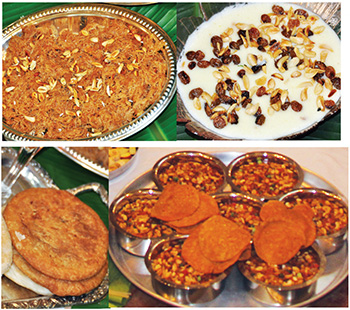
(Clockwise from top left): sev; ravo; malido; and papri
The malido would be accompanied by papri (a deep fried, savory, salty, thin crusted bread of sorts). Ervad Framroze’s papri, on that special day, would be light, crisp and non-oily. A dollop of malido on the top of a piece of papri and a Parsi would feel that he had just crossed the Chinvat Bridge on the day of judgment and entered behest (heaven). Humdins would cleanse their palates with chopped apples, bananas, pomegranate and melons.
The papri is quite similar to the famous Sindhi breakfast item – dal (lentils) pakwaan. If Mirchandani and Batlivala were blindfolded, they would not be able to tell papri from pakwaan. Indeed, we had once mischievously served pakwaan to a priest visiting us "Gannij sojji papri chhè – Kai agiary ni chhè (excellent papri, which agiary is it from)?” he enquired. We, of course, did not tell the good andhyaru about its Sindhi origin.
Barring the traditional Zoroastrians (please observe our newfound politeness in eschewing the word ‘fringe’), most would let non-Zoroastrians eat the chaasni, except its most sacred item, the daroon (a hardened, rice flour chappati – exact equivalent of the ‘bread’ in church communion). We can assure our non-Parsi friends that they are not missing anything. Despite its high spiritual status, daroon is tasteless – though, on that special day, even the daroon tasted soft and divine. We must hasten to add that daroon may be consumed by cows and goats (normal practice in Navsari and Udvada), though not by non-Parsis. The discrimination is somewhat similar to the dog (but not non-Parsis) being allowed entry in the bunglis at Doongerwadi to witness the funeral ceremony.
If Ervad Framroze was capable of conjuring up Michelin starred temple cuisine, at least on special days, routine temple cuisine is almost inedible: The malido, sickly pink in color, hard as a pebble, made out of jaggery and vanaspati oil, without eggs, sugar or dry fruits. Devoted behdins, out of respect for their deceased ancestors, would try to swallow it, wrapped in rubbery hard daroon. The papri would be capable of cutting the insides of your throat. The bhakras (an indigenous cookie), if eaten by a daring soul, would instantly remind you of your root canal treatment.
Every large agiary has a kitchen attached to it. Apart from serving food to the practising mobeds, these kitchens produce temple cuisine — almost uniformly pedestrian — as offerings to the deceased at baaj and stoom prayers. The stoom (popularly pronounced as satoom) involves offering a full meal to the soul of the dear departed. We have heard a portly behdin lady telling the harassed panthaky of the agiary that he was to place only chicken drumsticks, and not wings, in her late husband’s satoom offering, as the deceased simply deplored chicken wings!
On the last day of the muktads (all souls’ days), when the flower vases and vessels are finally lifted, the agiary would send to the behdins a full meal as chaasni comprising a rather anaemic omelette, pieces of dry chicken and fish, wheat chappatis and french beans, generally, so awful that it would be surreptitiously given away to the non-Parsi servants.
In the good old days, Navsari temple cuisine was exotic and delicious. On ‘big days,’ old ladies would freelance as temple chefs and conjure up mouth-watering sadhana (not to be confused with a popular heroine of the yesteryears, famous for her haircut). The Parsi sadhana is a steamed cake made of fermented rice, very light on the palate, if rightly made. Then there was kumaash (a kind of Persian sweet cake) and the yummy varadhvaroon (also made for pre-wedding feasts in the moffusil). The varadhvaroon looks like a huge bhakra but is very different in taste. It has a hard exterior, which crumbles to reveal a soft and sweet inside. The dough would be marinated overnight with slightly fermented toddy (an alcoholic drink made from the sap of the palm tree) and buttered sugar added to the concoction, which would be deep fried in sojju pure ghee, the next morning – a delicious accompaniment to the mint and lemongrass flavored Brooke Bond tea.
We cannot end this column on temple cuisine without narrating this endearing anecdote. Almost four decades ago, when this columnist was a cub reporter with The Bombay Samachar and assisting the venerable Jehan Daruwalla in his Parsi column on Wednesdays called "Parsi Prakash,” he penned a little piece on an episode in a Bombay agiary relating to temple cuisine. The panthaky’s son, now deceased, usually a well liked and affable fellow, demanded a piece of freshly made koprapaak (a sweetmeat made out of coconut and spiced for flavor) from the temple cook. The cook, a pious man, told him to wait till the koprapaak was first offered in prayers, which were about to begin. The son, furious at this denial, hit the cook’s back with the chamach (a large cooking spoon) used for making the sweetmeat. Industrial action by temple workers was narrowly averted. We thought this episode fit for publication and titled it as "Kissa koprapaak ka” (in those days, a popular political thriller film Kissa Kursi ka had been released).
A few days later, the enraged gentleman barged into Daruwalla’s cabin and wanted to meet this columnist. Since we did not want to be similarly hit by the temperamental gentleman, we politely suggested that we would be glad to publish his clarification, a journalistic ploy to further the controversy. In the next column, a clarification appeared, with the gentleman’s smiling photo so that he could be easily identified, stating that the gentleman was apologetic for the slight hurt caused to the temple cook; and, in any event, it was not koprapaak, but mehsoor (another delicious sweetmeat). Of course, the title of our column said: "Sorry, it was not koprapaak, but mehsoor.”
Berjis M. Desai, managing partner of J. Sagar Associates, advocates and solicitors, is a writer and community activist.
◆ ◆ ◆
From the archive