
Cover Story
To serve humanity
For a hundred years the Parsi Ambulance Division has rendered yeoman service to members of all communities
Every year the Parsi Ambulance Division (PAD) is summoned to accompany the procession of Christians from Azad Maidan to Mount Mary Church at Bandra. It starts at 10 p.m. and ends the next day at 4 a.m. Explains Homi R. Wadia, honorary secretary of the PAD, "We have to follow them with our ambulance. Sometimes when old people feel tired, they wish to sit in the ambulance. Some young ones also tend to fall sick. It’s a matter of pride for us that Christians always approach the Parsi Ambulance Division.”
During Ganpati immersion, members of the PAD would be stationed from 1 p.m. to 10.30 p.m. at Chowpatty Beach. In case of casualties they were expected to be well prepared. Adds Adi L. Doctor, station officer and supervisor of the Division, "We even shift accident cases until and unless some member of the public volunteers to take responsibility of the injured person. In case of house collapse as well, we go on duty as soon as we receive a call from the fire brigade. Of course, we are not allowed to enter the collapsed building, but the brigadiers bring the patients near our ambulances. We keep the patients on stretchers and take them to the hospital.”
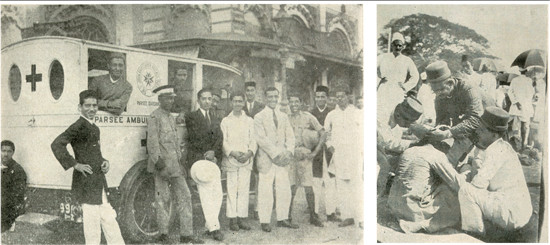
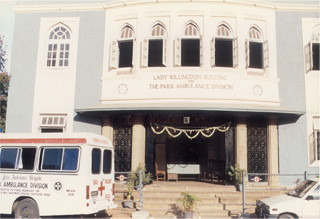
Above (left): PAD officials on duty during the riots in 1929 and (right) treating wounded satyagrahis during the Wadala Salt Raid in 1930. Below: Lady Willingdon Building which houses the PAD.
In addition to public duties, some of the other PAD work includes transporting patients from hospitals/clinics to residences and vice versa, sports duties in schools where, in case of minor casualties, the patient is treated immediately or, in case of a major injury, the patient is taken straight to the hospital. Continues Wadia, "At times, even the police call us. On our District Parade day on September 12, 2004, we had invited Pratap Singh Patankar, deputy commissioner of police (traffic), to talk on "How people can avoid accidents.”
Apart from organizing various lectures, PAD also conducts medical camps, exhibitions on AIDS-HIV infection, general check-ups, blood donation drives, etc. They distribute spectacles, clothes and ration to the poor free of cost from the charitable dispensary that the Division runs from Lady Willingdon Building, opposite Bombay’s Metro cinema. Adds Homiar N. Vakil, a solicitor by profession, working for Mulla and Mulla, and one of the trustees of the Division, with gratitude, "The success of these camps is mainly due to the support of doctors and free medicines from various pharmaceuticals.”
Some of the other trustees who professionally manage the PAD Trust are Maneck R. Antia (sales officer with Taraporewalla and Sons), chairman of the board of trustees and superintendent of the Division (since retired), Aspi F. Sarkari [executive assistant in the Estate Department of the Bombay Parsi Punchayet (BPP)] incoming superintendent, who takes care of training and day-to-day functioning of the Division, Dr Bejan J. Shroff (chief superintendent of the B. D. Petit Parsee General Hospital), who looks after the examination of the Division’s candidates and their knowledge in first aid, and Mehli Colah (BPP financial consultant), who takes care of investments and accounts of the trust.
Although the membership of this Division is only for Parsis, it caters to people of all communities, irrespective of caste, color, creed or religion. Dr Prakash S. Kothare, MBE, commissioner, St John Ambulance Brigade No 3, Maharashtra District, appreciates: "The members of the Parsi Ambulance Division are volunteers devoted to the cause of humanity, round the clock, day and night. The Division is very active during natural/national calamities, so much so that few of their members have even sacrificed their lives in communal riots, civil agitation, explosion at the Victoria Docks...” Two of the most devoted members of the Division, first ambulance officer and divisional treasurer Gustaspji Nusserwanji Gazdar, associated commander (brother) of the venerable order of St John and private Jamshed Ardeshir Navdar, fell victims to the fury of rioters while performing ambulance duty on September 1, 1946.
On a nominal refundable deposit, the PAD also provides wheel chairs, surgical beds, commodes, walkers, walking sticks, crutches, etc. These are absolutely free of cost and are to be returned after use. If these are required for long periods of time, they are to be renewed every three months. Clarifies Vakil, "Except for the refundable deposit, the patients don’t have to pay for anything. We refund the deposit when the article is returned. At the time of returning the articles, patients give whatever donation they feel like. Some patients simply give the deposit itself as donation. Moreover, giving a donation is not compulsory. All the money is ploughed back into the ambulance fund. After all, we survive on donations ... Recently the Division received eight walkers from the Lions Club of Bombay Host as donation.” Donations to the PAD are exempted under Section 80G of the Income Tax Act, 1961. Adds ambulance officer Keiky M. Press, treasurer, "We also get funds from the Dorab Tata Trust, the Ratan Tata Trust, etc.”
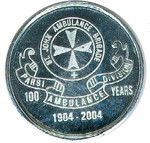
All their ambulances have been donated by various institutions and individuals. At their centenary celebration function on April 2, 2004 at Albless Baug, Jamshed N. Guzder, BPP’s chairman emeritus, announced a donation of 10 lakh rupees in memory of his wife Shirin for the purchase of a fourth ambulance, a Tata 407, with accessories. A year later, on April 3, 2005 Guzder was invited to inaugurate the ambulance on the occasion of the Division completing 101 years of service. A memento was presented to Guzder as also to Antia who had served the PAD for 60 years, the last 14 as its superintendent.
Being a 24-hour service, the ambulances also travel out of the city. They attend calls at places like Navsari and Surat. Vakil goes into the reminiscing mode: "When the Division was started, there were hand-driven ambulances which were in operation during the World War.”
When the Division was formed, it had about 20 members on its roll, all of whom operated from their respective residences till such time the Lady Willingdon Building was constructed. The foundation stone of the PAD headquarters, known as the Lady Willingdon Building, was laid by Sir Hormusji Cowasji Dinshaw. Constructed at a cost of Rs 60,000 it was inaugurated by Sir Fredrick Sykes, the then governor of Bombay, on April 9, 1932. The N. M. Wadia Hall within was in recognition of a donation of Rs 10,000 from the trustees of the N. M. Wadia Charities.
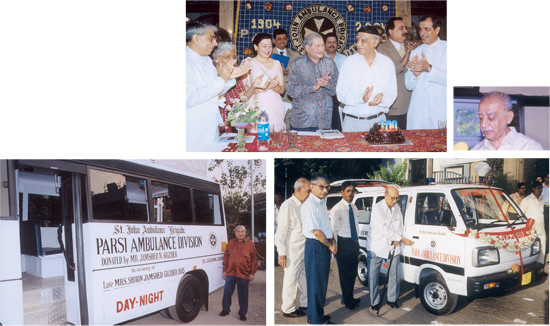
(Clockwise from alongside) At the centenary function: Guzder (centre) with Sarkari and Antia (first and second from right respectively); retiring superintendent Antia and the two new, recently donated ambulances
The membership of the Division grew to 114, the highest, in 1940. Over the years it has declined to a mere 45 in 2004. "This is mainly because young persons hesitate to join since they have many other interesting activities outside,” says Antia. "But, even if a few Parsis take a little interest in our all-round activities, we on our part will try to enliven their joining this institution so that the good work of the Parsi Ambulance Division could be carried on for many years to come.” On the other hand, says Wadia, "Merely increasing numbers is not enough. What is important is dedication to do the honorary work. Parades are held only on Sundays. Attending 12 parades in a year is a must. Some members, perhaps due to other preoccupations, skip the parades and are termed ‘inefficient’ at the end of the year. Many of our good old members working with Godrej had to leave the Division since they had to work in factories even on Sundays. Again, providing services in times of need is equally important.” It is important to note that the PAD, should, at any point of time, have at least 10 members.
The PAD, the first Ambulance division of its kind in Asia, was formed on April 1, 1904 under the auspices of the St John Ambulance Brigade Overseas. A year earlier there was a gathering at the Town Hall for the presentation of first aid certificates to successful candidates and employees of the Bombay Municipal Corporation. Major George Lund, then municipal corporator and honorary secretary of the newly formed St John Ambulance Association, Bombay, met Lord Northcote, the then governor of Bombay, who had presided over the function. When Lund requested the governor to help the Association, he was told that since the Association was merely a "teaching body,” it was not possible but that when its active branch, the Ambulance Brigade, "the working body,” would start, the Government would surely consider helping the Association. Dr Kawasji Edulji Dadachanji, also a municipal corporator, took this suggestion seriously. He knew Cawasha Muncherji Motisha as not only a drill teacher at the Elphinston High School, but also as an instructor in the Sir Dinshaw Petit Gymnasium, where Dadachanji was a managing committee member. Dadachanji and Motisha got together and collected a band of zealous members of the Gymnasium, who had already by then passed their examinations in first aid, home nursing and home hygiene. They started training the enthusiasts in infantry, stretcher drills, etc. Dadachanji then approached Lund for the formation of a Brigade.
The Parsi Ambulance Division, was thus founded with Lund as its first chief superintendent, Dr Dinanath B. Naik Dandekar, its first chief honorary surgeon, Drs Dadachanji and Framroze N. Kapadia, its first honorary brigade surgeons, Dinshaw Edulji Mahwa, the first ambulance officer, along with Motisha, Darasha Nusserwanji Marker, Ardeshir Cawasji Doctor and Dosabhai Framji Panthaki, as the other founder members.
As explains Wadia, "In order to become a member, it is important that a person attends at least 12 drills, each of which must have some practice of first aid. It is also important to pass a re-examination in first aid. A member has to be present at the annual inspection, where the member’s discipline, general appearance, efficiency in stretcher drill and elementary foot drill is checked. The member has also to turn out to the satisfaction of the officer-in-charge... Punctuality is a must.” After 10 years of "efficient” service, the members get a Seva medal from the Delhi headquarters. After every five years, they get a Service bar. First aid competitions are conducted for members. Every June a jashan and prize distribution function are held wherein winners are given shields.
According to Sarkari, "First aid is also kown as the fine art of saving a life. It gives a man a different skill, equips him to aid his family, the public, and, occasionally, even himself in cases of injury and sudden illness. It also teaches self-reliance and makes a person safety-conscious. In fact it is invaluable for teachers and anyone in charge of young folk.”
◆ ◆ ◆
From the archive