
Institutions
"A passion for teaching"
The Sir J.J. College of Commerce has grown and diversified over the past 50 years
"We always trim our sails to the winds of change,” exults Homai Mehta, director of the Sir J. J. College of Commerce which is currently in its golden jubilee year.
Starting with only three subjects of shorthand, typing and book-keeping, today, it offers a variety of courses viz. executive secretary, office assistant, personality development, call center training, computers, public speaking, telemarketing and so on.
Apart from revamping its infrastructure to suit the modern day requirements of a Business College, the J. J. College plans "to... allow our education to permeate into larger sections of society... The College will franchise its educational program... To begin with, we plan to cover the central and western suburbs of Mumbai. We are also open to an accreditation or joint venture with any reputed educational institution abroad for offering quality education in the field of business studies,” says Mehta.
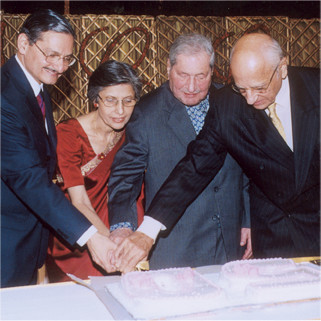
(From left) Cyrus Guzder, Homai Mehta, Jamshed Guzder and Shroff at the golden jubilee celebrations
In the recent past, the College has started conducting workshops on various subjects for Indian and multinational companies. "It’s like taking education to the customer instead of him/her coming to College. We provide tailor-made courses to employees on effective interpersonal relationships, time management, presentation skills, customer service excellence, business writing skills, image projection, etc.” Given a revamped infrastructure, Mehta would like to start a course in advanced communication as well.
The demand for secretarial education, however, seems to be on the ebb with people rushing for management courses: "This has prompted the Bombay Parsi Punchayet (BPP) trustees (who are in charge of the College) to think of introducing management courses... With upgradation in equipment and infrastructure, we expect the flow of students to increase. Our administrative professional course, which does not include shorthand, is gradually becoming popular and we would like to make it even more so.”
There was a time when courses were only for Parsis. Subsequently 65 percent of the girls in the secretarial course were Parsis. Today they are barely one-third the total number of students in the College: "It could also be because the Parsi population itself has dwindled,” says Mehta.
As part of its on-going golden jubilee celebrations, the College has instituted the super Achievers’ Awards in order to recognize those among its students who have progressed on the corporate ladder. The Awards were presented by Cyrus Guzder, chairman and managing director of AFL at a function on December 11, 2004 at the Seth Jeejeebhoy Dadabhoy Agiary compound. The golden jubilee function was celebrated with a thanksgiving jashan, live band and a sit-down dinner catered by Tanaz Godiwalla. This College, in particular, is quite popular for giving medals and awards to its students unlike other institutions, which merely give a diploma or a certificate. Explains Mehta, "Giving recognition to students motivates them. It adds publicity to the J. J. College of Commerce amongst employers. It helps corporates as well to identify the best students, who, in turn, are benefited.” Jamshed N. Guzder who was chairman of the College for 25 years distributed prizes to meritorious students for the year 2002-2003 and 2003-2004.
As Cyrus Guzder impressed on the secretaries, "You may not be visible and you may not carry explicit authority, but you wield considerable influence and your skill lies in wielding that influence effectively.” Guzder cited an adage, "The supply of good women far exceeds the supply of men who deserve them.”
He added, "Though Sir Jamsetji Jejeebhoy acquired fame and fortune he practiced the virtues of industry, social contribution and charity. These are timeless virtues and Indian industry would achieve even greater heights if all industrialists practice these virtues.”
BPP chairman Minoo Shroff who is also the chairman of the College lauded the efforts of Mehta and her team for successfully running so many useful courses despite infrastructural constraints. He then presented mementos to the staff in recognition of their long and dedicated services, most of them for over a quarter of a century.
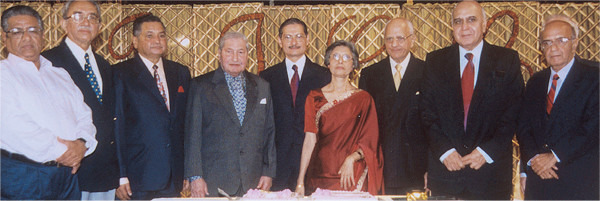
From left BPP trustees Dinshaw Mehta, Maneck Engineer and Burjor Antia; Jamshed and Cyrus Guzder, Homai Mehta, Shroff, Tamboly and Homi Mehta
BPP chief executive Officer Behram Dastur who resided in the same complex as Mehta described her as "very modest... no self aggrandizement; (a person who) serves mankind. "At the function past student Benaifer Daruwalla described Mehta as "warm hearted and a great teacher ” while Shernaz Desai referred to her as a "trainer par excellence... an institution builder.”
In the seventies when MBAs and campus recruitments were unheard of, it was Mehta who introduced a Placement Bureau. Initially, a service rendered to the alumni of the College, it developed into a full-fledged division of its own, offering employment even to students trained elsewhere, provided they passed the Bureau’s screening tests.
But the idea behind starting this Bureau goes back to the 19th century. In 1844, Sir Jamsetjee Jejeebhoy, First Baronet, envisioned the need for vocational education for all. "That is what we call, ‘job-oriented courses’ today,” explains Mehta. "In those days, the concept of College education was hardly there. Sir Jamsetjee felt that after students pass out from schools, they should continue their studies; that there should be an institution which teaches job-oriented skills.” The Sir Jamsetjee Jejeebhoy Parsi Benevolent (J.J.P.B.) Institution Commercial Classes were constituted in 1914 by the then trustees of the BPP who managed the J.J.P.B. Institution.
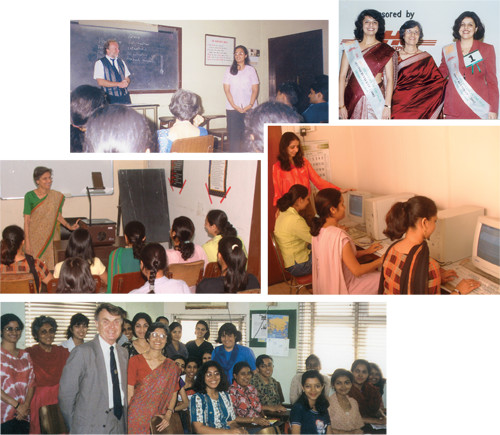
Clockwise from top left: Instructor from City & Guilds, Homai Mehta center with secretarial awardees, a computer class in session; Simon Allison of City & Guilds with Mehta and students; Mehta teaching class
In 1954, the Commercial Classes had converged into the Sir J. J. Commercial Institute. From 1954 to date, the Institute has been offering part-time courses leading up to professional examinations conducted by the Corporation of Certified Secretaries, London, the Pitman’s Institute, London (now known as City and Guilds London), the Maharashtra State Council of Examinations, the Indian Merchants’ Chamber and the Indian Institute of Bankers. These part-time courses, along with the full-time shorthand and typewriting courses, led the Maharashtra Government to recognize the diplomas offered by the Commercial Institute. In 1960 the Institute was renamed the Sir J. J. College of Commerce.
The progress of this College is largely due to the efforts of Homai and her husband Homi Mehta, both ex-students of the 1961 batch of the Sir J. J. College of Commerce. Later, in 1965, Homi had joined the College as a part-time faculty member to teach law and practice of banking. Says Homai proudly: "My husband drew plans for the growth of the College and presented them to Maneck Mistry, then BPP trustee in charge of the Institute, and to Prof P. C. Hansotia, then principal of the College. They backed the plans and, in 1966, a full-fledged secretarial division was formed.”
In 1968 Homi participated in a Lions International-aided project in USA and UK, where he studied job-oriented patterns of business education. On his return, he assumed charge as director of the College and introduced courses.
In the meantime, Homai had joined the Tatas as a secretary. But her "passion for teaching” made her leave a secure job and join the College as a part-time lecturer in 1968. Homai reasons: "There was an avenue of introducing secretarial education in this College and, having worked as a secretary, I felt I had the know-how and experience... In the seventies there was a rush of men going to the Gulf which created a big vacuum in industry. Parsis have particularly benefitted. In the seventies, most girls were studying the secretarial course on an ‘earn and learn’ basis. After they got jobs in companies, they’ve been a big support to their families; some of them have even been breadwinners.”
In 1971, Homai, apart from being a full-time lecturer, also became faculty and administrative co-ordinator of the College. Within a few years the Correspondence Course Division was formed and new courses such as telex operating, data entry system, computer packaging, etc were introduced. Homai grew to become director of the Sir J. J. College of Commerce in 1989.
The College has several firsts to its credit: "We were the first to start with an executive secretary course, exclusive for graduates, in 1969. We were also the first to organize the ‘Fantastique Secretarial Nite’ in which the ‘Secretary of the Year’ is selected at a specially programed contest. We promoted the National Institute of Professional Secretaries, now called the Indian Association of Secretaries and Administrative Professionals. This organization is affiliated to the Association of Secretaries and Administrative Professionals in Asia-Pacific and International Association of Administrative Professionals, USA. Also, we were the first to invite Peter Pitman to Bombay to review the impact of Pitman’s shorthand instruction all over India.” Peter Pitman is the grandson of Sir Issac Pitman, founder of Pitman’s International Institute, which is synonymous with shorthand the world over.
Homai’s biggest challenge is to get business for the College, to get the latest and good quality training programs as against so many highly qualified corporate consultants and trainers. Another challenge she faces is "how to get students interested in their studies because some of them revolt against subjects like, say, shorthand, since it is the most difficult subject. The challenge is how to win them over!”
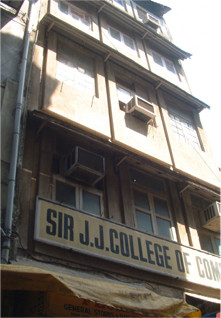
The college building at Nanabhoy Lane: renovations required
As far as Homai is concerned, she has to ensure funds are generated by introducing new courses, enroling more students and running training programs, "just as a CEO would ensure that the company runs smoothly on wheels...”
The Sir J. J. College of Commerce would like corporates to come forward and help provide the latest equipment, just as Godrej and Boyce had donated manual typewriters in the 1970s to start the Godrej Typewriter Wing. New in its place is the S. B. Bhabha Computer Wing. "Our old, dilapidated building has been the biggest stigma,” laments Homai Mehta. They dream to convert the old structure of the Sir J.J. College of Commerce located at 14, Nanabhoy Lane, Fort, Bombay, with its large stone and wooden staircases, within the next five years, into a new, swanky education center, equipped with state-of-the-art machines and modules.
It is interesting to learn from the director that the funding of the College is entirely through fees charged to students, which is spent in upgrading equipment, paying salaries and maintaining the premises. "Yet, we charge less than our competitors,” maintains the director. Although the College is managed by the BPP, it is registered as a separate entity and gets no monetary support from the BPP and the Sir J. J. P. B. Institution.
The Students Welfare League of the Sir J. J. College of Commerce plays an active role. It organizes the Annual College Day every year and brings out a souvenir. Whatever is earned from this function is diverted to the special Students Welfare League Fund. "This is the only way we can gather funds and have surplus. This fund is then used to subsidize fees of poor students of all communities,” says Homai. Education is provided by numerous institutions but there’s something special about the Sir J. J. College of Commerce: "It provides your money’s worth,” says Homai. Batches are small so that the College can give personalized service to students. Apart from job competence, values are drilled into the young minds: "We hear so much about rampant copying... We inculcate in them that values are more important than scoring high marks.
Homai has a message for her past, present and future students: "Career should be mission-driven and not ambition-driven. Strive to make a difference. This will help you uphold the values you cherish... and take failure in your stride...”
"Successful students are the rewards for all our efforts. We don’t feel sad when a batch of students leave after passing from our College. They come to us as buds and, when they leave, they’re fully bloomed, ready to face the world. We feel proud that we have been able to mold them.”
◆ ◆ ◆
From the archive